
Breakthrough in Exoplanet Hunt
A New Era in Space Exploration and Planet Discovery
The search for planets beyond our solar system has taken a massive leap forward thanks to groundbreaking research from the T16 Planet Hunt project. Using data from Transiting Exoplanet Survey Satellite (TESS), scientists have identified more than 10,000 new potential exoplanets, marking one of the most significant discoveries in modern astronomy.
This achievement not only expands our understanding of the universe but also highlights how advanced data analysis and machine learning are transforming space research. With thousands of new candidates now identified, astronomers have a treasure trove of targets to study in the years ahead.
What Is the T16 Planet Hunt Project?
The T16 project is an ambitious effort designed to push the limits of planet detection using TESS data. Unlike traditional approaches that focus primarily on brighter stars, this project explores a much larger dataset, including fainter stars that are often overlooked.
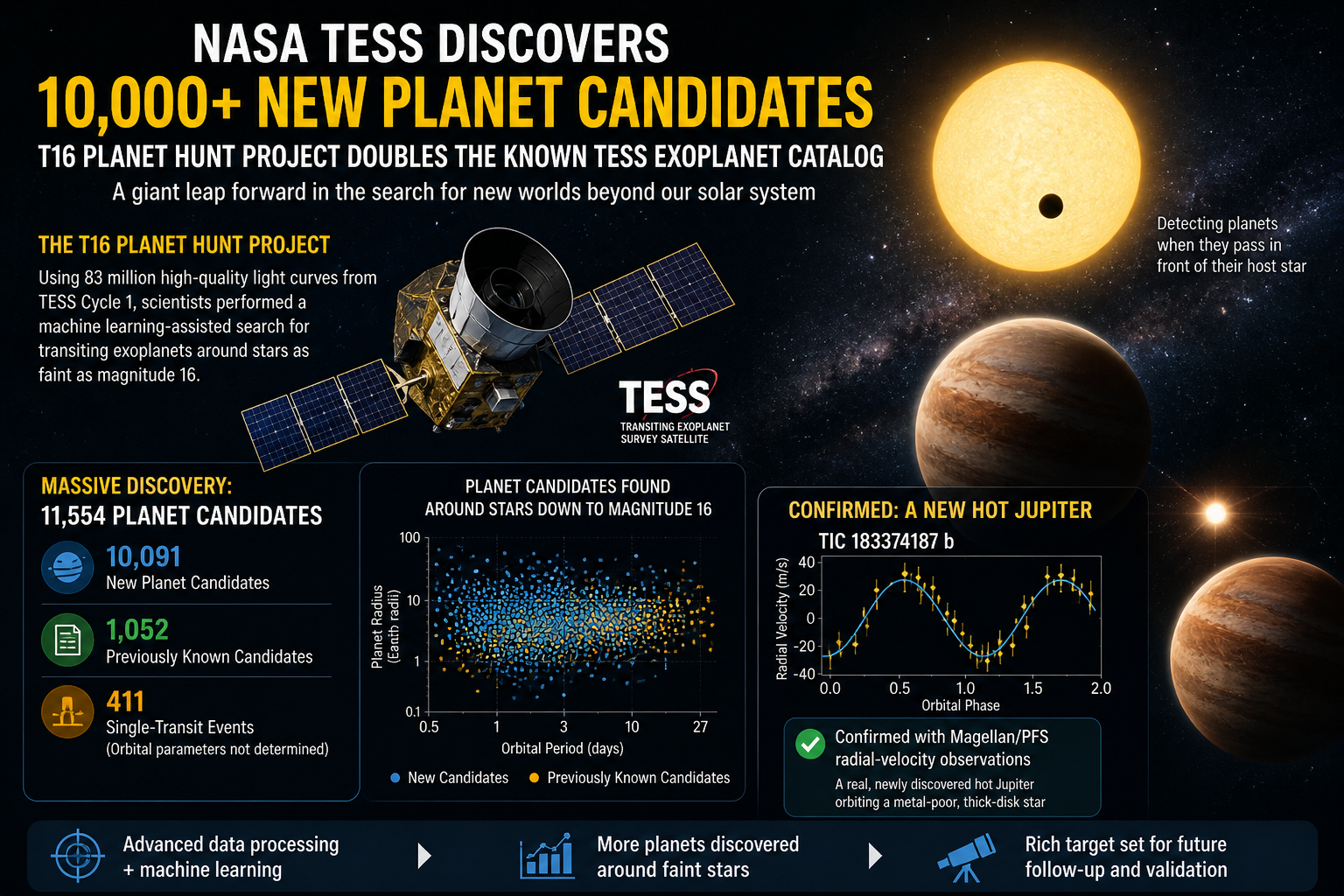
Researchers processed an enormous dataset of over 83 million light curves from TESS Cycle 1 observations. These light curves represent the brightness of stars over time and are crucial for detecting planets using the transit method—when a planet passes in front of its host star, causing a slight dip in brightness.
By applying advanced correction techniques, the T16 team was able to remove noise and system errors, creating a clean dataset ideal for identifying subtle planetary signals.
Why Fainter Stars Hold the Key to More Discoveries
Most traditional planet searches have focused on bright stars because they are easier to observe. However, scientists have long suspected that many undiscovered planets orbit fainter stars.
The T16 project set out to test this idea—and the results did not disappoint. By extending the search to stars as faint as magnitude 16, researchers significantly increased the chances of finding new worlds.
This approach opens up a new frontier in exoplanet research, suggesting that the universe may be even more crowded with planets than previously believed.
Over 11,000 Planet Candidates Identified
Through their semi-automated search process, scientists discovered an astonishing 11,554 planet candidates. Among these:
- 10,091 are completely new discoveries
- 1,052 were previously known candidates
- 411 are single-transit events, meaning only one transit was observed
These planets have orbital periods ranging from just half a day to 27 days, indicating a wide variety of planetary systems. The sheer number of discoveries more than doubles the known catalog of TESS exoplanet candidates, making this one of the largest expansions in the field.
Confirming a New Hot Jupiter: TIC 183374187
One of the most exciting outcomes of the T16 project is the confirmation of a new “hot Jupiter”—a gas giant planet that orbits very close to its star. This particular planet was found around the star TIC 183374187.
To confirm the discovery, scientists used follow-up observations with advanced instruments, including the Magellan Planet Finder Spectrograph. By measuring the star’s radial velocity—tiny movements caused by the planet’s gravitational pull—they verified that the signal was indeed caused by a real planet.
This confirmation is a crucial step, proving that the T16 detection pipeline is not only capable of finding candidates but also identifying genuine exoplanets.
The Role of Machine Learning in Modern Astronomy
One of the key innovations behind the T16 project is the use of machine learning to analyze massive datasets. With millions of stars to examine, traditional methods would be too slow and inefficient.
Machine learning algorithms can quickly scan through light curves, identify patterns, and flag potential planetary signals. This allows scientists to focus their efforts on the most promising candidates.
As technology continues to advance, AI-driven approaches are expected to play an even bigger role in space exploration, enabling discoveries that were once thought impossible.
What This Means for the Future of Exoplanet Research
The discovery of over 10,000 new planet candidates is more than just a milestone—it’s a glimpse into the future of astronomy. These findings provide a rich dataset for further study, including:
- Confirming additional planets
- Studying planetary atmospheres
- Searching for potentially habitable worlds
With so many new candidates, future missions and telescopes will have plenty of targets to explore, bringing us closer to answering one of humanity’s biggest questions: Are we alone in the universe?
Expanding the Cosmic Census of Planets
The T16 project has significantly expanded the known population of exoplanets, particularly around faint stars. This broader view helps scientists better understand how planets form and evolve across different types of star systems.
By doubling the number of known TESS candidates, this research has reshaped our understanding of the galaxy’s planetary diversity.
Conclusion: A Giant Leap in the Search for New Worlds
The T16 Planet Hunt represents a major breakthrough in the ongoing search for exoplanets. By combining massive datasets, advanced data processing, and machine learning, scientists have unlocked a new level of discovery.
With over 10,000 new planet candidates and a confirmed hot Jupiter, this project proves that there is still much to explore in our universe. As technology continues to evolve, we can expect even more exciting discoveries that will deepen our understanding of the cosmos and our place within it.