Launching Early, Under Budget & Set to Transform Space Discovery
NASA’s Roman Space Telescope Ready for Launch – A Game-Changer for Astronomy
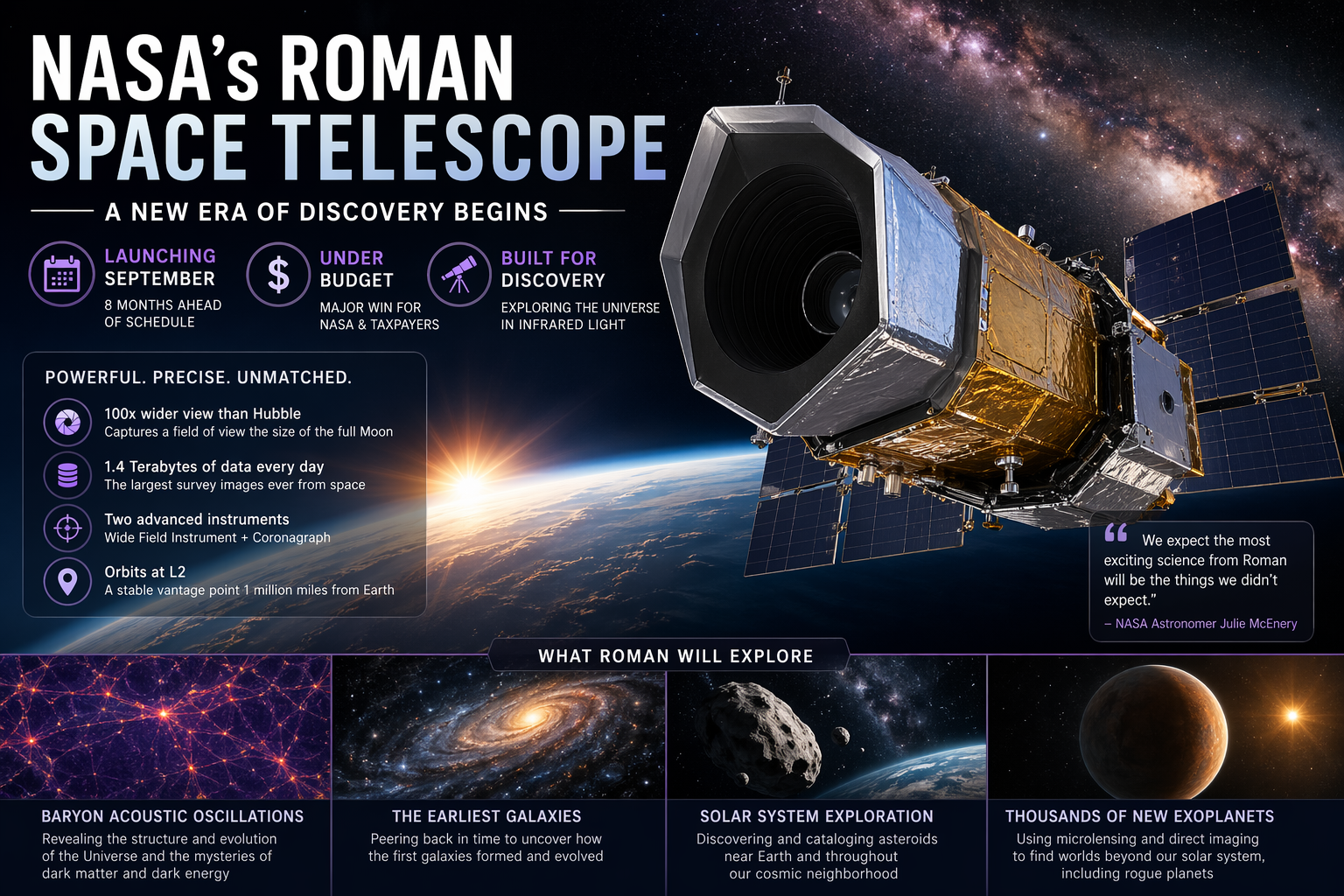
NASA is getting ready to launch the Nancy Grace Roman Space Telescope, one of the most fascinating space observatories to date. The fact that this mission is eight months ahead of time and under budget—a unique accomplishment for a space project this complicated—makes it even more remarkable.
This potent telescope, which is scheduled to debut in September, is intended to investigate the cosmos in ways never seen before, including taking enormous pictures, finding new planets, and solving puzzles related to dark energy and the early universe.
From Spy Satellites to Space Science – A Unique Origin Story
The journey of the Roman Space Telescope is anything but ordinary.
Back in 2012, the National Reconnaissance Office offered NASA unused spy satellite hardware. Instead of building everything from scratch, NASA repurposed this advanced technology to create a more powerful observatory.
Originally planned as the WFIRST, the mission evolved into what we now call the Roman Space Telescope—featuring a much larger mirror and enhanced imaging capabilities.
This clever reuse of technology not only saved time and money but also significantly boosted performance.
Why Infrared Astronomy Matters
Studying the universe in infrared light allows scientists to see what’s otherwise invisible.
Earth’s atmosphere blocks much of this infrared radiation, which is why space telescopes like Spitzer Space Telescope and James Webb Space Telescope were launched.
The Roman Telescope will take this a step further—not by zooming in on tiny areas, but by scanning vast regions of space all at once. This wide-field view will help scientists study:
- The earliest galaxies
- The structure of the universe
- Asteroids near Earth
- Exoplanet atmospheres
Powerful Instruments with Massive Data Output
The Roman Telescope carries two primary instruments:
1. Wide Field Instrument (WFI)
This is the heart of the mission.
- Captures images 100 times wider than Hubble Space Telescope
- Uses 18 high-resolution detectors
- Produces 1.4 terabytes of data per day
To put that into perspective, a single image is so massive it would require thousands of 4K screens to display fully!
2. Advanced Coronagraph
This cutting-edge tool blocks out bright starlight, allowing scientists to directly observe nearby planets.
It’s a major step forward in technology and will help pave the way for future missions like the Habitable Worlds Observatory.
A Simpler, Faster Deployment in Space
Unlike the complex deployment of the James Webb Space Telescope, the Roman Telescope is designed to be simpler and more reliable.
- Solar panels and antennas deploy automatically
- Setup begins within 20 minutes after launch
- Full commissioning will take about 90 days
It will orbit at the Lagrange Point L2, a stable region ideal for space observations.
Mission Lifetime – Built to Last
The telescope is expected to operate for at least 10 years, limited mainly by its fuel supply.
However, if everything goes smoothly, it could continue delivering groundbreaking discoveries well beyond that timeframe—just like Hubble.
What Will the Roman Telescope Discover?
Mapping the Universe’s Structure
One of its biggest goals is to study Baryon Acoustic Oscillations—ancient patterns formed by sound waves in the early universe.
These patterns help scientists understand:
- Dark matter
- Dark energy
- How the universe evolved
Hunting Thousands of New Exoplanets
Using a technique called Gravitational Microlensing, Roman will detect planets by observing how their gravity bends light.
This method allows scientists to discover:
- Planets far from their stars
- “Rogue planets” floating freely in space
Experts expect tens of thousands of new planets to be identified—far more than previous missions like Kepler Space Telescope.
The Most Exciting Discoveries? The Unexpected Ones
While NASA has clear goals for the Roman Telescope, history shows that the biggest discoveries often come as surprises.
Just like Hubble and Webb revealed unexpected cosmic wonders, Roman is expected to uncover entirely new phenomena that could reshape our understanding of the universe.
Final Thoughts: A New Era of Space Exploration Begins
The Nancy Grace Roman Space Telescope represents a bold step forward in astronomy.
With its wide-field vision, advanced technology, and innovative origins, it’s not just another telescope—it’s a cosmic explorer set to redefine how we see the universe.
As it prepares for launch, one thing is certain:
The Roman Telescope won’t just answer questions—it will create new ones.
If you want, I can also turn this into a YouTube script, meta description, or featured image prompt to help boost your blog traffic even more.