How VR and AR Are Transforming Industries Beyond Gaming in 2026
Virtual and Augmented Reality Are Entering a New Era
Virtual Reality (VR) and Augmented Reality (AR) technologies are rapidly evolving from niche gaming tools into powerful digital transformation platforms that are reshaping industries across the globe. In 2026, VR and AR innovations are no longer limited to entertainment. Businesses, healthcare providers, educators, retailers, manufacturers, and even governments are embracing immersive technologies to improve productivity, training, communication, and customer experiences.
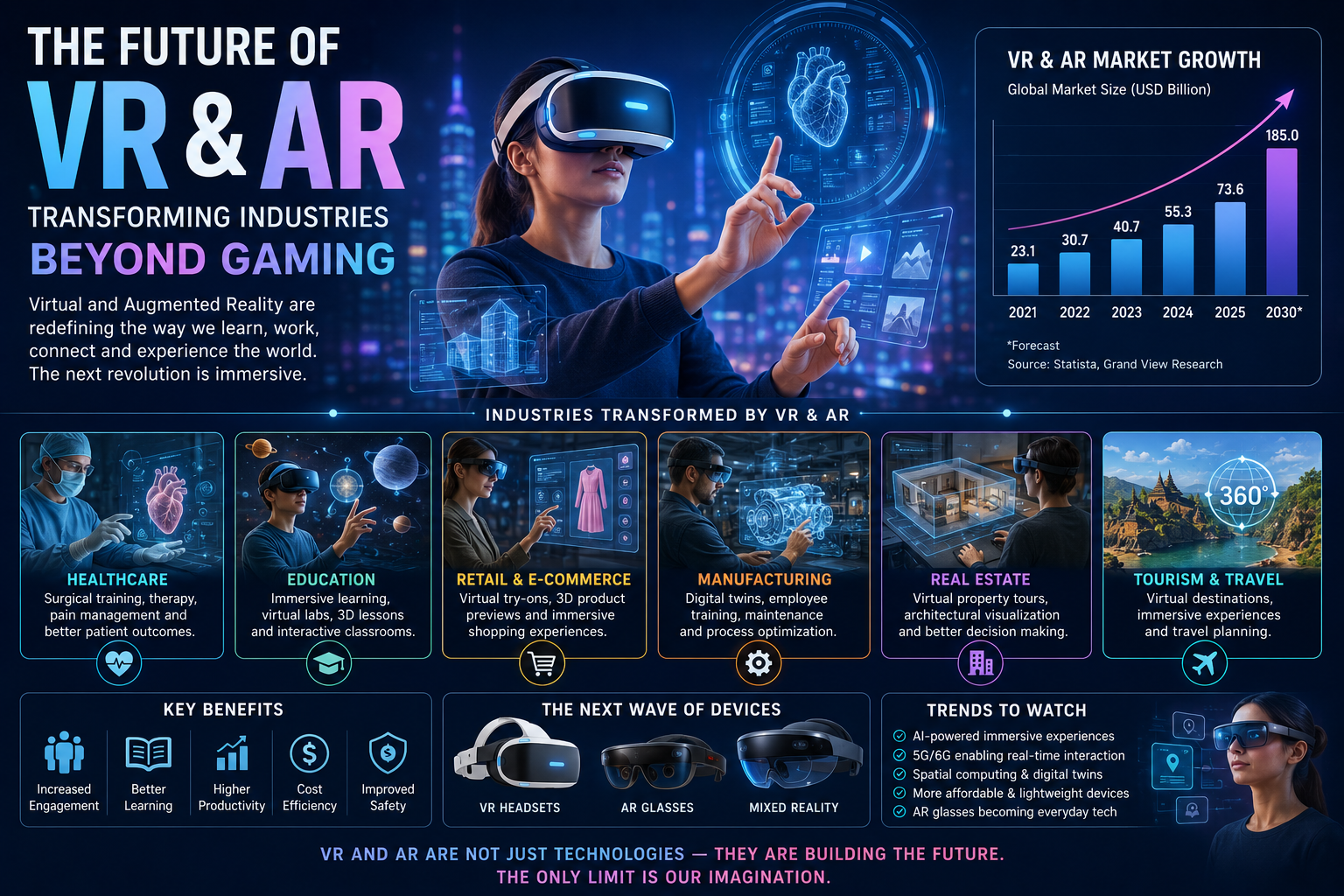
The global VR and AR market is witnessing explosive growth as companies invest heavily in mixed reality ecosystems, wearable devices, AI-powered immersive experiences, and next-generation spatial computing platforms. Industry analysts predict that immersive technology could become one of the defining technological revolutions of the decade.
From virtual offices and AI-powered digital assistants to immersive medical simulations and smart retail experiences, VR and AR are fundamentally changing how humans interact with digital information.
Why VR and AR Are Becoming Mainstream Technologies
For years, Virtual Reality and Augmented Reality struggled with expensive hardware, limited content, and weak adoption outside gaming communities. However, recent technological breakthroughs are changing the landscape dramatically.
Several key factors are driving the rise of VR and AR in 2026:
- Faster AI-powered processing
- More affordable mixed reality headsets
- Improved cloud computing infrastructure
- Better motion tracking systems
- 5G and ultra-fast connectivity
- More realistic graphics and spatial audio
- Cross-platform software ecosystems
Technology companies are now positioning spatial computing as the next major evolution after smartphones.
Modern VR and AR devices are becoming lighter, smarter, and significantly more practical for everyday use. Instead of isolating users in fully virtual environments, new mixed reality systems blend digital elements with the real world in a more natural and productive way.
How Artificial Intelligence Is Powering Modern VR and AR
Artificial Intelligence is playing a massive role in advancing immersive technologies. AI-powered systems are now enhancing VR and AR experiences through:
- Real-time object recognition
- Smart environmental mapping
- Gesture tracking
- Voice interaction
- Predictive rendering
- Personalized virtual experiences
AI allows immersive systems to better understand user behavior and surroundings, making interactions more natural and responsive.
For example, AI-enhanced AR glasses can now identify objects, translate languages instantly, provide navigation assistance, and display contextual information in real time.
Meanwhile, AI-driven VR platforms can personalize virtual training programs, simulate realistic environments, and adapt experiences based on user performance.
The combination of AI with immersive technology is expected to define the future of human-computer interaction.
VR and AR Are Expanding Beyond Gaming
Gaming remains one of the largest sectors for immersive technology, but the biggest growth opportunities are emerging in non-gaming industries.
Healthcare Is Being Revolutionized by VR and AR
Healthcare is becoming one of the most impactful applications of immersive technology.
Hospitals and medical institutions are using VR for:
- Surgical simulations
- Medical training
- Pain management
- Mental health therapy
- Rehabilitation programs
AR systems are helping surgeons visualize organs and medical data during procedures with unprecedented accuracy.
Medical students can now practice complex surgeries in realistic virtual environments without risking patient safety. Patients suffering from anxiety, PTSD, and chronic pain are also benefiting from immersive therapy sessions powered by VR technology.
Experts believe immersive healthcare solutions could dramatically reduce training costs while improving treatment outcomes.
Education Is Becoming More Interactive
The education sector is rapidly adopting Virtual Reality and Augmented Reality to create more engaging learning experiences.
Traditional classrooms are evolving into immersive digital environments where students can:
- Explore ancient civilizations virtually
- Conduct simulated science experiments
- Learn anatomy in 3D
- Visit historical landmarks remotely
- Participate in virtual laboratories
Immersive learning improves student engagement, retention, and understanding by making education more interactive and experiential.
In remote learning environments, VR classrooms are helping bridge the gap between physical and digital education.
As educational institutions continue adopting digital transformation strategies, VR and AR are expected to become standard teaching tools.
Retail and E-Commerce Are Becoming More Immersive
Retailers are using AR technology to improve online shopping experiences and reduce product return rates.
Modern AR shopping systems allow customers to:
- Virtually try on clothes
- Preview furniture in their homes
- Test makeup digitally
- Explore products in 3D
- Receive personalized recommendations
This creates more confidence in online purchases while improving customer satisfaction.
Luxury brands, fashion companies, and furniture retailers are heavily investing in immersive commerce experiences as competition in e-commerce intensifies.
Virtual showrooms are also becoming increasingly popular, allowing consumers to browse products from anywhere in the world using VR headsets.
Manufacturing and Engineering Are Using Digital Twins
Manufacturing industries are leveraging VR and AR technologies for industrial design, training, maintenance, and workflow optimization.
One of the most important trends is the rise of “digital twins” — virtual replicas of real-world machines, factories, or systems.
Engineers can now:
- Simulate production processes
- Monitor equipment remotely
- Detect maintenance issues early
- Train employees safely
- Improve operational efficiency
AR headsets are also helping technicians perform complex repairs by displaying step-by-step instructions directly in their field of vision.
This significantly reduces downtime and improves workplace productivity.
The Rise of the Metaverse and Spatial Computing
Although the initial hype around the metaverse slowed after early expectations proved unrealistic, the underlying technologies continue evolving rapidly.
The focus has shifted from purely social virtual worlds toward practical “spatial computing” applications.
Spatial computing refers to digital systems that interact naturally with physical environments using:
- 3D interfaces
- Spatial mapping
- Gesture controls
- Eye tracking
- Voice commands
- Mixed reality overlays
Major technology companies are investing billions into spatial computing platforms because they believe immersive computing could eventually replace many traditional smartphone functions.
The next generation of computing may involve wearable AR glasses instead of handheld mobile devices.
Challenges Facing VR and AR Technologies
Despite rapid innovation, several obstacles still limit widespread adoption.
High Hardware Costs
Premium VR and AR headsets remain expensive for many consumers and businesses.
Battery and Comfort Limitations
Wearable devices still face challenges related to battery life, weight, and long-term comfort.
Privacy Concerns
AR systems collect massive amounts of environmental and behavioral data, raising serious privacy concerns.
Content Limitations
The success of immersive technology depends heavily on high-quality software ecosystems and compelling user experiences.
Motion Sickness and Accessibility
Some users continue experiencing motion sickness or difficulty adapting to immersive environments.
Technology companies must address these issues before VR and AR achieve full mainstream adoption.
Predictions for the Future of VR and AR
The future of immersive technology looks incredibly promising.
Industry experts predict that by the end of the decade:
- AR glasses could become as common as smartphones
- Virtual workspaces may become standard for remote teams
- AI-powered digital avatars will assist users daily
- VR training could replace many traditional training methods
- Immersive shopping will dominate online retail
- Spatial computing could redefine social media platforms
The convergence of AI, cloud computing, 5G, and immersive hardware will continue accelerating innovation.
Businesses that invest early in VR and AR strategies may gain significant competitive advantages as adoption increases globally.
Practical Advice for Businesses and Content Creators
Businesses and bloggers looking to stay ahead of VR and AR trends should focus on:
- Learning immersive content creation
- Exploring AR marketing opportunities
- Experimenting with virtual collaboration tools
- Monitoring emerging spatial computing platforms
- Investing in employee training for immersive technologies
- Using AI-powered immersive analytics
Content creators can also benefit enormously by producing:
- VR-compatible video content
- Interactive 3D experiences
- AR social media filters
- Immersive educational content
- Virtual product demonstrations
The demand for immersive digital experiences is expected to grow dramatically over the next few years.
Why Visual Content Matters in VR and AR Articles
When covering complex technologies like VR and AR, visuals are essential for audience engagement and understanding.
To improve blog performance and reader retention, consider incorporating:
- Infographics explaining VR and AR ecosystems
- Comparison charts between VR, AR, and Mixed Reality
- Industry adoption statistics
- Images of next-generation headsets
- Workflow diagrams for immersive technologies
Visual storytelling helps simplify technical concepts while improving SEO engagement metrics such as time-on-page and social sharing.
Final Thoughts
Virtual Reality and Augmented Reality are no longer experimental technologies limited to gaming enthusiasts. They are becoming foundational tools for the future of communication, business, healthcare, education, and digital interaction.
As AI integration, spatial computing, and wearable technology continue evolving, immersive experiences will become increasingly integrated into everyday life.
The companies, creators, and professionals who embrace VR and AR innovation today will likely play a major role in shaping the next generation of the digital economy.
What do you think about the future of Virtual Reality and Augmented Reality? Will AR glasses eventually replace smartphones? Share your thoughts and predictions in the comments below and join the discussion about the future of immersive technology.