
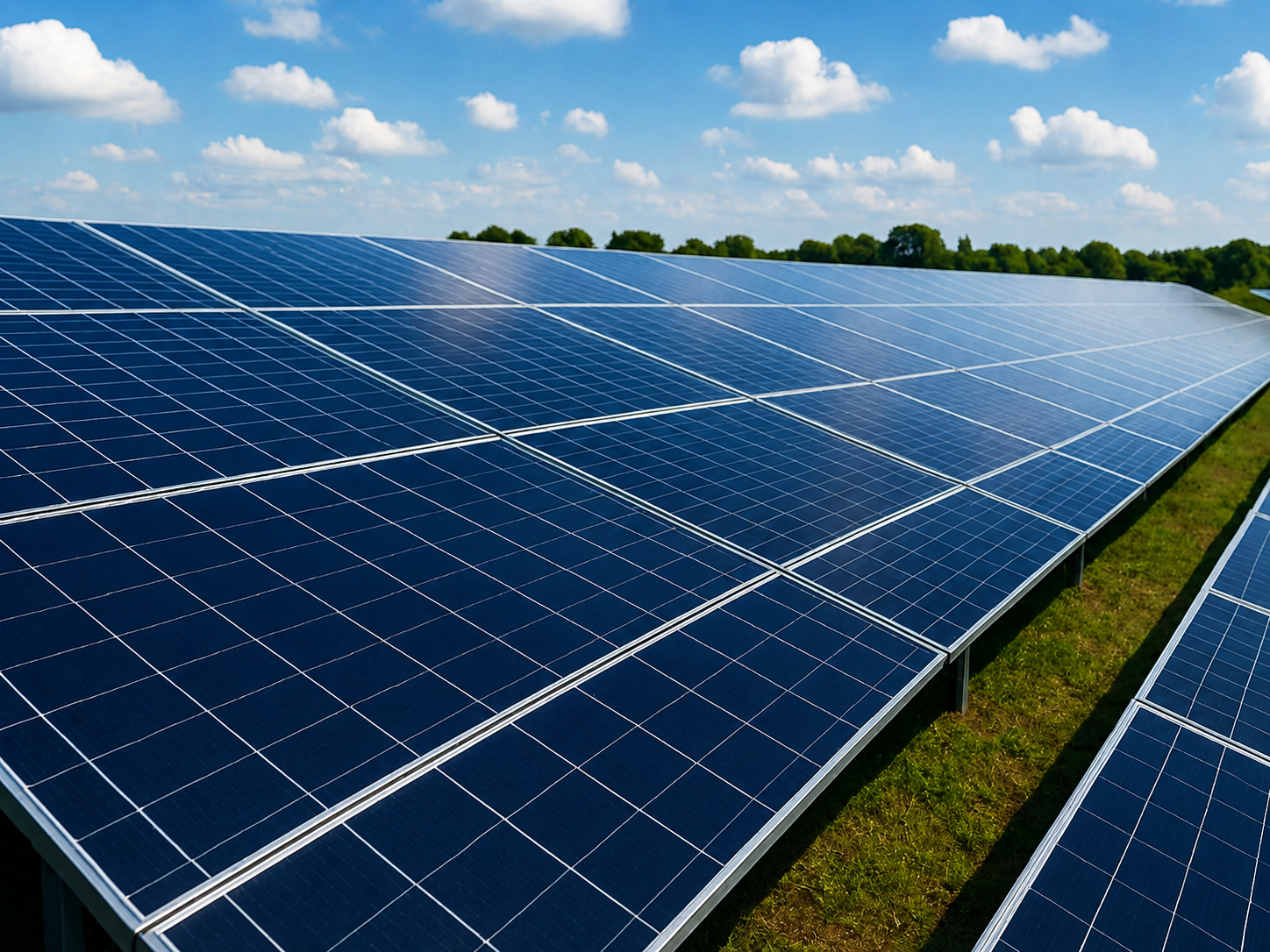
NASA-Inspired Electric Dust Shields Could Revolutionize Solar Panel Efficiency in Dusty Regions
As solar energy expands across deserts, industrial corridors, and water-stressed regions, one persistent problem continues to undermine performance: dust accumulation. While solar panels are often discussed in terms of efficiency ratings, battery storage, and installation costs, a less glamorous issue – dust deposition – can quietly erode energy output at a significant scale.
Now, a technology originally developed by NASA researchers for lunar and planetary missions may offer a compelling solution on Earth. A recent study published in Renewable Energy explored the use of a transparent electric curtain, also known as an electrostatic dust shield, to remove dust from solar panels without water, brushes, or moving mechanical parts. More importantly, the research examined how to operate the system intelligently so that the energy used for cleaning does not outweigh the energy recovered.
This is more than an interesting engineering story. It points to a broader shift in solar operations: the move from passive energy generation to self-optimizing solar infrastructure.
Why Dust Is a Serious Problem for Solar Energy
Dust is one of the most underestimated threats to solar panel performance. In dry and dusty environments, fine particles settle on panel surfaces and block sunlight from reaching photovoltaic cells efficiently. Over time, the losses can become severe.
According to research cited in the study, solar panels may lose:
- Up to 5% of output in a single day
- Between 12% and 40% over several months
- As much as 40% to 80% over several years if dust is not properly managed
Those numbers are especially concerning for large-scale solar farms in deserts, semi-arid regions, and polluted urban zones where airborne particulate matter is constantly present. In these environments, conventional cleaning methods are expensive, labor-intensive, and often dependent on a resource many of these regions lack: water.
That creates a major contradiction in the clean energy transition. Some of the best places to generate solar power are also the places where keeping panels clean is hardest.
What Is an Electric Curtain and How Does It Work?
The electric curtain system is a thin, transparent layer placed over the surface of a solar panel. It contains an array of embedded electrodes within a dielectric material. When alternating voltages are applied with specific phase shifts, the setup generates a traveling electric field wave across the panel surface.
This wave does something remarkable: it lifts and moves charged dust particles off the panel, effectively sweeping away contamination without any physical contact.
In practical terms, that means the system can clean solar panels without:
- Water
- Brushes
- Compressed air
- Robotic wipers
- Manual labor
The original concept was designed for use on the Moon and Mars, where dust is a mission-critical hazard and conventional cleaning simply is not possible. Since solar power is often one of the few viable long-term energy sources for extraterrestrial missions, NASA’s interest in dust mitigation was both necessary and strategic.
That same logic now applies to many Earth-based solar installations, particularly in remote deserts where maintenance access is difficult and water conservation is essential.
Why NASA’s Space Technology Matters for Earth-Based Solar Projects
Space technologies often sound futuristic until they become commercially practical. This appears to be one of those moments.
The electric curtain is especially promising because it addresses three problems at once:
- Energy loss from dust
- Water consumption during cleaning
- Operating and maintenance costs
In many solar-rich countries, developers are building increasingly large utility-scale projects in desert climates. These regions offer excellent solar irradiation, but they also expose panels to sand, dust, and grime that reduce output quickly. Traditional cleaning schedules are often fixed rather than adaptive, meaning operators may either clean too often and waste resources or wait too long and lose valuable generation.
A transparent electrostatic cleaning layer introduces the possibility of continuous or threshold-based maintenance, where cleaning occurs only when it makes economic and operational sense.
That is a meaningful advancement. It shifts solar maintenance from a reactive routine to a data-driven optimization strategy.
The Real Innovation: Smart Energy Optimization
The most important insight from the Renewable Energy study is not simply that the electric curtain works. It is that cleaning must be controlled intelligently.
Because the dust-removal system itself consumes electricity, it cannot run endlessly without consequence. If activated too frequently or under the wrong conditions, the power spent on cleaning could exceed the energy gained from improved solar output. In that case, the technology would solve one problem while creating another.
To address this, researchers developed an optimal control framework. The idea is straightforward but powerful:
- The system activates when panel performance drops below a defined threshold
- It deactivates once performance recovers sufficiently
- Operators can adjust the trigger points based on environmental conditions and system scale
This kind of control logic is where the technology becomes commercially viable. It turns an elegant invention into a potentially profitable one.
Unique Insight: The Future of Solar Will Be Autonomous, Not Just Renewable
This study reflects a larger industry trend that deserves more attention: the future of solar is not just about generating clean power – it is about building autonomous energy systems that can monitor, adapt, and optimize themselves.
For years, solar innovation has focused on panel efficiency, storage systems, and inverters. Those remain important. But the next major leap may come from operational intelligence:
- Panels that detect fouling and trigger self-cleaning
- Systems that predict dust events using weather and air-quality data
- AI-driven maintenance schedules based on energy pricing and performance curves
- Integrated sensor networks that balance cleaning, cooling, and output forecasting
In that context, electric dust shields are not just a maintenance feature. They are part of a new generation of smart solar assets.
My prediction is that this type of technology will first gain traction in high-value, high-maintenance environments – utility-scale desert solar farms, off-grid industrial energy systems, military applications, and remote infrastructure. From there, costs could decline enough for broader deployment in commercial and even residential installations.
Practical Implications for the Solar Industry
If this technology matures commercially, it could reshape how operators think about solar maintenance and project economics.
1. Lower Water Dependency
In arid regions, water-free cleaning may become one of the most valuable aspects of electrostatic dust removal. Solar plants would no longer need to rely heavily on scarce freshwater resources to preserve performance.
2. Reduced Labor and Maintenance Costs
Manual cleaning requires teams, logistics, safety protocols, and repeated site visits. An automated dust shield could reduce the frequency of physical intervention, particularly at remote sites.
3. Better Energy Yield Forecasting
With more consistent panel cleanliness, operators could forecast output with greater accuracy. That improves grid planning, financial modeling, and long-term asset valuation.
4. Increased Suitability for Extreme Environments
This technology may prove especially useful not only in deserts but also in polluted urban areas, mining zones, and remote microgrids where maintenance is difficult.
Challenges That Still Need to Be Solved
Despite its promise, the electric curtain is not a guaranteed breakthrough yet. Several real-world questions remain:
- Durability: How well will the transparent electrode layer hold up under years of UV exposure, heat cycling, abrasion, and storms?
- Installation cost: Will the added material and electronics make economic sense at scale?
- Performance variability: Dust is not uniform. Particle size, moisture, composition, and adhesion behavior differ by region.
- Retrofit complexity: Integrating the system into existing solar farms may be harder than designing it into new modules from the start.
These factors will determine whether the technology remains a specialized innovation or becomes a mainstream industry standard.
Why This Matters Now
The timing of this research is important. Global solar deployment is accelerating, especially in regions where dust and water scarcity coexist. As the industry grows, marginal efficiency losses become major financial and operational issues at scale.
A few percentage points of recovered output across a large solar farm can translate into substantial revenue gains. At the same time, reducing water use aligns with sustainability goals and improves the environmental profile of solar operations.
That combination – higher output with lower resource use – is exactly the kind of advancement the renewable energy sector needs.
Visual Content Ideas for Your Blog Post
To make this topic more engaging for readers, consider adding the following visuals:
- Infographic: How dust reduces solar panel output over time
- Diagram: How the electric curtain generates a traveling electric field to remove particles
- Comparison chart: Traditional cleaning vs. electrostatic dust removal
- Map graphic: Regions where dusty climates and solar expansion overlap
- Workflow illustration: Threshold-based activation and deactivation for optimal energy gain
A simple diagram could look like this:
flowchart LR
A[Dust accumulates on solar panel] --> B[Panel output drops]
B --> C[Control system detects threshold]
C --> D[Electric curtain activates]
D --> E[Traveling electric field moves dust away]
E --> F[Panel output recovers]
F --> G[System deactivates to save power]
Final Takeaway
NASA-inspired electric dust shield technology could become one of the most practical solar maintenance innovations of the coming decade. Its appeal lies not only in its ability to remove dust without water or manual cleaning, but in the study’s deeper insight: cleaning must be optimized, not merely automated.
If developers, manufacturers, and operators can solve the cost and durability challenges, this technology may play a major role in making solar power more efficient in exactly the places where it has the most growth potential.
What makes this story especially compelling is that it connects space exploration, sustainability, and intelligent infrastructure in one solution. That is the kind of cross-disciplinary innovation that often defines the next wave of energy progress.
What do you think – could self-cleaning solar panels become standard in desert solar farms, or will cost and complexity slow adoption? Share your thoughts in the comments and join the discussion.