A Bold Move to Reshape the Future of AI Coding Title: SpaceX Acquires AI Coding Platform Cursor in $60 Billion Deal: What It Means for the Future of AI Development
SpaceX’s $60 Billion Cursor Acquisition Signals a New Era in AI Coding
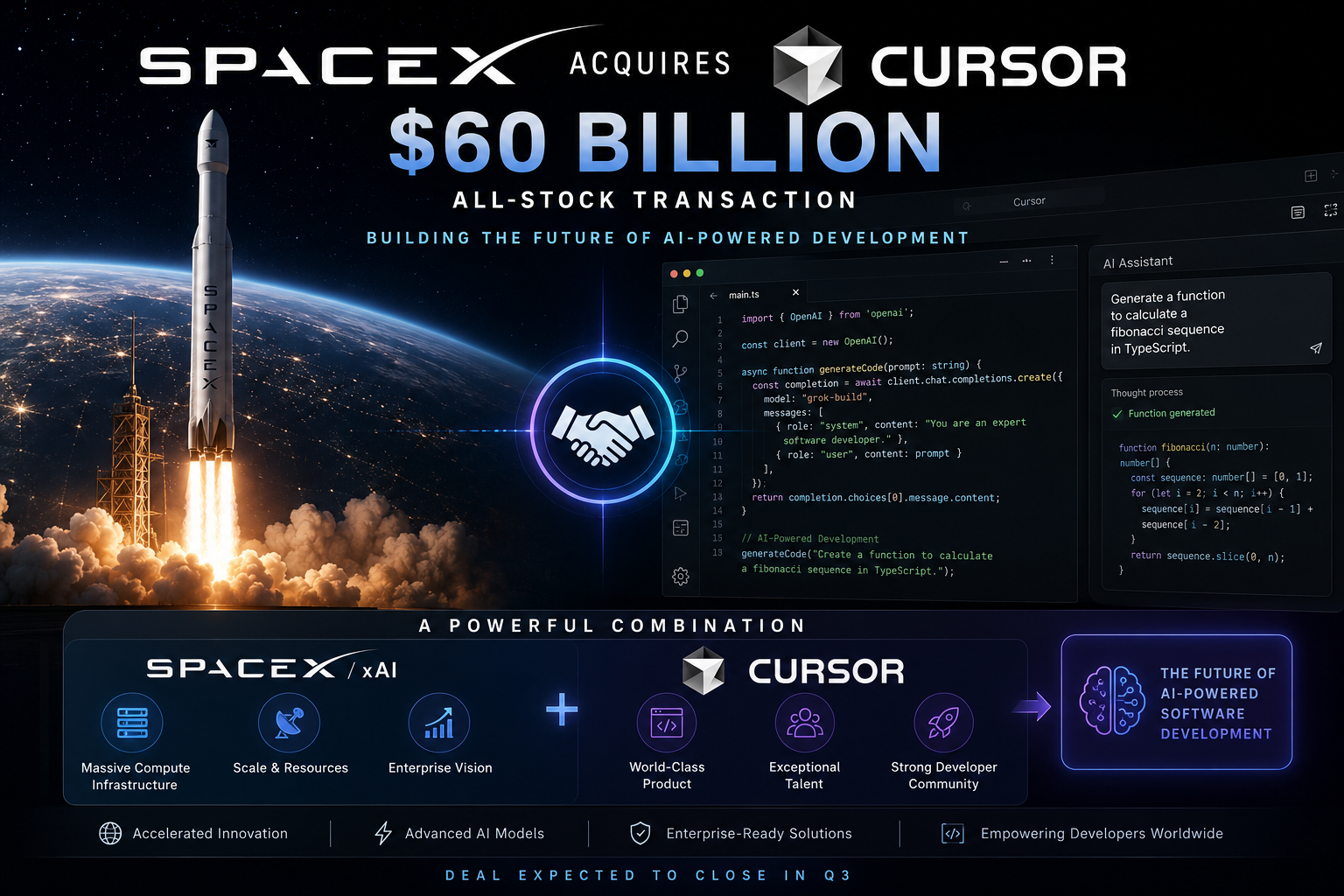
The artificial intelligence industry witnessed another major shakeup as SpaceX announced its acquisition of AI-powered coding platform Cursor in a staggering $60 billion all-stock transaction. The deal, expected to close during the third quarter, marks one of the largest acquisitions in AI history and highlights the growing importance of AI-assisted software development.
Coming just days after SpaceX’s historic IPO and only months after its merger with xAI, the acquisition demonstrates an aggressive strategy to strengthen SpaceX’s position in the increasingly competitive AI landscape.
While many technology analysts view the deal as a bold gamble, others see it as a strategic move that could redefine how developers write software in the coming years.
Why Cursor Matters in the AI Coding Revolution
Cursor emerged as one of the first development environments to deeply integrate large language models into the coding workflow.
Built as a specialized version of Visual Studio Code, Cursor transformed traditional coding by allowing developers to:
- Generate code using natural language prompts
- Refactor existing code automatically
- Debug software with AI assistance
- Explain complex codebases instantly
- Accelerate software development cycles
At a time when AI coding assistants were still experimental, Cursor successfully positioned itself as a pioneer in AI-powered software engineering.
Its rapid adoption among developers helped establish the concept that coding assistants could become a core part of the development process rather than merely optional productivity tools.
However, the market evolved rapidly.
Growing Competition Changed the Landscape
Although Cursor experienced impressive revenue growth, its dominance gradually weakened as larger AI companies entered the space.
Major competitors introduced advanced coding capabilities, including:
| Company | AI Coding Product |
|---|---|
| Anthropic | Claude Code |
| OpenAI | ChatGPT Coding Tools |
| Gemini Code Assist | |
| Microsoft | GitHub Copilot |
| Amazon | CodeWhisperer |
Among these, Anthropic’s Claude Code reportedly emerged as one of the strongest competitors, capturing significant developer mindshare and market share.
Despite having a strong product and talented engineering team, Cursor faced a challenge common among AI startups: limited computing resources.
AI coding systems require enormous computational power for model training and inference. As larger companies continued investing billions into infrastructure, Cursor found it increasingly difficult to keep pace.
The Compute Problem That Led to This Acquisition
Earlier this year, Cursor publicly acknowledged that future growth was constrained by access to computing power.
This challenge became particularly significant as AI models grew larger and developers demanded more sophisticated coding capabilities.
The situation began changing when xAI entered the picture.
A strategic partnership granted Cursor access to xAI’s compute infrastructure, enabling both companies to collaborate on model development.
Among the outcomes was the development of Grok Build, an AI model focused on coding and knowledge-work applications.
Many industry observers now view that partnership as the first step toward the acquisition announced today.
What initially appeared to be a technology collaboration ultimately evolved into a full-scale merger strategy.
Why SpaceX Wanted Cursor
The acquisition addresses several critical weaknesses in SpaceX’s AI ambitions.
1. SpaceX Needed a Competitive AI Product
While Grok attracted significant public attention, it struggled to compete directly with the strongest offerings from OpenAI, Anthropic, and Google.
Critics often argued that Grok remained too focused on chatbot interactions while competitors expanded into:
- Software engineering
- Autonomous coding agents
- Enterprise workflows
- Business automation
- Research assistance
Cursor instantly gives SpaceX a proven product with an established user base and strong developer credibility.
2. Cursor Needed Massive Infrastructure
The opposite was true for Cursor.
The company had:
Strong engineering talent
An innovative product
Growing revenue
But lacked:
Sufficient compute resources
Infrastructure scale
Capital to compete with trillion-dollar technology giants
SpaceX’s massive resources could solve these limitations almost immediately.
3. Enterprise AI Is Becoming the New Battleground
Following its IPO, much of SpaceX’s long-term valuation narrative depends on expanding beyond aerospace into advanced technology services.
Enterprise AI represents one of the largest opportunities available.
Businesses increasingly seek AI solutions that can:
- Generate software
- Automate workflows
- Analyze data
- Reduce operational costs
- Improve developer productivity
By acquiring Cursor, SpaceX gains a direct entry point into this rapidly expanding market.
Strategic Advantages of the Deal
The acquisition creates several unique competitive advantages.
Integrated Compute and Software
Unlike many competitors, the combined organization can potentially control both:
- AI infrastructure
- AI coding applications
This vertical integration could lead to:
- Faster model training
- Lower operational costs
- Improved performance
- More specialized coding systems
Access to Existing Partnerships
Cursor already maintains relationships involving compute access and AI development partnerships.
Industry analysts note that favorable termination clauses within some agreements could allow SpaceX to redirect infrastructure resources toward its own AI initiatives if demand grows significantly.
This flexibility may become increasingly valuable as AI infrastructure shortages continue across the industry.
The Risks Investors Should Watch
Despite the excitement, this acquisition is far from a guaranteed success.
Fierce Competition
The AI coding market is becoming one of the most crowded sectors in technology.
Companies investing heavily include:
- OpenAI
- Anthropic
- Microsoft
- Amazon
- Meta
Each possesses enormous financial resources and research capabilities.
Developer Loyalty Is Difficult to Win
Software developers are highly selective about their tools.
Even substantial technological improvements do not always translate into adoption.
SpaceX must convince developers that Cursor under its ownership provides meaningful advantages over alternatives.
AI Infrastructure Costs Remain Massive
Running state-of-the-art coding models requires billions of dollars in hardware investment.
While SpaceX possesses significant capital, maintaining competitive AI infrastructure remains an expensive challenge.
What This Means for Developers
For developers, the acquisition could bring several positive developments.
Potential benefits include:
- Faster AI coding assistance
- Larger context windows
- Improved code generation quality
- More advanced autonomous coding agents
- Better integration with enterprise systems
The combination of Cursor’s product expertise and SpaceX’s infrastructure resources could accelerate innovation across the software development ecosystem.
Developers should closely monitor future announcements regarding Grok Build and next-generation coding models.
Industry Prediction: The Rise of AI-Native Development Platforms
This acquisition highlights a broader trend shaping the future of software engineering.
The next generation of development environments will likely be AI-native rather than AI-assisted.
Instead of merely suggesting code, future platforms may:
- Build complete applications autonomously
- Conduct testing independently
- Deploy software automatically
- Monitor production systems
- Continuously optimize applications
In this future, developers become architects and supervisors rather than manual coders.
The SpaceX-Cursor combination appears positioned to compete aggressively in that transformation.
Conclusion
SpaceX’s $60 billion acquisition of Cursor represents far more than a simple corporate transaction. It reflects the growing belief that AI-powered software development will become one of the most valuable technology markets of the next decade.
For SpaceX, the deal provides a credible AI coding platform and a pathway into enterprise software. For Cursor, it delivers the computational power and financial backing needed to compete against industry giants.
Whether this partnership becomes a defining success story or another ambitious AI experiment remains uncertain. What is clear, however, is that the battle for dominance in AI-assisted software development has entered a new phase.
As the industry evolves, developers, investors, and businesses alike will be watching closely.
Suggested Visuals for the Article
Infographic 1: Why SpaceX Bought Cursor
- Cursor → Talent + Product + Developer Base
- SpaceX/xAI → Compute + Capital + Infrastructure
- Combined Company → Enterprise AI + Coding Platform
Chart 1: AI Coding Assistant Market Leaders (Illustrative)
- Claude Code
- GitHub Copilot
- ChatGPT Coding Tools
- Gemini Code Assist
- Cursor
Infographic 2: Future of AI Software Development
2024 → Code Suggestions
2026 → Autonomous Coding Agents
2028 → AI-Native Development Platforms
2030 → Fully Automated Software Engineering Workflows
Join the Discussion
Do you think SpaceX’s acquisition of Cursor can challenge OpenAI, Anthropic, and Google in the AI coding race?
Would you trust AI to build entire applications with minimal human intervention?
Share your thoughts in the comments below and join the discussion about the future of AI-powered software development.