How to Watch the Stunning Celestial Event in the Evening Sky
Venus and Jupiter Planetary Conjunction: A Rare Skywatching Opportunity
Skywatchers around the world are preparing for one of the most beautiful astronomical events of the year as Venus and Jupiter appear exceptionally close together in the evening sky. This remarkable phenomenon, known as a planetary conjunction, offers stargazers a rare opportunity to witness two of the brightest planets shining side by side shortly after sunset.
Although Venus and Jupiter remain millions of miles apart in reality, their positions relative to Earth create the illusion that they are nearly touching in the night sky. The event is expected to attract astronomy enthusiasts, photographers, and casual observers alike.
In this guide, we will explore what a planetary conjunction is, why this event is special, how to observe it, and what it reveals about our fascinating solar system.
What Is a Planetary Conjunction?
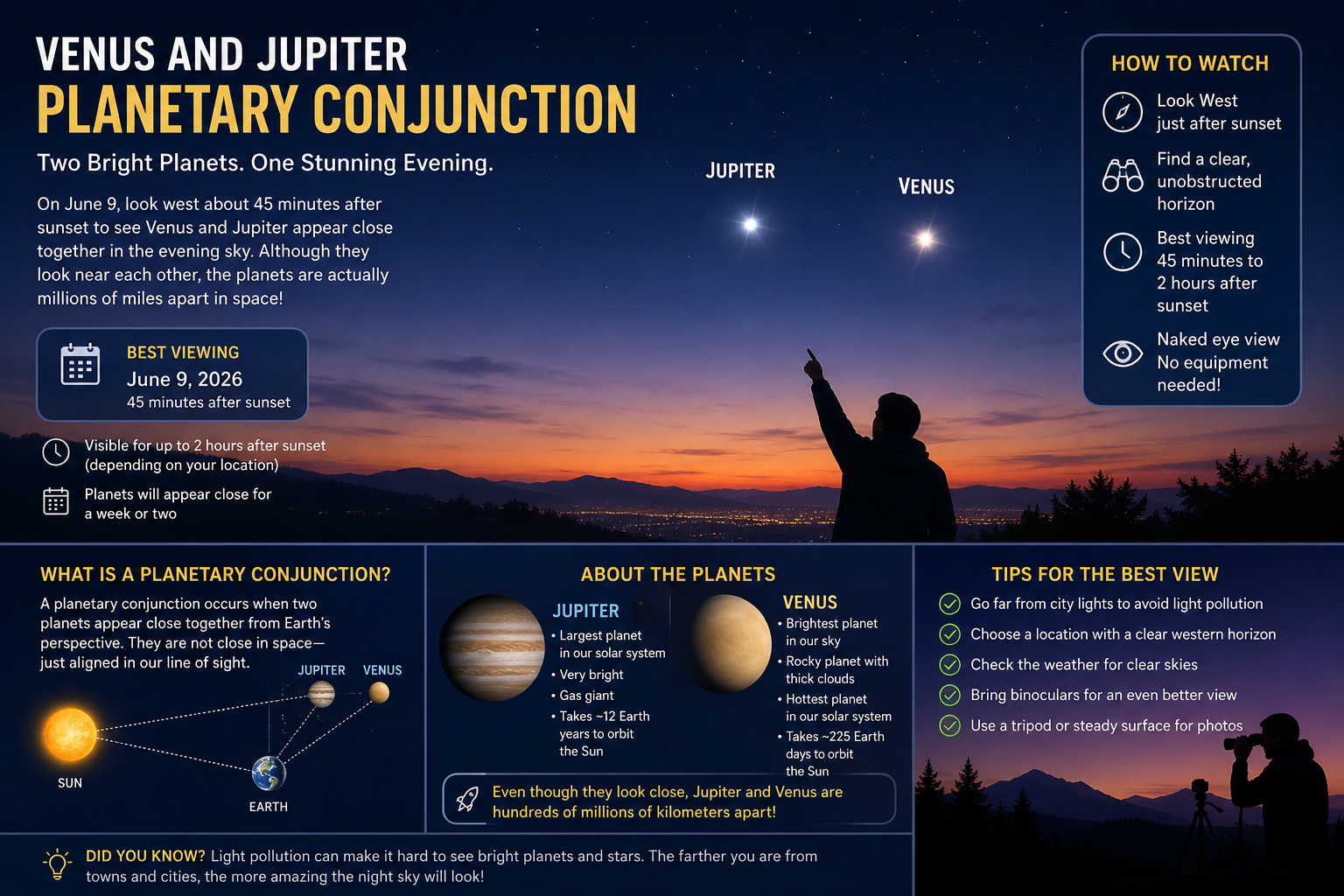
A planetary conjunction occurs when two planets appear close together from Earth’s perspective. This visual alignment happens because the planets orbit the Sun at different distances and speeds.
Despite appearing side by side, Venus and Jupiter are separated by hundreds of millions of kilometers in space. The conjunction is simply a line-of-sight effect that creates a spectacular visual display for observers on Earth.
Astronomers often compare conjunctions to seeing two distant streetlights appear close together when viewed from a specific angle, even though they may actually be far apart.
Why Venus and Jupiter Are So Bright
One reason this conjunction is particularly impressive is that it involves the two brightest planets visible from Earth.
Venus: The Evening Star
Venus is often called the “Evening Star” or “Morning Star” because of its exceptional brightness. Its thick cloud cover reflects a significant amount of sunlight, making it the brightest planet in our sky.
Jupiter: The Giant of the Solar System
Jupiter, the largest planet in our solar system, also shines brilliantly due to its massive size and reflective cloud tops. Even though it is much farther from Earth than Venus, its immense scale allows it to remain highly visible.
During the conjunction, observers can easily identify Jupiter on the left side and Venus on the right side shortly after sunset.
When and Where to Watch the Conjunction
The best time to observe the Venus-Jupiter conjunction is approximately 45 minutes after sunset.
Viewing Direction
Look toward the western horizon after sunset. The planets will appear as two bright points of light close together in the twilight sky.
Peak Viewing Date
Astronomy experts indicate that the closest visual alignment occurs on June 9, making it the ideal evening for observation. However, the planets will remain visibly close for approximately one to two weeks before gradually separating again.
Visibility Window
Depending on local conditions, the planets may remain visible for up to two hours after sunset. Observers with a clear, unobstructed horizon will enjoy the best views.
How Light Pollution Affects Skywatching
One of the biggest challenges for observing celestial events is light pollution.
Light pollution is caused by excessive artificial lighting from:
- Streetlights
- Shopping centers
- Office buildings
- Billboards
- Sports stadiums
- Residential developments
According to experts, artificial light can significantly reduce the visibility of stars, planets, and other astronomical objects.
Best Locations for Viewing
For the best experience, consider observing from:
- Rural areas
- Nature parks
- Mountain viewpoints
- Beaches with open horizons
- Dark-sky reserves
The farther you are from major urban centers, the more spectacular the conjunction will appear.
Tips for Photographing the Conjunction
Astrophotographers are especially excited about this event because Venus and Jupiter create an attractive composition in the evening sky.
Photography Tips
- Use a tripod to stabilize your camera.
- Shoot during twilight for balanced exposure.
- Include landscape elements such as trees or mountains.
- Use a zoom lens if available.
- Experiment with different exposure settings.
Modern smartphones equipped with night-mode features can also capture impressive images of the conjunction.
What This Event Teaches Us About the Solar System
Planetary conjunctions are more than beautiful sky shows. They provide a valuable reminder of how celestial mechanics work.
The planets are constantly moving around the Sun in predictable orbits. As Earth travels through space, our perspective changes, creating the illusion of close encounters between planets.
These events help people better understand:
- Orbital motion
- Relative planetary positions
- The scale of the solar system
- The dynamics of planetary movement
For educators and parents, conjunctions provide excellent opportunities to inspire curiosity about science and astronomy.
Future Skywatching Events to Watch For
The Venus-Jupiter conjunction is only one of many exciting celestial events visible throughout the year.
Astronomy enthusiasts can also look forward to:
Meteor Showers
Annual displays such as the Perseids and Geminids offer spectacular streaks of light across the night sky.
Lunar Eclipses
These events occur when Earth passes between the Sun and the Moon.
Planetary Alignments
Occasionally multiple planets become visible together, creating even more dramatic sky views.
Supermoons
These occur when the Moon appears larger and brighter due to its closer proximity to Earth.
As public interest in astronomy continues to grow, more people are discovering the excitement of observing the universe from their own backyards.
Expert Analysis: Why Astronomy Is Becoming More Popular
Recent years have seen a surge in public interest in astronomy. Several factors are contributing to this trend:
- Improved smartphone photography
- Greater access to telescopes
- Increased media coverage of space exploration
- Missions from NASA and other space agencies
- Growing awareness of dark-sky conservation
Events like the Venus-Jupiter conjunction provide an accessible entry point for beginners who want to learn more about the cosmos.
Experts predict that public participation in amateur astronomy will continue growing as technology makes stargazing easier and more interactive.
Conclusion
The Venus and Jupiter planetary conjunction is a stunning reminder of the beauty and precision of our solar system. Although the planets only appear close together from our perspective on Earth, the visual spectacle creates an unforgettable experience for skywatchers.
Whether you are an experienced astronomer or someone simply stepping outside to admire the evening sky, this celestial event offers a perfect opportunity to connect with the wonders of space.
Find a dark location, look west after sunset, and enjoy one of nature’s most captivating astronomical displays.
Suggested Visuals for This Article
Infographic 1: Venus vs. Jupiter Comparison
- Size comparison
- Distance from the Sun
- Brightness ranking
- Orbital period
Infographic 2: How a Planetary Conjunction Works
- Sun
- Earth
- Venus
- Jupiter
- Viewing angle illustration
Infographic 3: Best Stargazing Conditions Checklist
✓ Clear skies
✓ Low light pollution
✓ Western horizon visibility
✓ Binoculars (optional)
✓ Camera or smartphone
Join the Discussion
Have you observed a planetary conjunction before? Did you capture photos of Venus and Jupiter together in the evening sky?
Share your experience, observations, and photographs in the comments below. We’d love to hear what you saw and discuss your favorite astronomy events with fellow readers.