Is Apple Finally Close to the Perfect iPhone?
Apple’s All-Screen iPhone Vision Could Become Reality With the iPhone 19 Pro
For years, Apple fans and technology analysts have imagined a future iPhone with a completely uninterrupted display — no notch, no Dynamic Island, no bezels, and no visible front camera. Now, new reports suggest that Apple may finally be moving closer to turning that vision into reality with the rumored iPhone 19 Pro.
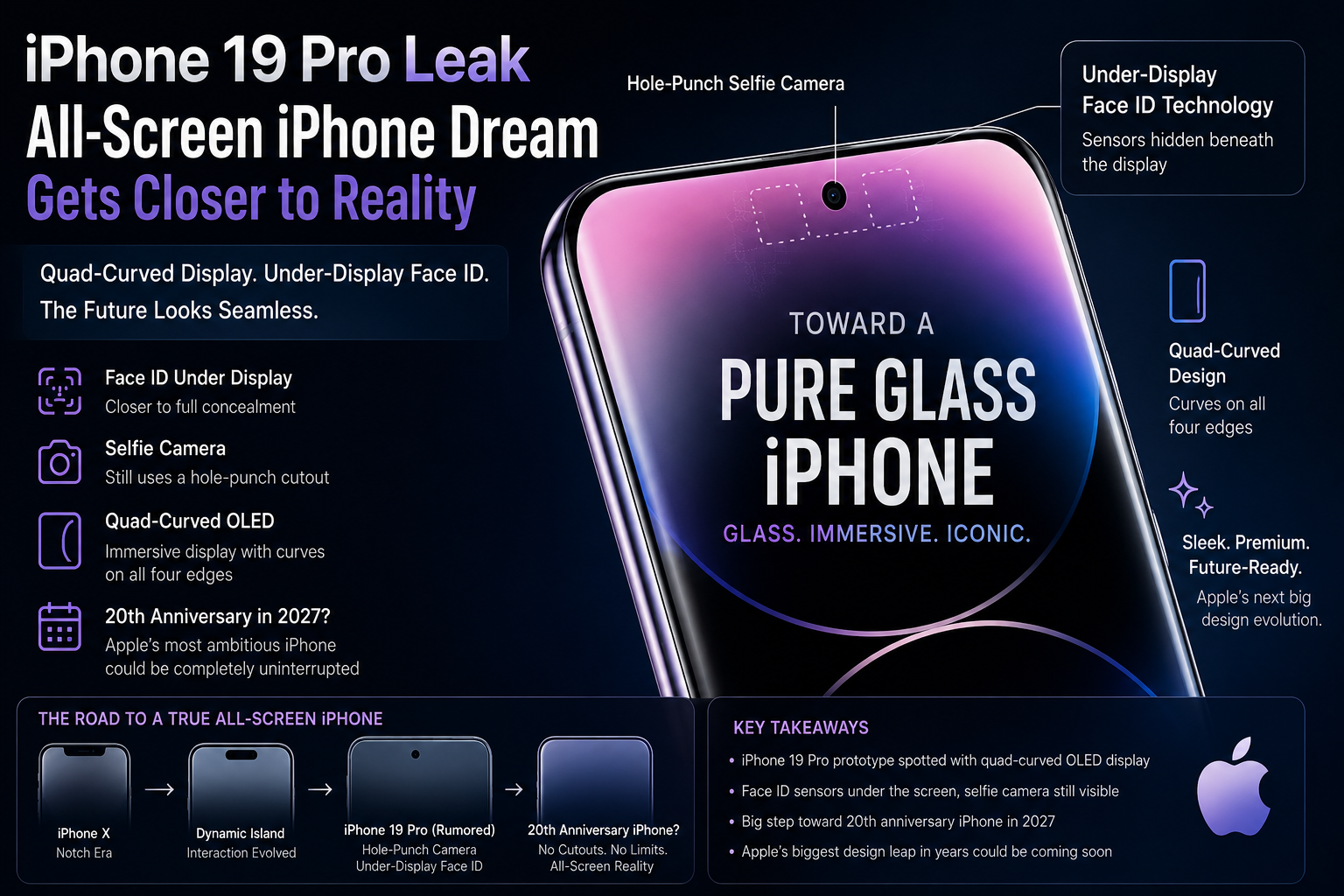
According to recent leaks shared by well-known Weibo-based tipster Digital Chat Station and later reported by MacRumors, Apple is currently testing a prototype featuring a quad-curved OLED display and under-display Face ID technology. However, one major challenge still remains: the front-facing selfie camera.
The leaked information suggests Apple is working aggressively toward its long-rumored “pure glass” iPhone concept ahead of the iPhone’s 20th anniversary in 2027. If successful, the upcoming iPhone generation could represent one of the biggest smartphone design revolutions since the original iPhone launch.
But the bigger question is whether Apple can make this futuristic design feel innovative enough twice — once with the iPhone 19 Pro and again with the special anniversary iPhone model expected in 2027.
Apple’s Long Journey Toward an All-Screen iPhone
The idea of a truly bezel-free and uninterrupted iPhone display has existed for nearly a decade.
Apple first moved toward immersive displays with the introduction of the iPhone X, which replaced the traditional home button with edge-to-edge OLED screen technology. Since then, the company has gradually reduced visible hardware elements through:
- Smaller bezels
- Face ID integration
- Dynamic Island technology
- Under-display component research
- Advanced OLED panel engineering
However, creating a completely seamless display remains extremely difficult because front-facing sensors and cameras still require exposure to light.
While Apple reportedly appears close to hiding Face ID components beneath the screen, the selfie camera remains a major engineering obstacle.
Why Under-Display Cameras Are So Difficult
Under-display camera technology already exists in some Android smartphones, but most implementations suffer from compromised image quality.
The problem is simple but technically complex:
The display itself blocks light from reaching the camera sensor efficiently.
This often results in:
- Reduced image sharpness
- Poor low-light performance
- Distorted colors
- Lower selfie quality
- Visible display interference
Apple has historically prioritized camera performance over rushing unfinished technology into consumer devices.
That’s why the company appears to be taking a slower, more cautious approach compared to some Android manufacturers.
Industry analysts believe Apple will not fully remove visible camera cutouts until it can achieve near-flagship selfie image quality without compromise.
What Is a Quad-Curved OLED Display?
One of the most exciting aspects of the reported iPhone 19 Pro prototype is its quad-curved OLED display.
Unlike traditional flat-screen smartphones, quad-curved displays curve subtly along all four edges of the device, creating a more immersive and futuristic appearance.
Potential Benefits of Quad-Curved Displays
Quad-curved OLED technology could provide:
- Slimmer visual bezels
- More immersive viewing experiences
- Premium design aesthetics
- Improved edge gesture interactions
- Enhanced screen-to-body ratio
The design creates the illusion that the display is flowing seamlessly around the edges of the phone.
This approach aligns closely with Apple’s long-term ambition of creating a “single sheet of glass” iPhone.
Apple May Be Reviving a Design Trend Android Already Explored
Interestingly, curved-edge smartphone displays are not entirely new.
Several Android smartphone manufacturers experimented heavily with curved OLED displays during the late 2010s and early 2020s.
Brands like:
- Samsung
- Huawei
- Xiaomi
- Vivo
- Oppo
introduced aggressively curved displays on flagship devices to create futuristic aesthetics.
However, the industry later shifted back toward flatter displays because many users complained about:
- Accidental touches
- Durability concerns
- Screen glare
- Higher repair costs
- Reduced practicality
Ironically, Apple’s own flat-edge design philosophy influenced much of this industry-wide shift.
Now, reports suggest Apple may be reconsidering curved-edge designs — but likely with a more refined and subtle implementation focused on immersive aesthetics rather than extreme curves.
The 20th Anniversary iPhone Could Be Apple’s Biggest Design Leap Yet
Much of the excitement surrounding the iPhone 19 Pro stems from its possible connection to Apple’s highly anticipated 20th-anniversary iPhone expected in 2027.
Technology analysts believe Apple wants the anniversary device to become a major symbolic product similar to how the iPhone X redefined smartphone design during the iPhone’s 10th anniversary cycle.
According to multiple reports, the anniversary iPhone may feature:
- A completely uninterrupted display
- Fully hidden Face ID
- Invisible under-display selfie camera
- Advanced AI integration
- Next-generation OLED materials
- Ultra-thin bezels
- New glass-focused construction
If these rumors prove accurate, Apple could introduce the most futuristic iPhone ever created.
Apple Faces a Major Product Positioning Challenge
However, Apple may now face an interesting design and marketing problem.
If the iPhone 19 Pro already introduces quad-curved displays and partially hidden under-display components, how does Apple make the 20th-anniversary iPhone feel dramatically different only a year later?
Possible Split Strategy
Many industry observers believe Apple could adopt a tiered approach:
iPhone 19 Pro
- Quad-curved OLED display
- Under-display Face ID
- Visible hole-punch selfie camera
Anniversary iPhone (2027)
- Completely uninterrupted display
- Fully hidden selfie camera
- No visible cutouts
- More premium exclusive design
This strategy would allow Apple to gradually transition users toward its long-term vision while preserving the anniversary model as a major innovation milestone.
Why Smartphone Design Innovation Matters Again
The smartphone industry has entered a stage where raw hardware improvements are becoming increasingly incremental.
Modern flagship devices already offer:
- Excellent cameras
- Fast processors
- High refresh-rate displays
- Long battery life
- Powerful AI features
As a result, smartphone manufacturers are once again focusing heavily on industrial design and user experience to differentiate products.
Apple especially relies on visual identity and design language as key parts of its brand strategy.
The pursuit of an all-screen iPhone reflects a broader industry movement toward:
- Invisible hardware
- Seamless interfaces
- Immersive displays
- Minimalist aesthetics
- AI-powered interactions
Future smartphones may eventually look more like pure digital surfaces rather than traditional electronic devices.
AI and Display Technology Could Shape the Future iPhone Experience
The evolution of display technology is happening alongside rapid advancements in Artificial Intelligence.
Future iPhones may integrate:
- AI-powered contextual interfaces
- Adaptive screen layouts
- Smarter Dynamic Island systems
- Spatial computing features
- Personalized visual experiences
Apple is already investing heavily in on-device AI processing and advanced display engineering.
Combining AI with immersive display technology could redefine how users interact with smartphones over the next decade.
The all-screen iPhone may ultimately become not just a hardware evolution, but a completely new style of digital interaction.
Practical Challenges Apple Still Needs to Solve
Despite the excitement surrounding the leaks, several technical challenges remain before Apple can fully realize its all-screen vision.
Selfie Camera Quality
The biggest obstacle continues to be preserving premium front-camera image quality beneath OLED displays.
Display Durability
Curved-edge screens are often more fragile and expensive to repair.
Heat Management
Packing advanced sensors beneath ultra-thin displays creates thermal engineering challenges.
Battery Efficiency
More advanced OLED panels and hidden components may impact power consumption.
Manufacturing Complexity
Producing seamless displays at Apple’s massive global scale requires extremely advanced manufacturing precision.
Apple is known for delaying features until they meet strict quality standards, so the company may still take years before fully eliminating visible cutouts.
Why the iPhone 19 Pro Could Still Be a Major Turning Point
Even if the final product still includes a visible hole-punch selfie camera, the iPhone 19 Pro may represent a critical transition phase toward the future of smartphone design.
Historically, Apple often introduces major technologies gradually rather than all at once.
Examples include:
- Face ID adoption
- Dynamic Island evolution
- OLED transition
- Apple Silicon development
The iPhone 19 Pro could follow the same strategy by slowly preparing users for a fully seamless future iPhone.
Final Thoughts
The rumored iPhone 19 Pro prototype suggests that Apple is closer than ever to achieving its long-standing dream of a truly all-screen iPhone. With quad-curved OLED technology, under-display Face ID, and ongoing advancements in hidden camera systems, Apple appears determined to redefine smartphone design once again.
However, the company still faces difficult engineering and strategic challenges — especially surrounding selfie camera quality and product differentiation ahead of the iPhone’s 20th anniversary.
If Apple successfully solves these problems, the next few years could deliver one of the biggest design transformations in smartphone history.
The future iPhone may no longer feel like a device with a screen. Instead, it could become a seamless piece of interactive glass powered by AI, advanced OLED technology, and invisible hardware hidden beneath the surface.
What do you think about Apple’s all-screen iPhone vision? Would you prefer a fully uninterrupted display even if selfie camera quality slightly decreases? Share your thoughts and predictions in the comments below.