How AI Agents and Smarter Systems Are Transforming the Digital World
Artificial Intelligence and Machine Learning are no longer futuristic concepts reserved for research labs and tech giants. In 2026, AI and ML technologies have become deeply integrated into daily life, business operations, healthcare, education, cybersecurity, and even creative industries. From intelligent AI agents that can manage workflows independently to multimodal systems capable of understanding text, images, voice, and video simultaneously, the AI revolution is entering a completely new phase.
The global technology industry is rapidly shifting from simple automation toward “agentic AI” — systems that can reason, make decisions, and perform complex tasks with minimal human input. Industry experts now believe that AI will become increasingly invisible, seamlessly operating behind the scenes across digital services and devices.
This transformation is creating enormous opportunities for businesses, developers, content creators, and consumers alike. However, it is also raising serious questions about ethics, privacy, security, and the future of work.
The Rise of Personal AI Agents
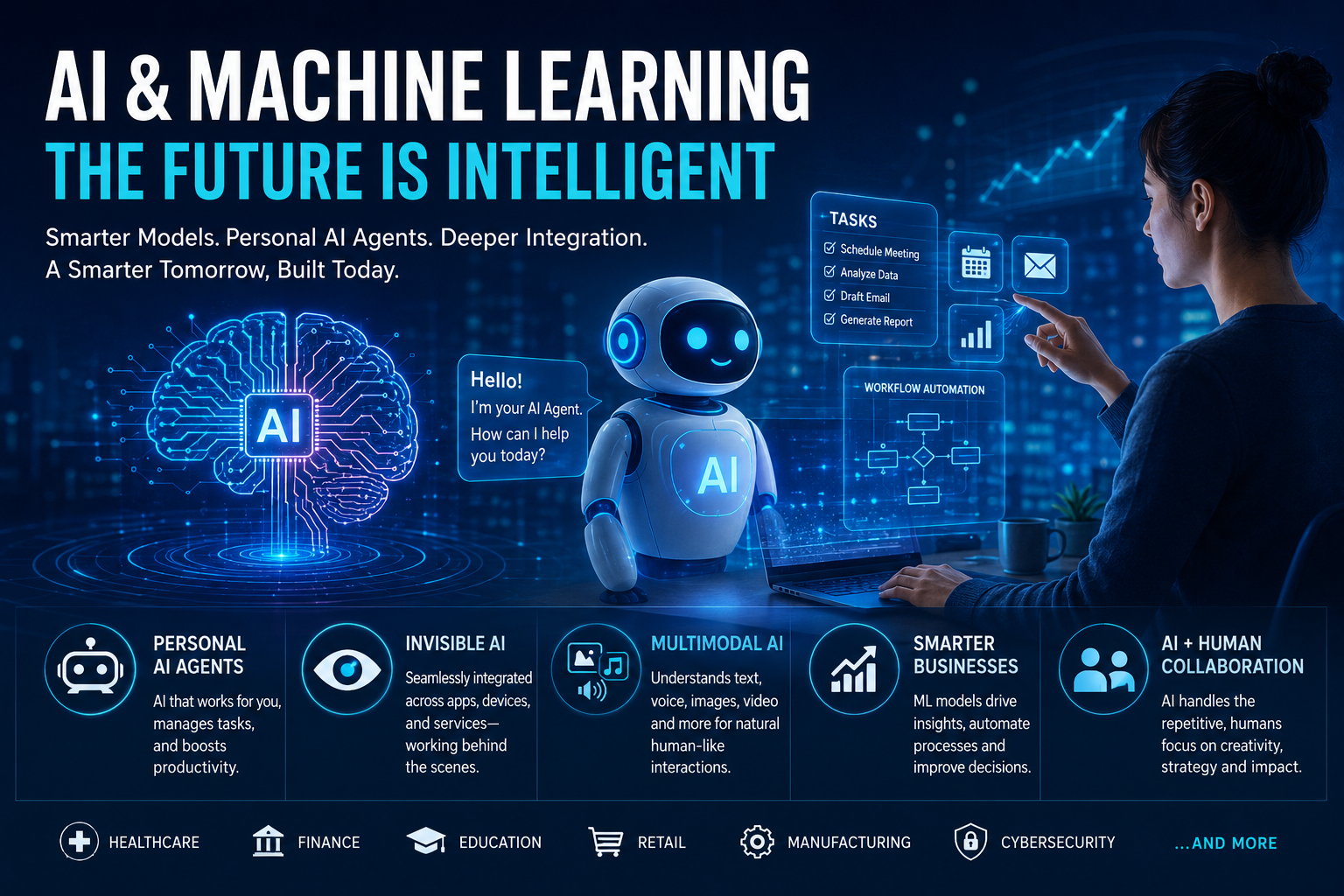
One of the biggest Artificial Intelligence trends dominating 2026 is the emergence of personal AI agents. Unlike traditional chatbots that simply respond to prompts, modern AI agents can actively complete tasks, analyze information, coordinate workflows, and even make decisions.
Major technology companies are investing heavily in agentic AI systems. At recent technology events, companies showcased AI assistants capable of handling scheduling, research, document editing, shopping, communication, and workflow automation across multiple applications simultaneously.
These AI agents are becoming digital coworkers rather than simple software tools.
For example, an advanced AI agent can now:
- Organize meetings automatically
- Write and summarize emails
- Analyze spreadsheets
- Generate reports
- Conduct online research
- Manage customer interactions
- Automate repetitive office tasks
- Assist software developers with coding
Experts predict that AI agents will soon evolve into collaborative AI teams, where multiple specialized agents work together to solve complex problems.
This trend is especially important for businesses looking to improve productivity and reduce operational costs.
AI Is Becoming “Invisible”
Another major trend in Machine Learning and Artificial Intelligence is the rise of “Invisible AI.” Instead of users actively opening AI tools, AI capabilities are now being embedded directly into apps, websites, operating systems, smart devices, and cloud services.
Tech analysts believe the future of AI lies in seamless integration rather than standalone products.
Today, AI is already integrated into:
- Search engines
- Smartphones
- Video platforms
- E-commerce websites
- Banking systems
- Customer support services
- Smart home devices
- Productivity software
This deeper integration means users may interact with AI dozens of times daily without even realizing it.
For example, AI-powered systems now personalize recommendations, optimize search results, detect fraud, enhance cybersecurity, improve voice assistants, and automate business workflows behind the scenes.
The next generation of AI-powered applications will focus less on flashy chatbot interfaces and more on delivering intelligent experiences naturally and efficiently.
Multimodal AI Is Redefining User Experience
Traditional AI systems were limited to one form of input, such as text or images. However, multimodal AI is changing that completely.
Modern AI models can now process:
- Text
- Images
- Voice
- Video
- Audio
- Sensor data
simultaneously.
This enables much more natural human-computer interaction. (TechTarget)
For instance, users can now upload an image, ask a spoken question, and receive a contextual answer generated using multiple data sources at once.
This technology is already transforming industries like:
Healthcare
AI systems can analyze medical scans, patient records, voice data, and diagnostic information together to improve disease detection and patient care.
Education
AI tutors are becoming more personalized, adapting lessons based on student performance, voice interactions, and learning behavior.
Content Creation
Creators can now generate videos, graphics, scripts, music, and animations using simple prompts powered by generative AI.
E-Commerce
Retail platforms are using AI to offer hyper-personalized shopping experiences based on browsing patterns, images, and purchase history.
Multimodal AI is expected to become one of the most valuable sectors of the global AI industry over the next decade.
Machine Learning Is Powering Smarter Businesses
Machine Learning is becoming the foundation of modern enterprise infrastructure. Businesses are increasingly using ML models to analyze data, predict trends, automate operations, and improve customer experiences.
Industries benefiting most from AI and ML include:
- Finance
- Manufacturing
- Logistics
- Healthcare
- Retail
- Marketing
- Cybersecurity
In manufacturing, AI-powered predictive systems can now monitor equipment performance, identify failures before they occur, and optimize supply chains automatically.
In finance, machine learning algorithms detect fraud, assess risks, and automate investment strategies in real time.
Meanwhile, marketing teams are using AI-driven analytics to personalize campaigns and improve customer targeting.
The future of business will increasingly depend on how effectively companies integrate AI into their core systems rather than treating it as an optional add-on.
AI and Human Collaboration Will Define the Future
Despite fears about automation replacing jobs, many researchers believe AI will function more as a collaborative partner than a complete replacement for humans.
The next generation of AI systems is designed to augment human capabilities rather than eliminate them.
AI can process massive amounts of information quickly, but humans still provide creativity, emotional intelligence, ethics, and strategic thinking.
This creates a powerful partnership where:
- AI handles repetitive tasks
- Humans focus on innovation and decision-making
Businesses that successfully combine human expertise with AI-powered tools are likely to gain significant competitive advantages in the coming years.
Challenges Facing Artificial Intelligence in 2026
While the AI boom offers enormous opportunities, several challenges remain.
Privacy and Data Security
AI systems require large amounts of data to function effectively. This raises concerns about data privacy, surveillance, and cybersecurity.
AI Bias
Machine learning models can inherit biases from training data, potentially leading to unfair or discriminatory outcomes.
Deepfakes and Misinformation
Generative AI tools can create highly realistic fake videos, images, and audio, increasing the risk of misinformation.
Regulation
Governments worldwide are working to introduce AI regulations to ensure transparency, accountability, and ethical usage.
Job Displacement
Some industries may experience workforce disruption as AI automates repetitive tasks.
Organizations must prioritize responsible AI development to maintain public trust and ensure long-term sustainability.
Practical Advice for Businesses and Content Creators
Businesses and bloggers looking to stay competitive in the AI era should focus on several key strategies:
- Invest in AI literacy and training
- Use AI tools to improve productivity
- Prioritize ethical AI practices
- Focus on human creativity alongside automation
- Experiment with AI-powered content creation
- Stay updated with emerging AI trends
- Implement AI gradually rather than replacing entire systems immediately
For content creators and bloggers, AI can assist with research, SEO optimization, content generation, video editing, and audience analysis. However, authentic human storytelling and originality remain essential for long-term success.
Final Thoughts
Artificial Intelligence and Machine Learning are evolving faster than ever before. The rise of personal AI agents, multimodal systems, and invisible AI integration is reshaping how people interact with technology across every aspect of life.
Businesses that adapt early to these changes will gain significant advantages in productivity, innovation, and customer engagement. At the same time, society must address the ethical and security challenges that come with increasingly powerful AI systems. The future of AI is not just about smarter machines. It is about creating intelligent systems that work alongside humans to unlock new levels of creativity, efficiency, and innovation in the digital age.