A Cosmic Transformation Revealed
Hubble Revisits the Trifid Nebula and Uncovers a Dramatic Stellar Evolution
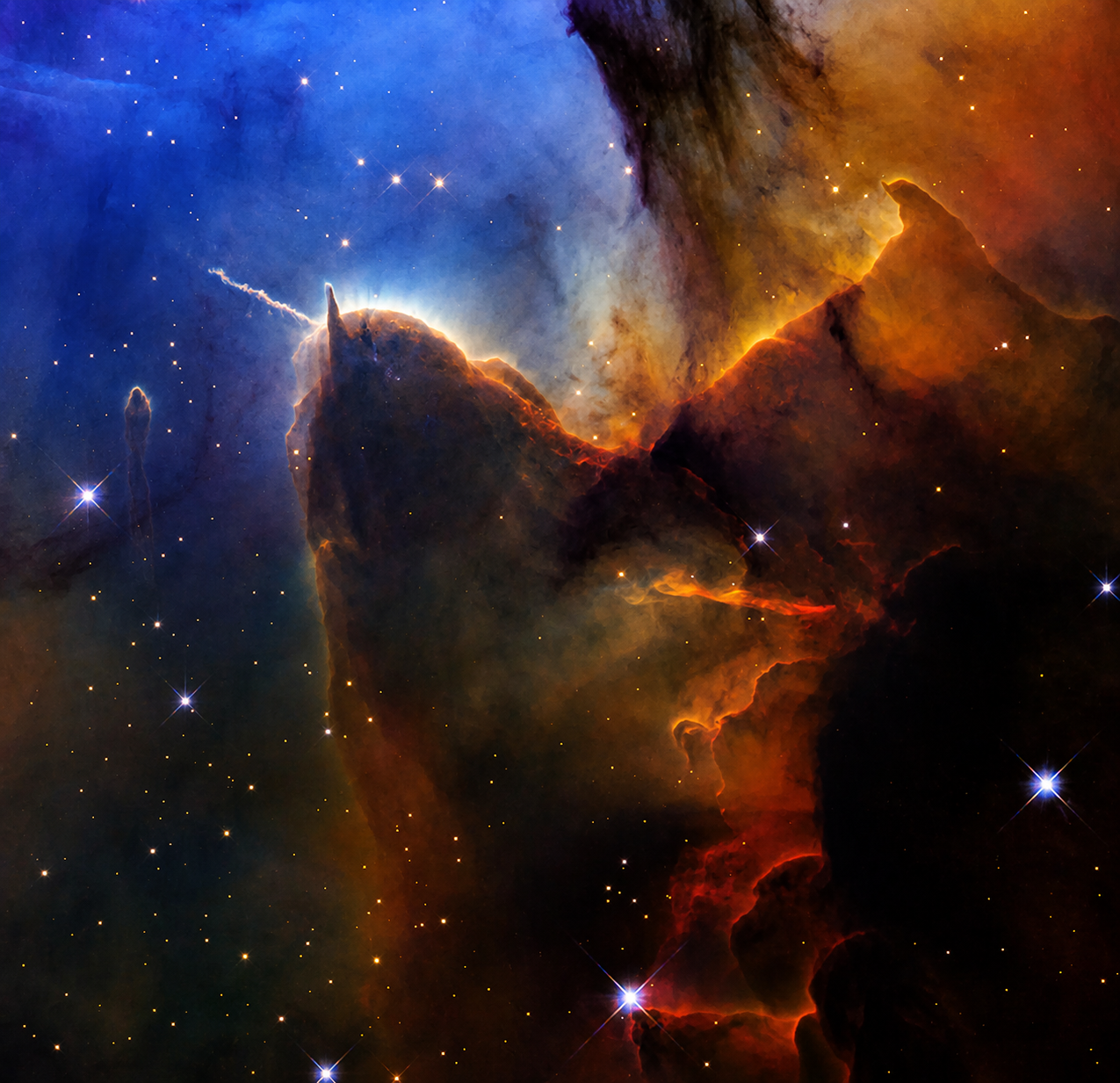
After nearly three decades, the legendary Hubble Space Telescope has returned to one of its most mesmerizing targets—the Trifid Nebula. The result is nothing short of breathtaking.
This newly released image not only showcases stunning cosmic beauty but also reveals something extraordinary: visible changes in a star-forming region over human timescales. Located about 5,000 light-years away in the Sagittarius constellation, this nebula is a dynamic nursery where stars are born, evolve, and reshape their surroundings.
A Cosmic Nursery Full of Energy and Chaos
Often nicknamed the “Cosmic Sea Lemon” due to its unusual shape, this region of the nebula is anything but calm. It is filled with glowing gas clouds, sharp ridges, and swirling dust structures sculpted by powerful young stars.
Massive stars in the region release intense ultraviolet radiation, which:
- Strips electrons from surrounding gas, causing it to glow in vibrant orange hues
- Pushes away dust through strong stellar winds
- Creates bright blue patches where dust has thinned
- Leaves darker, nearly black regions where dust remains dense
This interplay of light and matter creates the nebula’s dramatic and colorful appearance.
Then vs Now – What Changed in 30 Years?
The first detailed image of this region was captured in 1997 using Hubble’s older camera system. Now, with its advanced Wide Field Camera 3, Hubble has taken a second look—and the differences are remarkable.
Scientists have observed that:
- A jet of gas from a newborn star has expanded noticeably
- Certain glowing regions have shifted and intensified
- New structures appear more defined due to improved imaging technology
This rare comparison allows astronomers to directly study how stellar environments evolve over time—something that usually takes thousands or millions of years.
The Power of Newborn Stars: Herbig-Haro Jets
One of the most exciting discoveries in this updated image is the growth of a powerful jet linked to a Herbig-Haro object known as HH-399.
These jets are formed when newborn stars eject streams of high-energy gas into space. In this case:
- The jet originates from a young star hidden within the nebula
- It has expanded significantly since 1997
- Scientists can now estimate its speed and energy output
Another bright streak nearby suggests a second jet may be forming, hinting at even more stellar activity within the region.
A Glimpse Into the Future of the Nebula
While the Trifid Nebula looks chaotic today, its future is much calmer.
Bright stars already visible in the image have:
- Cleared out surrounding gas and dust
- Reached a stable, mature stage
Over the next few million years:
- Remaining gas and dust will gradually disperse
- Hidden stars will emerge fully formed
- The nebula itself will fade, leaving behind a cluster of stars
A Celebration of Hubble’s Legacy and New Discoveries
This stunning image also marks the 36th anniversary of the Hubble Space Telescope, highlighting its continued importance in modern astronomy.
Meanwhile, newer observatories like the Vera C. Rubin Observatory are beginning to explore the same cosmic regions, offering fresh perspectives and complementary data.
Final Thoughts: A Living, Breathing Universe
The updated view of the Trifid Nebula is more than just a beautiful space image—it’s proof that the universe is constantly changing, even within a single human lifetime.
By revisiting familiar cosmic landmarks, Hubble reminds us that space is not static. It’s alive with motion, energy, and transformation—waiting to be rediscovered with every new observation.