How Apple’s Launch Strategy Is Reshaping the Premium Smartphone Market in 2026
iPhone 18 Pro Release Strategy Could Redefine the Premium Smartphone Market in 2026
Apple’s iPhone 18 Pro Launch Is More Than a Product Release—It’s a Market-Shaping Event
Every year, the smartphone industry witnesses a familiar yet powerful phenomenon: Apple’s annual iPhone launch. While consumers often focus on new cameras, processors, AI features, and design upgrades, industry insiders know that Apple’s greatest weapon isn’t always the hardware itself—it’s timing.
The expected launch of the iPhone 18 Pro and iPhone 18 Pro Max in September 2026 once again demonstrates how Apple influences the entire premium smartphone ecosystem. From Samsung and Google to emerging Android manufacturers, competitors are forced to adapt their release schedules, marketing campaigns, and sales strategies around Apple’s calendar.
The result is a fascinating strategic battle that extends far beyond product specifications. It is a global contest for consumer attention, retail shelf space, media coverage, and ultimately, market share.
The iPhone Launch Window: A Strategic Advantage Apple Has Perfected
Apple has transformed its September launch event into one of the most anticipated technology moments of the year.
Unlike many smartphone manufacturers that frequently adjust launch dates, Apple has maintained remarkable consistency. Consumers, investors, retailers, and technology media all know when to expect the next iPhone announcement.
This predictability creates a powerful advantage.
Months before the official unveiling, discussions surrounding the new iPhone dominate social media platforms, technology blogs, YouTube channels, and news websites. By the time Apple officially announces its latest devices, consumer attention has already been captured.
This means that September effectively becomes “iPhone season,” leaving little room for competitors to generate meaningful excitement around their own premium smartphones.
Why Android Manufacturers Are Being Forced Into Earlier Launches
The influence of Apple’s release cycle has become so significant that major Android brands have adjusted their schedules accordingly.
Samsung’s Position
Samsung continues to showcase its technological innovation through premium devices such as the Galaxy S series and its foldable lineup.
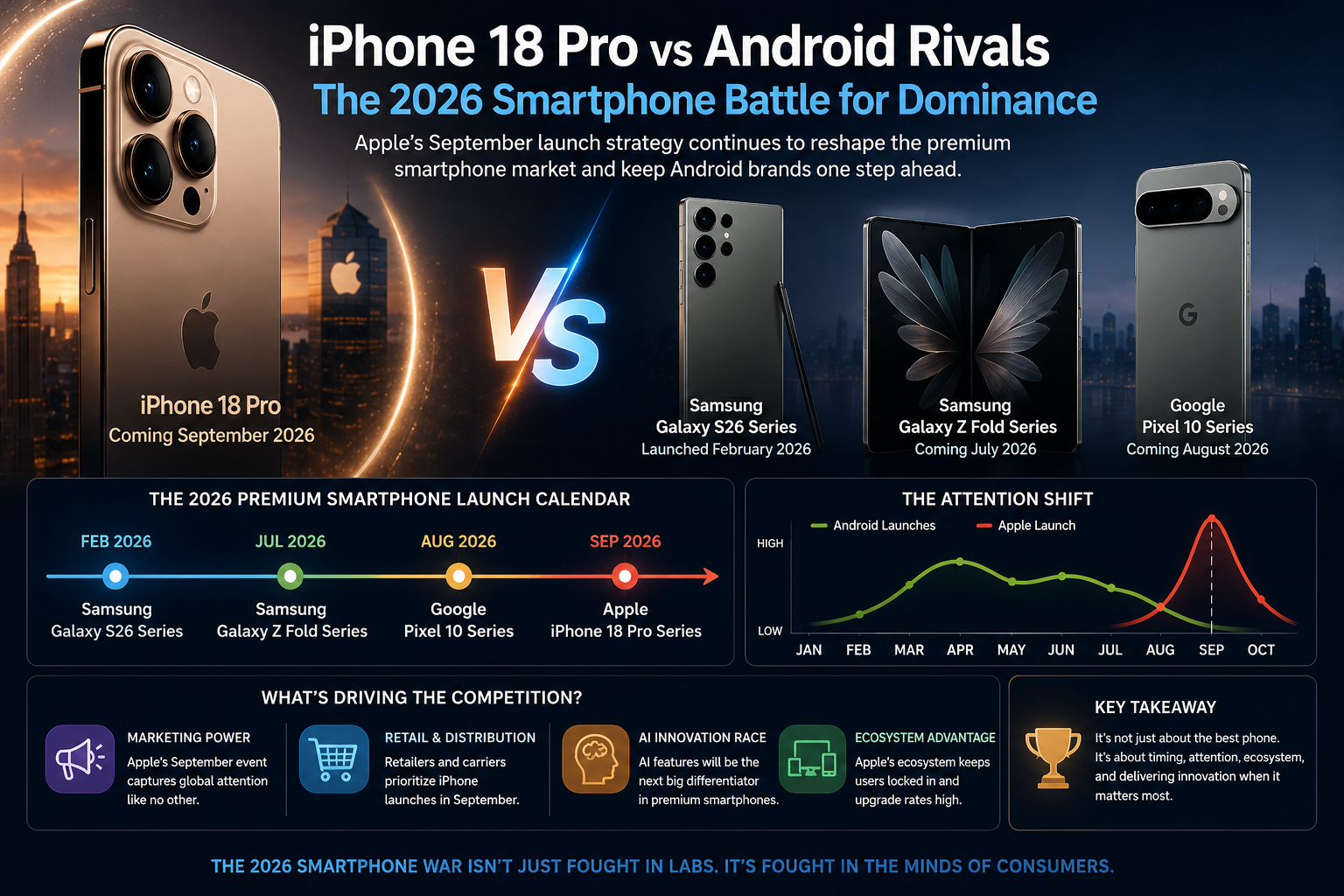
The Galaxy S26 family launched earlier in February 2026, creating a release gap of several months before Apple’s flagship announcement.
While this strategy allows Samsung to enjoy an uninterrupted launch period, it also presents challenges:
- Product momentum begins fading before September.
- Consumer attention shifts toward Apple rumors and leaks.
- Retail promotions become necessary to sustain demand.
Samsung’s foldable devices remain one of the few areas where Apple currently lacks direct competition, giving the company an opportunity to maintain differentiation despite Apple’s market dominance.
Google’s New Timing Strategy
Google has also altered its approach.
Rather than launching Pixel devices closer to the holiday season, Google increasingly favors August announcements.
This creates a narrow sales window before Apple’s September event arrives.
The challenge is obvious:
Consumers considering a premium smartphone purchase may delay buying a Pixel device if they know a new iPhone is only weeks away.
As a result, Google’s marketing teams must work harder and spend more aggressively to convert potential buyers before Apple’s launch machine takes over.
The Real Battlefield: Consumer Attention
Many people assume smartphone companies compete primarily through specifications.
While processor speed, battery life, AI capabilities, and camera quality certainly matter, the most valuable asset in modern technology marketing is consumer attention.
Attention is limited.
When Apple unveils a new iPhone:
- Technology websites prioritize iPhone coverage.
- Social media conversations shift toward Apple.
- YouTube creators focus on iPhone reviews.
- Retailers highlight Apple products.
- Carriers promote iPhone upgrade programs.
This concentrated attention creates enormous pressure on Android competitors.
Even excellent devices can struggle to remain visible during the weeks surrounding Apple’s launch.
How Apple’s Marketing Ecosystem Amplifies Every Launch
Apple’s influence extends beyond its own advertising budget.
The company benefits from what marketing experts often describe as “earned media.”
Every iPhone launch generates:
Massive Media Coverage
Thousands of news articles, videos, reviews, comparisons, and social media discussions appear within days of the announcement.
Retail Visibility
Telecom carriers and electronics retailers dedicate significant showroom space to new iPhone models.
Ecosystem Momentum
Existing Apple users often remain within the Apple ecosystem because of integration with:
- iCloud
- Apple Watch
- AirPods
- Mac
- iPad
- Apple Intelligence services
This ecosystem lock-in increases upgrade rates and further strengthens Apple’s position.
The Growing Role of AI in the Smartphone War
The 2026 smartphone market is no longer defined solely by cameras and hardware design.
Artificial intelligence is rapidly becoming a major differentiator.
Apple, Samsung, and Google are all investing heavily in:
- On-device AI processing
- Personalized assistants
- Real-time translation
- AI photo editing
- Productivity automation
- Context-aware computing
The iPhone 18 Pro is expected to place significant emphasis on AI-driven features, potentially creating another challenge for Android competitors attempting to establish their own AI ecosystems.
The company that successfully integrates AI into everyday smartphone experiences—not merely as a novelty—could gain a substantial competitive advantage over the next several years.
Market Predictions: What Happens After the iPhone 18 Pro Launch?
Several trends are likely to emerge following Apple’s 2026 flagship release.
1. Faster Android Innovation Cycles
Android manufacturers may accelerate product refresh cycles to maintain visibility throughout the year.
2. Increased Focus on Foldables
Foldable devices remain an area where Android brands hold a leadership position.
Companies like Samsung will likely continue investing heavily in foldable technology to create differentiation from Apple’s traditional smartphone design.
3. More Aggressive Pricing Strategies
To compete with Apple’s premium positioning, Android manufacturers may offer stronger trade-in programs, discounts, and bundled services.
4. AI Becomes the New Camera Race
Just as smartphone brands once competed primarily through camera quality, AI experiences could become the next major battleground.
Infographic Ideas for This Article
To improve reader engagement and SEO performance, consider adding the following visuals:
Infographic 1: Premium Smartphone Launch Calendar 2026
| Brand | Typical Launch |
|---|---|
| Samsung Galaxy S26 | February 2026 |
| Samsung Foldables | July 2026 |
| Google Pixel Series | August 2026 |
| Apple iPhone 18 Pro | September 2026 |
Infographic 2: Consumer Attention Curve
Create a line chart showing:
- Android launches peaking in summer.
- Apple attention surging in September.
- Industry-wide visibility shifting toward Apple after launch.
Infographic 3: AI Feature Comparison
Compare:
- Apple Intelligence
- Google AI
- Samsung Galaxy AI
Across categories such as productivity, photography, translation, and personalization.
Final Thoughts
The launch of the iPhone 18 Pro represents far more than the arrival of another premium smartphone. It highlights Apple’s unique ability to influence the entire industry’s rhythm.
Samsung, Google, and other Android manufacturers are no longer simply competing on hardware specifications—they are competing against Apple’s timing, marketing power, ecosystem strength, and consumer mindshare.
As artificial intelligence becomes increasingly central to the smartphone experience, the competition is likely to intensify further. The winner may not necessarily be the company with the most powerful hardware, but the one that best captures and retains consumer attention.
The 2026 smartphone battle is already underway, and the iPhone 18 Pro sits firmly at its center.
What Do You Think?
Will the iPhone 18 Pro dominate the premium smartphone market this year?
Or can Samsung, Google, and other Android manufacturers challenge Apple’s influence through innovation in foldables and AI?
Share your thoughts in the comments below and join the discussion.