
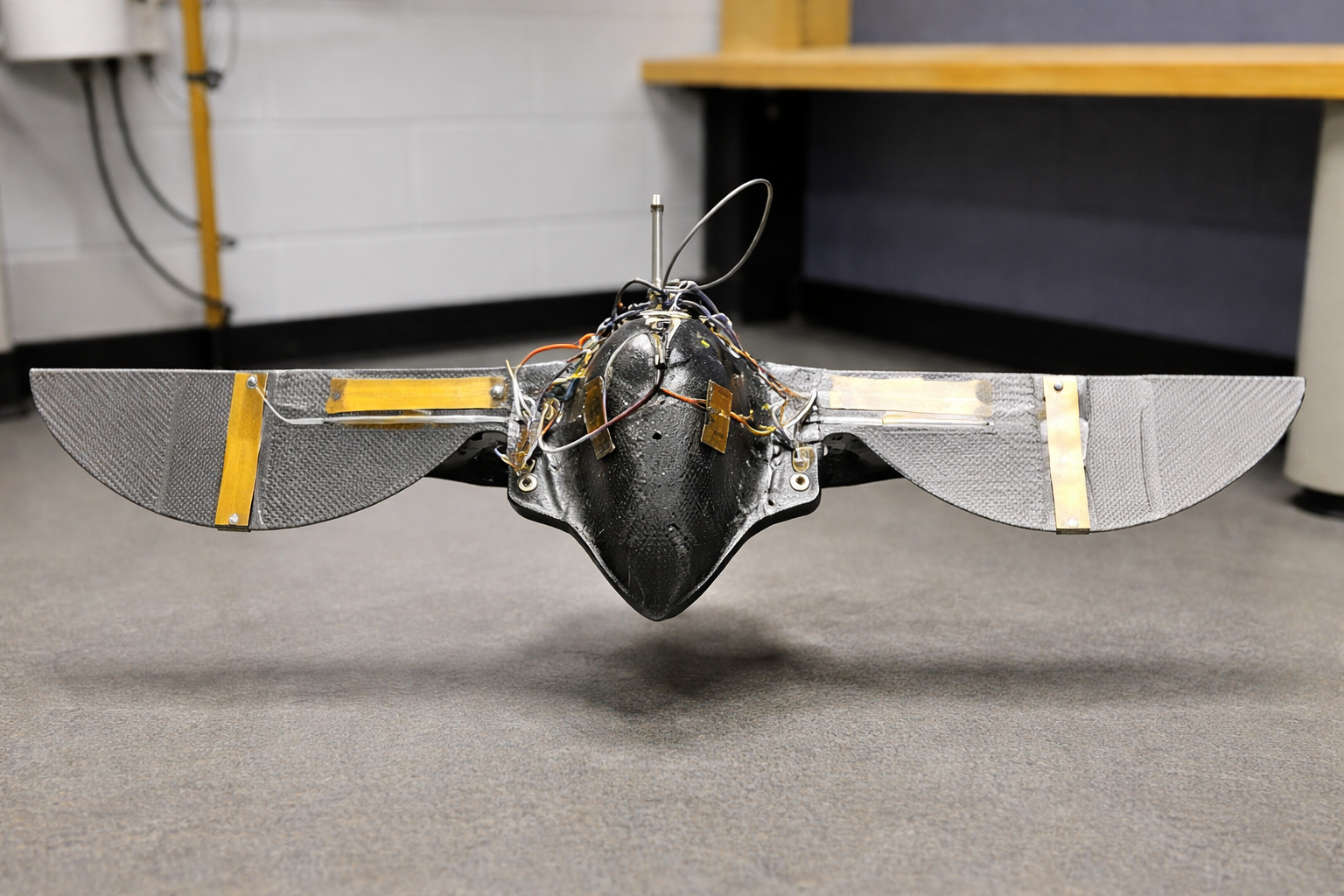
Motorless Drones: How Solid-State Ornithopters Could Transform the Future of Flight
Introduction: A New Era of Drone Technology
Researchers at Rutgers University are reimagining how drones might fly in the future in an innovative approach. Engineers have developed an experimental drone that moves solely on electricity, eliminating the need for motors, gears, and mechanical components.
This novel idea, called a solid-state ornithopter, uses flexible materials that flap and twist when electrical energy is applied, simulating the natural flying of birds. The end product is a highly versatile, lightweight, and efficient flying machine that has the potential to transform a variety of industries, including urban distribution systems and environmental monitoring.
What Is a Solid-State Ornithopter?
A solid-state ornithopter is a drone that flies without traditional mechanical components. Unlike conventional drones that depend on propellers and motors, this new design uses smart materials to generate movement.
At the heart of this innovation are piezoelectric materials, which deform when an electric current is applied. When integrated into a flexible wing structure, these materials enable the wings to flap and twist—just like a bird in flight.
Key Features:
- No motors, gears, or linkages
- Wings powered entirely by electrical stimulation
- Lightweight and flexible design
- Continuous shape-changing capability
The Science Behind the Innovation
The research was led by aerospace engineers Onur Bilgen and Xin Shan. Their approach combines aerodynamics, materials science, and biomechanics into a single system.
How It Works:
- The wings are made from a composite structure:
- A piezoelectric layer (acts like muscles)
- A carbon-fiber layer (acts like bones and feathers)
- When voltage is applied:
- The piezoelectric layer expands or contracts
- The entire wing flexes and produces flapping motion
This eliminates the need for traditional mechanical systems, making the drone more durable and efficient.
Why This Technology Matters
1. Enhanced Maneuverability
Because the wings can twist and adapt in real time, these drones can:
- Navigate tight or cluttered environments
- Perform delicate operations with precision
2. Reduced Wear and Tear
With no moving joints, there are fewer parts that can fail. This leads to:
- Longer lifespan
- Lower maintenance costs
3. Lightweight and Energy Efficient
Nature-inspired design ensures:
- Minimal weight
- Improved energy efficiency
- Better flight performance
Real-World Applications
This futuristic drone technology has the potential to impact multiple industries:
Environmental Monitoring
- Observe wildlife without disturbance
- Monitor ecosystems in hard-to-reach areas
Search and Rescue Operations
- Navigate collapsed buildings or dense forests
- Access areas where traditional drones struggle
Urban Package Delivery
- Safer and quieter operation in crowded cities
- Greater precision in tight delivery spaces
The Role of Simulation and Modeling
Since current materials are not yet powerful enough for full-scale implementation, the research team developed advanced computational models.
These simulations allow engineers to:
- Test flight performance
- Analyze aerodynamics
- Explore designs not yet physically possible
According to Bilgen, this approach helps researchers “look into the future” and prepare for when material technology catches up.
Current Limitations
Despite its promise, the technology still faces challenges:
- Material Constraints:
Existing piezoelectric materials lack the strength required for large-scale drones - Scalability Issues:
Translating lab models into real-world systems remains difficult
However, rapid advancements in material science could soon bridge this gap.
Interestingly, the same principles behind solid-state ornithopters could be applied to renewable energy systems.
Wind Turbine Optimization
- Turbine blades could adjust shape in real time
- Improved efficiency in varying wind conditions
As Bilgen explains, a turbine blade is essentially a rotating wing—making it a perfect candidate for this technology.
Nature-Inspired, But Beyond Nature
While the design draws inspiration from birds, the goal is not just imitation—but improvement.
Traditional aircraft already mimic bird wings, but this new approach pushes further by:
- Eliminating mechanical complexity
- Achieving motion through material behavior alone
This philosophy reflects a shift toward simpler systems with more advanced capabilities.
Future Outlook: What Comes Next?
The concept of motorless drones may still be in its early stages, but its potential is enormous. As material science evolves, we can expect:
- Fully functional electricity-driven drones
- More efficient and sustainable aerial systems
- Broader adoption across industries
This research marks a critical step toward a future where machines fly not with engines—but with intelligent materials.
Conclusion
The development of a motorless drone at Rutgers represents a bold leap in aerospace engineering. By harnessing the power of electricity and smart materials, researchers are paving the way for a new generation of drones that are lighter, smarter, and more adaptable.
As innovation continues, solid-state ornithopters could redefine not only how drones fly—but how we think about motion itself.