A Historic Leap for Space Research
Introduction: A Proud Moment for Pakistan
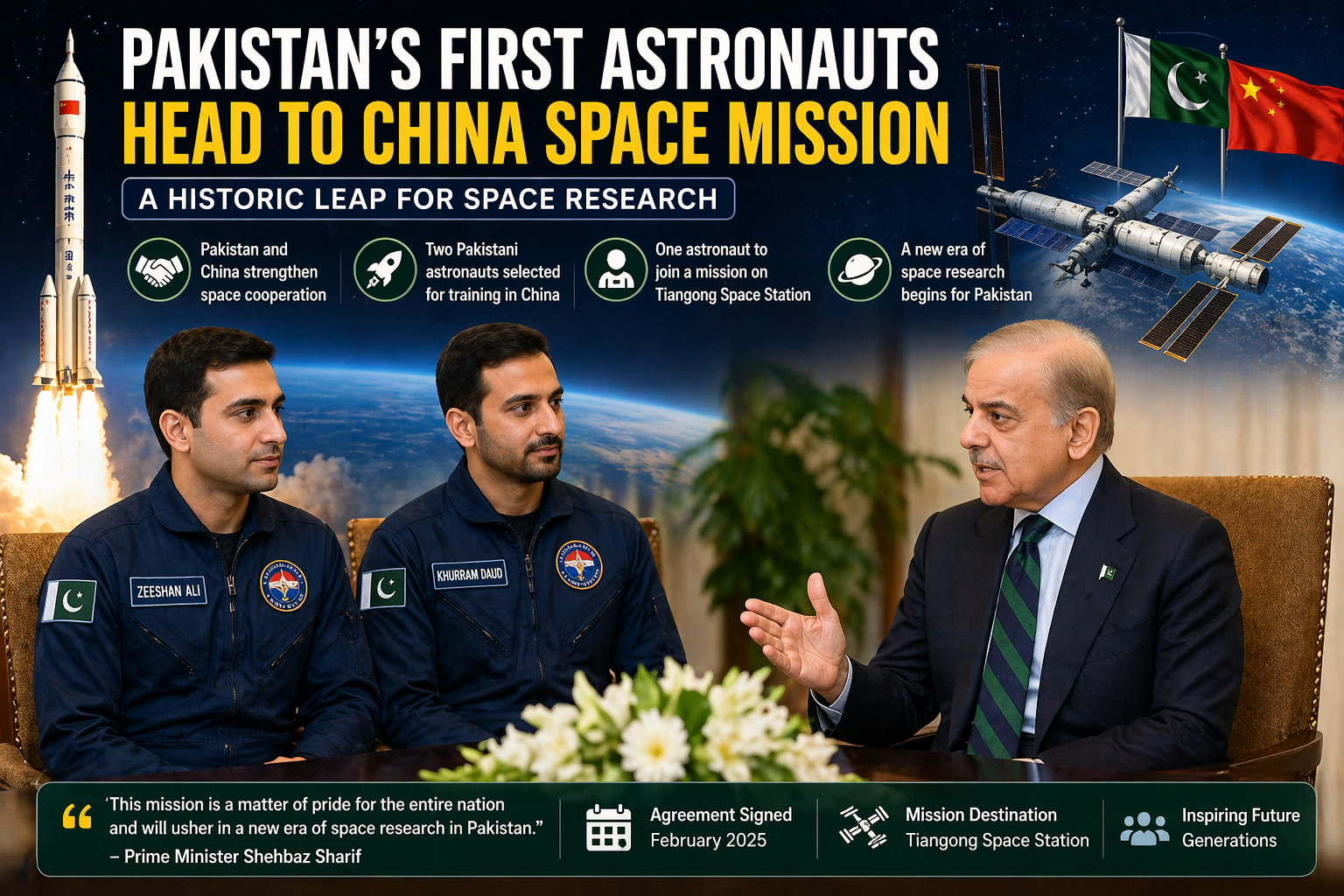
Pakistan has made significant progress toward joining the international space arena. Prime Minister Shehbaz Sharif recently visited and congratulated two Pakistani astronaut hopefuls who were chosen for China’s manned space program, which is a historic development. In addition to showcasing individual accomplishments, this milestone ushers in a new phase of Pakistan’s space aspirations.
Who Are the Pakistani Astronaut Candidates?
The two selected candidates — Zeeshan Ali and Khurram Daud — have successfully passed a rigorous selection process. Their dedication, discipline, and continuous hard work earned them a place in one of the most advanced space training programs in the world.
They are now set to travel to China, where they will undergo specialized training for human spaceflight missions.
A Historic Collaboration Between Pakistan and China
This achievement stems from a growing partnership between Space and Upper Atmosphere Research Commission (SUPARCO) and the China Manned Space Agency.
In February 2025, both countries signed a landmark agreement aimed at advancing human spaceflight opportunities for Pakistan. Under this agreement:
- Two Pakistani astronauts would receive training in China
- One astronaut would participate in a future mission
- The selected astronaut will serve as a payload specialist
This collaboration reflects the deepening strategic and scientific ties between the two nations.
Mission to the Tiangong Space Station
One of the selected astronauts will eventually travel to the Tiangong space station — China’s independently built space station.
This mission will be particularly significant because:
- It will mark the first time a foreign astronaut boards China’s space station
- Pakistan will officially join the list of nations with human spaceflight participation
- It opens doors for future joint space missions and research
Prime Minister’s Vision for Space Research
During the meeting, Prime Minister Shehbaz Sharif described the achievement as a “matter of pride for the entire nation.” He praised the candidates for their relentless efforts and dedication.
He also expressed hope that this mission will:
- Launch a new era of space research in Pakistan
- Strengthen scientific collaboration with China
- Inspire future generations to pursue careers in science and technology
Why This Mission Matters for Pakistan
This development is more than symbolic—it carries real long-term benefits:
1. Advancement in Space Technology
Pakistan will gain exposure to advanced space systems, research methods, and astronaut training.
2. Strengthened International Partnerships
The collaboration enhances Pakistan’s role in global space exploration through its partnership with China.
3. Inspiration for Youth
This milestone is expected to motivate students across Pakistan to explore careers in STEM (Science, Technology, Engineering, and Mathematics).
China’s Expanding Space Program
China has rapidly developed its independent space capabilities, especially after being excluded from the International Space Station collaboration due to restrictions involving NASA.
As a result, China has:
- Built its own space station (Tiangong)
- Expanded partnerships with countries like Pakistan
- Opened opportunities for international astronauts outside Western alliances
Final Thoughts: A Giant Leap Forward
Pakistan’s inclusion in China’s manned space program is a groundbreaking achievement that signals a bright future for the country’s space ambitions. With dedicated individuals like Zeeshan Ali and Khurram Daud leading the way, Pakistan is steadily moving toward becoming an active participant in human space exploration.
This mission is not just about reaching space—it’s about reaching new heights in innovation, collaboration, and national pride.