That Could Take Humans to Mars Faster
NASA’s Breakthrough Lithium-Fed Nuclear Thruster Could Revolutionize Mars Missions
In a major step toward deep space exploration, NASA has successfully tested a next-generation propulsion system that could dramatically change how humans travel to Mars. This new lithium-fed electromagnetic thruster represents a leap forward in efficiency, power, and long-duration space travel capability.
The test marks the first time such a system has reached these power levels in the United States, bringing scientists closer to making crewed missions to the Red Planet a reality.
A Record-Breaking Test at NASA’s Jet Propulsion Laboratory
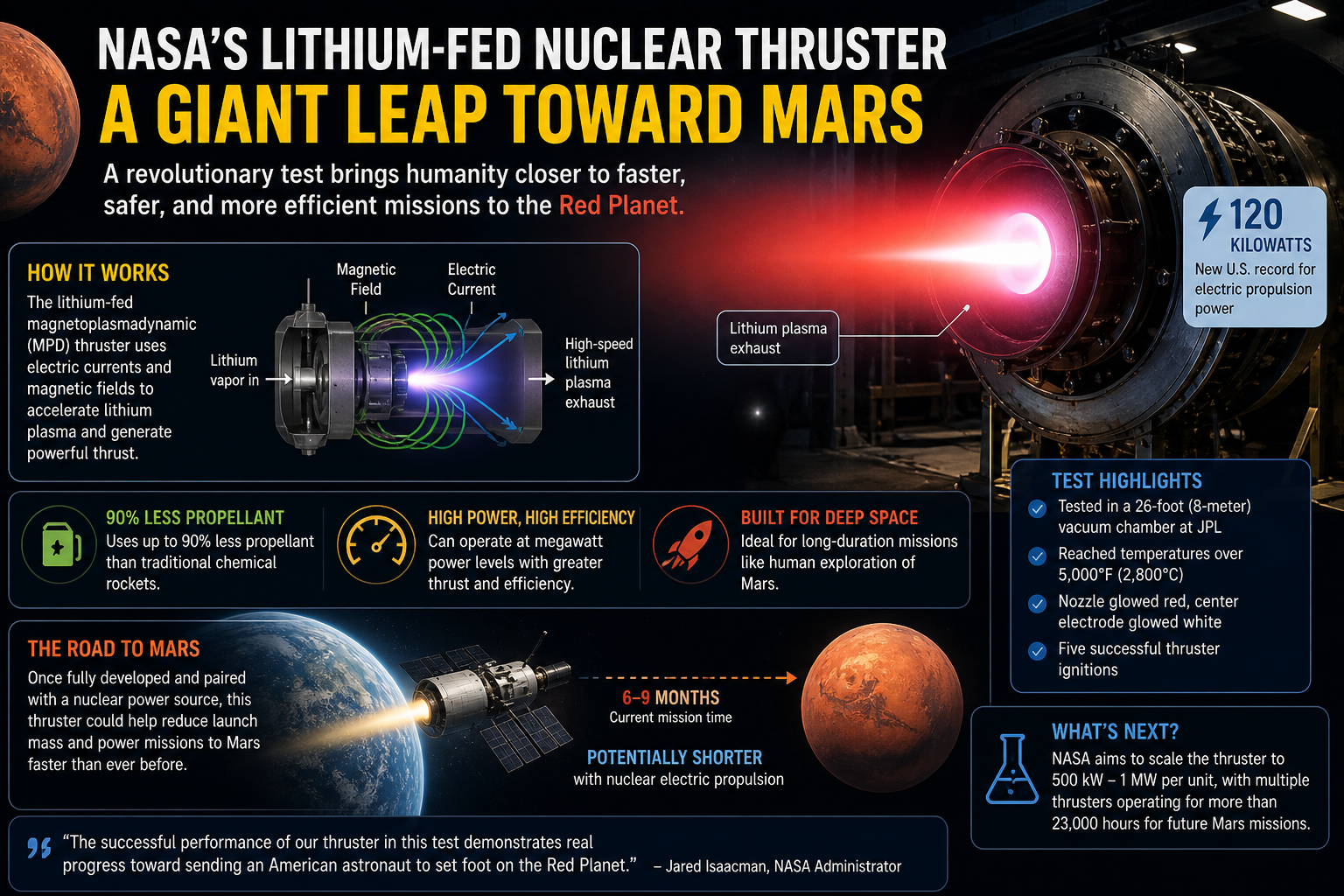
Engineers at NASA Jet Propulsion Laboratory (JPL) recently ignited a prototype electromagnetic thruster inside a specialized vacuum chamber. During the test, the system reached an impressive 120 kilowatts of power, setting a new benchmark for electric propulsion in the U.S.
To put this into perspective, that’s more than 25 times stronger than the propulsion system used on the Psyche mission, which launched in 2023.
The test wasn’t just about raw power—it proved that the thruster works as intended and can serve as a foundation for future upgrades.
How the Lithium-Fed Thruster Works
Unlike traditional rocket engines that rely on chemical combustion, this new system uses electric propulsion. It generates thrust by accelerating charged particles using magnetic and electric fields.
What makes this design unique is its use of lithium vapor as propellant. Known as a magnetoplasmadynamic (MPD) thruster, it works by:
- Passing high electrical currents through lithium plasma
- Interacting with magnetic fields to generate thrust
- Producing significantly higher efficiency than chemical rockets
This approach allows spacecraft to use up to 90% less propellant, making long-distance missions far more practical.
Extreme Conditions and Stunning Visuals
The test took place in a massive, water-cooled vacuum chamber designed to simulate space conditions. When the thruster fired, it produced extreme heat—reaching over 5,000°F (2,800°C).
Engineers observed a dramatic visual display:
- A glowing white-hot central electrode made of tungsten
- A bright red plasma plume emerging from the nozzle
These visuals weren’t just impressive—they confirmed that the system was operating under the intense conditions required for deep space travel.
Why This Matters for Future Mars Missions
NASA’s long-term goal is to send humans to Mars, and propulsion technology is one of the biggest challenges standing in the way.
This lithium-fed thruster could play a key role by:
- Reducing spacecraft mass
- Increasing payload capacity
- Delivering stronger, more sustained thrust
When combined with a nuclear power source, the system could support megawatt-level propulsion, which is essential for crewed interplanetary missions.
The Power Challenge Ahead
While the initial test is promising, there’s still a long road ahead. Future missions will require significantly more power—between 500 kilowatts and 1 megawatt per thruster.
A full Mars mission may demand:
- 2 to 4 megawatts of total power
- Multiple thrusters working simultaneously
- Continuous operation for over 23,000 hours
This introduces serious engineering challenges, especially when it comes to managing heat and ensuring long-term durability.
Collaboration Driving Innovation
The development of this advanced propulsion system is the result of collaboration between multiple institutions, including:
- NASA Jet Propulsion Laboratory
- Princeton University
- NASA Glenn Research Center
The project is funded under NASA’s Space Nuclear Propulsion initiative, which aims to unlock faster and more efficient deep space travel.
A Step Closer to the Red Planet
NASA leadership has emphasized that this successful test represents real progress toward sending humans beyond Earth orbit.
The data collected will guide the next phase of development, where engineers will push the system to even higher power levels and longer operational times.
Each milestone brings humanity closer to a future where astronauts can safely and efficiently travel to Mars—and potentially beyond.
Conclusion: A Giant Leap in Space Propulsion
NASA’s lithium-fed electromagnetic thruster is more than just an experiment—it’s a glimpse into the future of space exploration. By combining efficiency, power, and innovation, this technology could redefine how we approach interplanetary travel.
While challenges remain, one thing is clear: the journey to Mars is no longer just a dream—it’s becoming an engineering reality.