US Approves AI Chip Sales as Jensen Huang Pushes for Breakthrough
Nvidia H200 Chip Sales to China Approved by US Amid Rising AI and Tech War Tensions
The global artificial intelligence race has entered another critical phase as the United States approved sales of Nvidia’s powerful H200 AI chips to several major Chinese technology companies. However, despite official approval, not a single shipment has been completed yet, leaving one of the most important AI technology deals in uncertainty.
The situation highlights the growing tension between the United States and China over semiconductor technology, artificial intelligence leadership, and national security concerns. At the center of the controversy is Nvidia CEO Jensen Huang, who is reportedly seeking a major breakthrough during high-level diplomatic discussions involving Donald Trump and Xi Jinping.
The approved chip sales could reshape the future of the global AI market, the semiconductor industry, and the ongoing US-China technology rivalry.
US Approves Nvidia H200 AI Chip Sales to Major Chinese Tech Companies
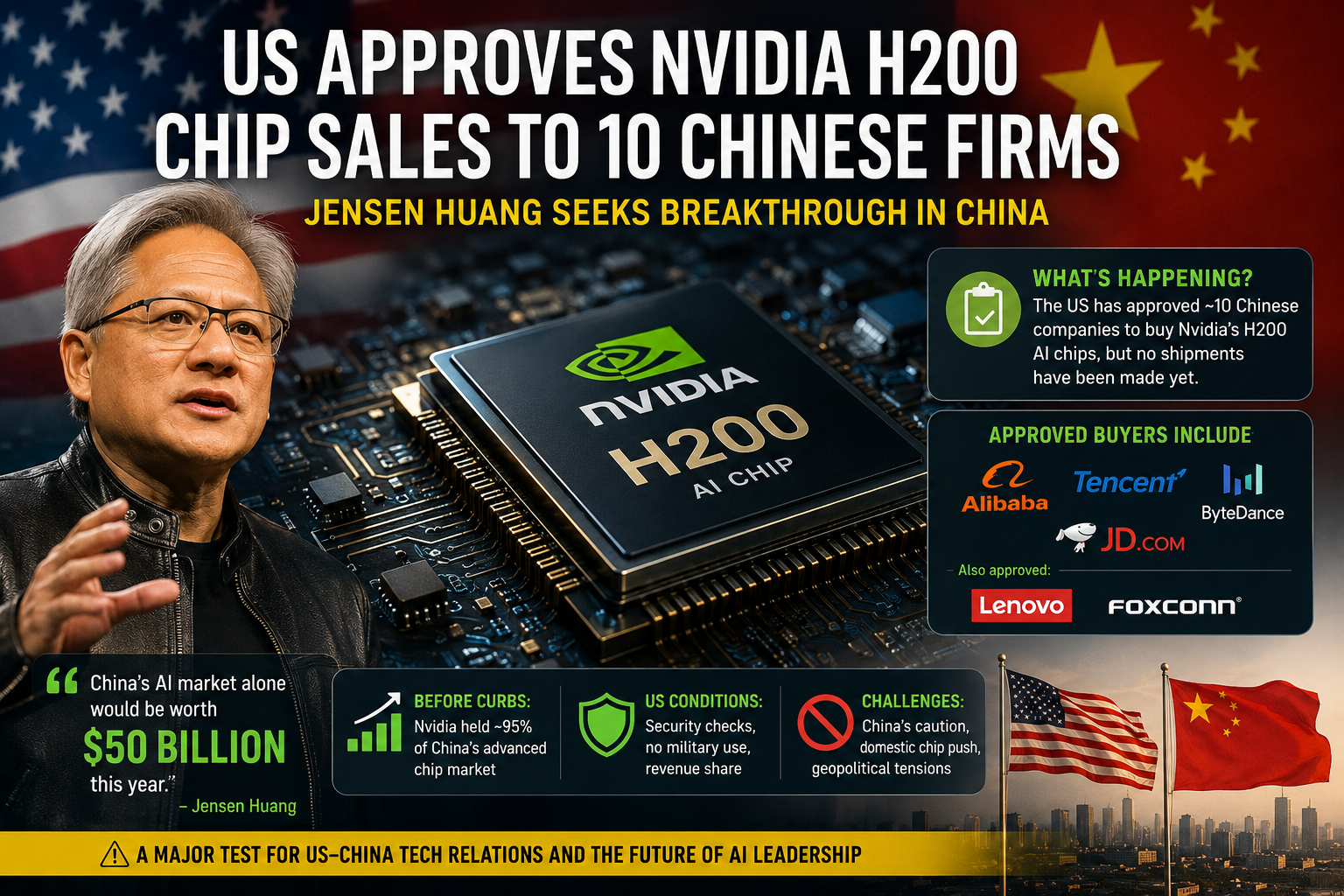
According to multiple reports, the US government has approved approximately 10 Chinese companies to purchase Nvidia’s H200 artificial intelligence chips. The approved firms reportedly include major Chinese technology giants such as Alibaba, Tencent, ByteDance, and JD.com.
In addition, distributors like Lenovo and Foxconn were also reportedly approved under US export licensing rules.
The Nvidia H200 chip is currently considered one of the most advanced AI accelerators available for artificial intelligence training, cloud computing, and large language models. These chips are crucial for powering AI systems used in generative AI, machine learning, autonomous technologies, and enterprise cloud services.
Under the current export agreement, each approved company could reportedly purchase up to 75,000 Nvidia H200 chips. However, despite receiving official approval, no actual deliveries have been completed yet.
That delay has raised serious questions about the future of US-China semiconductor trade.
Jensen Huang Joins High-Level China Talks Amid AI Chip Negotiations
The growing importance of the Nvidia H200 deal became even more visible when Jensen Huang joined diplomatic discussions connected to the Beijing summit.
Initially, Huang was not expected to participate in the official delegation traveling to China. However, reports suggest that President Donald Trump personally invited the Nvidia CEO to join the trip.
Trump reportedly picked up Huang in Alaska while traveling toward discussions with Chinese President Xi Jinping. The unexpected move immediately fueled speculation that Nvidia’s China business had become a major topic in broader US-China negotiations.
For Nvidia, the stakes are enormous.
Before stricter US export restrictions were introduced, Nvidia controlled roughly 95% of China’s advanced AI chip market. China previously represented around 13% of Nvidia’s overall revenue, making it one of the company’s most important international markets.
Jensen Huang has repeatedly warned that losing access to China could severely impact Nvidia’s future growth and weaken America’s position in the global AI industry.
Why the Nvidia H200 AI Chip Matters So Much
The Nvidia H200 is not just another computer chip. It represents one of the world’s most advanced artificial intelligence processors designed for high-performance AI computing.
The chip plays a major role in powering:
- Generative AI systems
- Large language models
- AI data centers
- Cloud computing infrastructure
- Machine learning applications
- Advanced research systems
As artificial intelligence becomes central to economic growth and national security, access to advanced semiconductors like the H200 has become a geopolitical issue.
The United States wants to maintain leadership in artificial intelligence technology, while China wants to reduce dependence on American semiconductor companies.
That competition has transformed Nvidia into one of the most strategically important companies in the global technology industry.
China Hesitates Despite US Approval for Nvidia Chips
Even though Washington approved the sales, Chinese companies reportedly became cautious about moving forward with purchases.
According to sources familiar with the matter, pressure inside Beijing has increased to either delay, restrict, or closely examine imports of advanced Nvidia AI chips.
One major concern involves China’s long-term strategy to build its own domestic semiconductor industry. Chinese officials worry that relying too heavily on Nvidia could weaken efforts to support local chip manufacturers.
Chinese technology companies are increasingly promoting domestic AI hardware solutions, especially chips developed by Huawei.
Although Chinese chips still trail Nvidia in performance, Beijing appears determined to accelerate development of homegrown AI infrastructure rather than remain dependent on US technology.
This strategic hesitation explains why approved deals have still not resulted in actual Nvidia H200 shipments.
US Export Restrictions Continue to Complicate AI Chip Sales
The situation surrounding Nvidia’s H200 sales demonstrates how complicated modern technology trade has become.
Under current US export rules, Chinese buyers must prove that the chips will not be used for military purposes. They must also demonstrate strong security protections before receiving approval.
Additionally, Nvidia itself must certify that it maintains sufficient chip inventory inside the United States.
Another unusual condition reportedly requires the US government to receive a percentage of the revenue generated from the sales. Reports suggest that around 25% of revenue from approved chip exports would return to the United States under the negotiated arrangement.
This structure reportedly forces Nvidia chips to pass through US territory before shipment to China, adding another layer of complexity to the process.
These restrictions have triggered concerns inside China about potential security risks, supply chain vulnerabilities, and possible foreign oversight.
The result is a highly fragile business environment where even approved technology deals remain politically sensitive.
Nvidia’s Position in China Is Becoming Increasingly Fragile
For years, Nvidia dominated China’s advanced AI chip market with little serious competition. However, ongoing export restrictions are changing that landscape rapidly.
Jensen Huang has openly warned that continued US export controls could permanently damage Nvidia’s position in China. According to Huang, Nvidia’s market share in Chinese AI accelerators has already collapsed dramatically due to tightening restrictions.
At the same time, Chinese companies are investing heavily in local alternatives.
Huawei and other domestic chip developers are now receiving greater support from Chinese firms seeking long-term technological independence. Some Chinese AI startups are even highlighting their ability to operate without Nvidia hardware.
If this trend continues, Nvidia could eventually lose one of the world’s largest artificial intelligence markets permanently.
US Hardliners Warn Nvidia China Sales Could Hurt American AI Leadership
Not everyone in Washington supports allowing Nvidia to continue selling advanced AI chips to China.
Several US lawmakers and policy experts argue that supplying powerful semiconductors to Chinese firms could reduce America’s technological advantage in artificial intelligence.
Critics believe every Nvidia chip sold to China potentially strengthens Chinese AI capabilities while reducing hardware availability for American companies.
Some US national security experts also worry that advanced AI chips could indirectly support military research, surveillance technologies, or strategic computing projects.
These concerns explain why Nvidia remains caught between competing political priorities.
On one side, the company wants access to China’s massive AI market. On the other side, US policymakers increasingly view semiconductor technology as a national security asset.
The Nvidia H200 Deal Could Shape the Future of Global AI Competition
The unresolved Nvidia H200 situation reflects a much larger global battle over artificial intelligence leadership, semiconductor manufacturing, and economic power.
Artificial intelligence is no longer just a technology industry trend. It is becoming one of the most important geopolitical issues of the modern era.
For Nvidia, the outcome could determine whether the company maintains dominance in the world’s fastest-growing AI market.
For China, the decision could influence the future of domestic semiconductor development.
And for the United States, the debate represents a difficult balancing act between economic opportunity and national security.
As Jensen Huang continues negotiations and global leaders hold high-level discussions, the future of Nvidia’s China business remains uncertain — but the impact on the worldwide AI industry could be enormous.