What the End of AI Exclusivity Means for the Future
OpenAI Ends Exclusive Partnership With Microsoft — A Game-Changer for the AI Industry
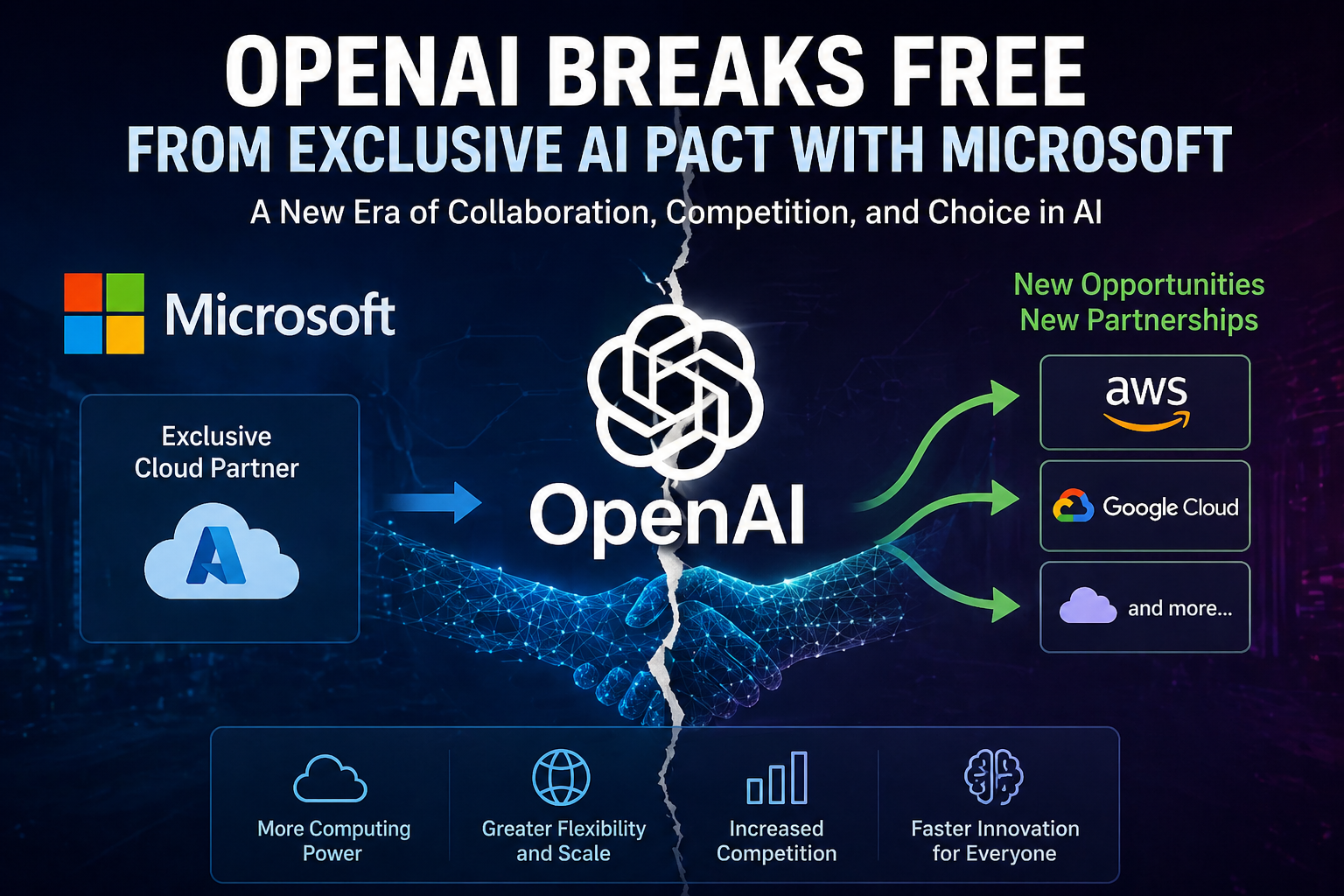
In a major shift that could redefine the artificial intelligence landscape, OpenAI has officially ended its exclusive partnership with Microsoft. This move signals a new era of flexibility, competition, and rapid innovation in the global AI race.
For years, Microsoft was the primary—and largely exclusive—partner powering OpenAI’s technologies through its Azure cloud platform. But now, that exclusivity is over, opening the door for OpenAI to collaborate with multiple tech giants.
What Changed in the OpenAI–Microsoft Deal?
The updated agreement between OpenAI and Microsoft introduces several critical changes:
- Microsoft is no longer the exclusive cloud provider for OpenAI
- OpenAI can now partner with rivals like Amazon Web Services and Google Cloud
- Microsoft retains a non-exclusive license to OpenAI’s technology until 2032
- Revenue-sharing between the two companies is being reduced and capped through 2030
This restructuring marks a significant departure from their original multi-billion-dollar deal signed in 2019.
According to reports, the change allows OpenAI to expand its enterprise reach and access more computing power—something that was previously limited under exclusivity agreements. (Reuters)
Why OpenAI Is Moving Away From Exclusivity
The decision didn’t happen overnight. Several key factors pushed OpenAI toward greater independence:
1. Growing Demand for AI Infrastructure
AI models like ChatGPT require enormous computing resources. By partnering with multiple cloud providers, OpenAI can scale faster and avoid bottlenecks.
2. Expanding Business Opportunities
Exclusivity limited OpenAI’s ability to sell its services across different platforms. Now, it can reach a broader global market.
3. Preparing for a Potential IPO
OpenAI is reportedly considering going public. A more flexible business model makes it more attractive to investors. (MarketWatch)
Microsoft Still Plays a Major Role
Despite the end of exclusivity, Microsoft is far from out of the picture.
- It remains OpenAI’s primary cloud partner
- It still holds a significant ownership stake (around 27%)
- It retains access to OpenAI’s models and technologies
Microsoft’s early investment—around $13 billion—has already delivered massive returns, with its stake now valued at over $200 billion. (TECHi)
This means the partnership is evolving—not ending.
The End of the “AGI Clause” and What It Means
One of the most controversial parts of the original agreement was the AGI (Artificial General Intelligence) clause, which defined how profits and control would shift if AI reached human-level intelligence.
That clause has now been removed, simplifying the relationship and reducing uncertainty for both companies. (The Verge)
This change also reflects a broader industry trend: companies want fewer restrictions and more flexibility as AI rapidly evolves.
A New AI Battlefield: Amazon, Google, and Beyond
With exclusivity gone, OpenAI is now free to collaborate with major cloud providers like:
- Amazon Web Services (AWS)
- Google Cloud
- Other emerging AI infrastructure partners
In fact, OpenAI has already explored large-scale deals with other providers, signaling a shift toward a multi-cloud strategy. (AInvest)
This intensifies competition among tech giants, as each races to dominate the AI infrastructure market.
What This Means for the Future of AI
The end of this exclusive partnership could have far-reaching consequences:
More Competition
Tech companies will compete more aggressively to host and power AI models.
Faster Innovation
OpenAI gains the flexibility to experiment, scale, and deploy faster across platforms.
Better Products for Users
Increased competition often leads to improved AI tools, lower costs, and better performance.
Shift in Industry Power
The AI ecosystem is moving away from closed alliances toward open, flexible partnerships.
Final Thoughts: Not a Breakup—A Strategic Evolution
While headlines may suggest a split, the reality is more nuanced. OpenAI and Microsoft are not ending their relationship—they are redefining it.
By removing exclusivity, both companies gain:
- Greater independence
- More strategic flexibility
- Stronger positioning in the fast-moving AI race
This move marks the beginning of a new chapter—one where collaboration is broader, competition is fiercer, and the future of AI is more open than ever before.