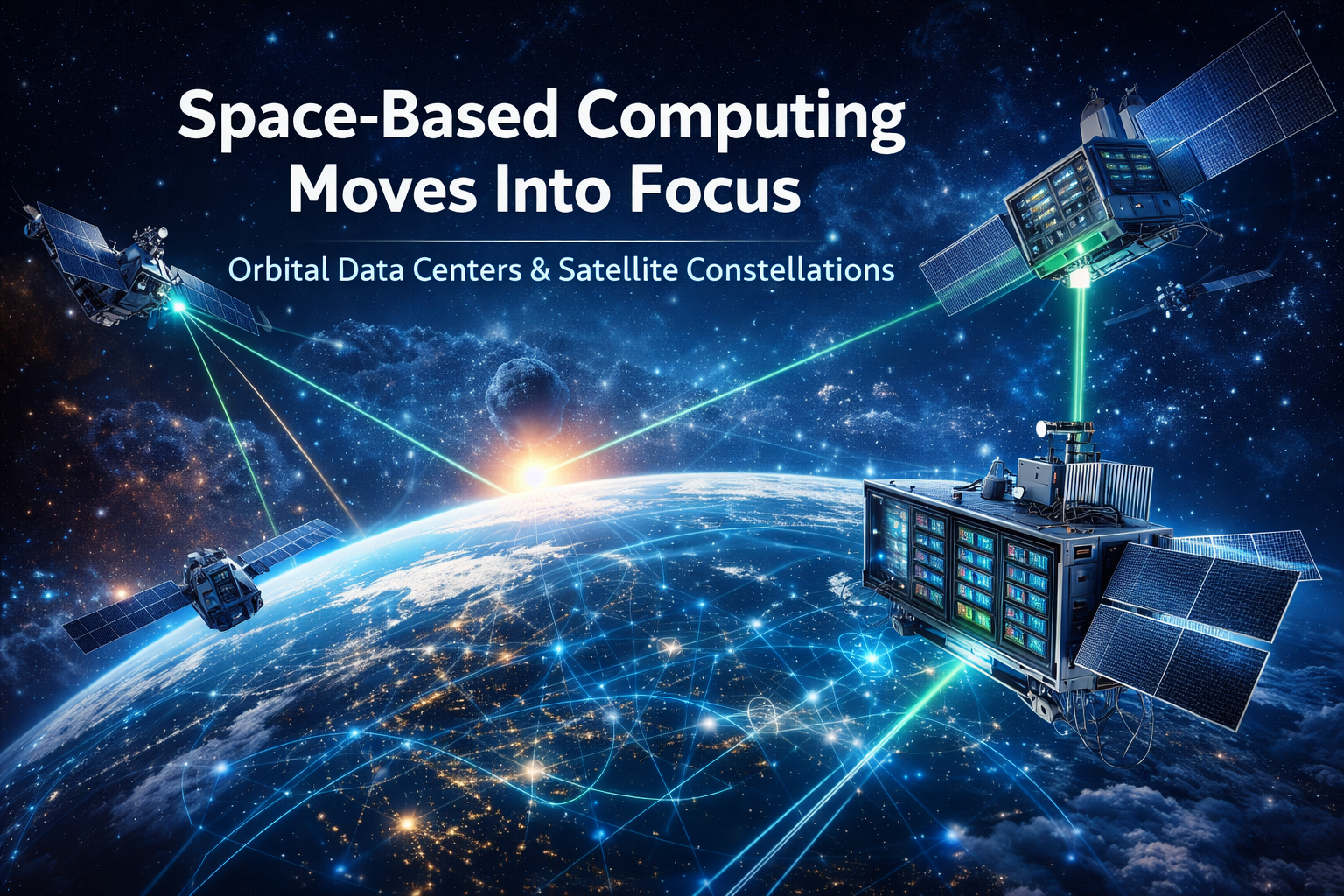
As governments and tech businesses seek beyond Earth to address growing demands for data and artificial intelligence, space-based computing has emerged as a major frontier in global space infrastructure in 2026. Space is currently being positioned as a platform for data processing, AI inference, and high-performance computing, after previously being used only for communication and observation.
Orbital computing is becoming a possibility because to improving satellite technologies and declining launch costs.
The Reasons Behind the Growing Adoption of Space-Based Computing
Interest in space-based computing is developing as artificial intelligence and communications become more integrated. Conventional models require that raw data be sent back to Earth for processing after being acquired in orbit. Delays and severe inefficiencies result from this.
Approximately 90% of data created in space is never handled efficiently, according to Li Chao, head of Zhejiang Lab’s space-based computing facility. Time-sensitive information would become much more valuable if it were processed immediately in orbit.
Another important consideration is energy efficiency. Low-Earth orbit and sun-synchronous satellites get almost constant sunshine, which makes them a reliable source of solar energy. Additionally, high-performance CPUs may benefit from the extreme cold of space, which lessens the need for power-hungry cooling systems like those used in ground-based data centers.
Orbital Data Centers and Satellite Constellations
Plans for large satellites have accelerated quickly. In an effort to create a massive network of orbiting data centers, SpaceX submitted applications on February 2 to deploy up to one million satellites. January
The magnitude of the international competition was further demonstrated by China’s submission of ideas including over 200,000 satellites.
This change was highlighted on January 26 during a meeting in Beijing, where the China Academy of Information and Communications Technology and many other organizations unveiled a collaborative project advocating for a “computing satellite network.”
China’s Space-Based Computing Strategy
Space-based computing has been incorporated into China’s long-range national strategy. During the 15th Five-Year Plan era, the China Aerospace Science and Technology Corporation has confirmed plans to build gigawatt-scale space computer facilities.
Leading the “Three-Body Computing Constellation,” which launches AI models straight into orbit, is Zhejiang Lab. By 2027, the initiative hopes to have 100 satellites in development, up from 39 at the moment.
Twelve computing satellites with a combined processing speed of 744 trillion operations per second were launched in May 2025. The network, which is connected by 100-gigabit-per-second laser lines, provides 30 terabytes of storage and five quadrillion operations per second.
These satellites are also a part of GuoXing Aerospace Technology’s “Star Computing” program, which aims to launch 2,800 computing satellites by 2030. The business created history in January when it launched the Qwen3 large language model into orbit.
Space-Based Data Center Challenges and Cost Prospects
Despite quick advancements, problems still exist. One of the most significant challenges is thermal control. Since heat may only be released through radiation in space, pressure is placed on radiator systems, internal heat transmission, and chip architecture.
Additional challenges include precise orbit management, dependable power systems, high-speed space-to-ground communications, and radiation-hardened semiconductors.
Cost will be the deciding factor. By 2030, space-based computing may be on par with Earth-based data centers in terms of cost, according to consultancy firm Starcloud, while Deutsche Bank predicts breakeven in 2032.
This timetable is being accelerated by developments in space photovoltaics and reusable launch vehicles. The outlook is further strengthened by China’s completely integrated solar supply chain and rising interest in lightweight perovskite solar technologies.