A Breakthrough in Planetary Science
Scientists have been perplexed by a peculiar phenomena for decades: why does Saturn seem to alter its rotation speed depending on how it is measured? This long-standing question has now been resolved thanks to ground-breaking observations made by the James Webb Space Telescope.
This finding changes our knowledge of planetary atmospheres and space habitats in addition to providing an answer to a basic question regarding Saturn.
The Mystery of Saturn’s Changing Spin
The confusion began when data from NASA’s Cassini spacecraft in 2004 suggested that Saturn’s rotation rate was changing over time.
This raised a major scientific problem.
Planets do not simply speed up or slow down their spin without a significant external force. Yet, measurements seemed to indicate otherwise. For years, astronomers struggled to explain this contradiction.
A Clue from Atmospheric Winds
In 2021, research led by Tom Stallard from Northumbria University proposed a crucial breakthrough.
The apparent changes in Saturn’s rotation were not real. Instead, they were caused by:
- Winds in Saturn’s upper atmosphere
- Electrical currents generated by these winds
- Distorted signals coming from the planet’s aurora
While this explained the illusion, one big question remained:
What was causing these powerful atmospheric winds?
JWST Provides the Missing Answer
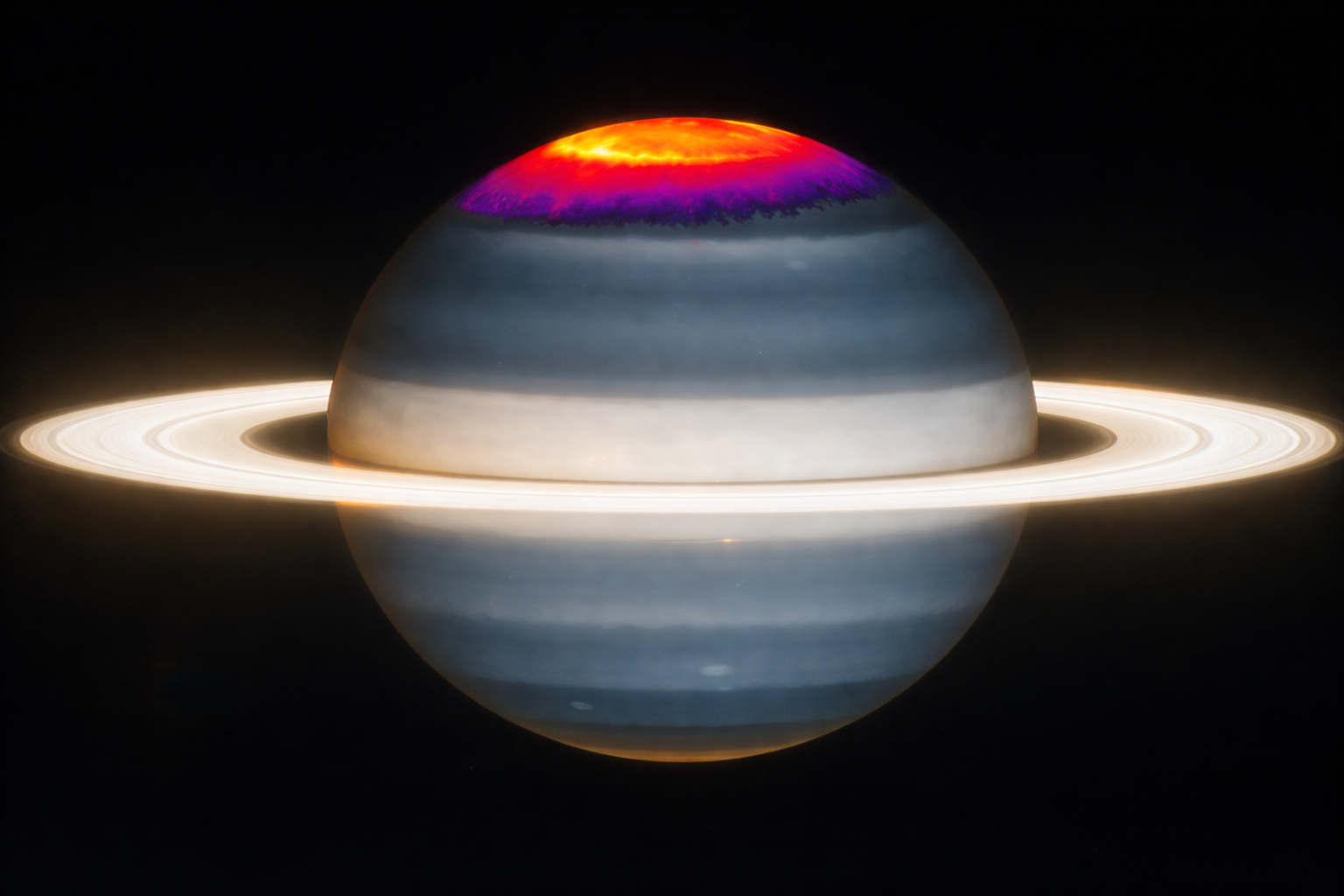
Using the powerful capabilities of the James Webb Space Telescope, researchers observed Saturn’s northern auroral region continuously for an entire Saturnian day.
This allowed scientists to collect highly detailed data that was previously impossible to obtain.
What Made JWST Different?
- 10× more accurate measurements than previous data
- Continuous observation of auroral activity
- High-resolution mapping of temperature and particle density
By studying the infrared glow of a molecule called trihydrogen cation (H₃⁺), scientists could precisely measure temperature changes in Saturn’s upper atmosphere.
The Discovery: A Self-Sustaining “Heat Pump”
The findings revealed something extraordinary.
Saturn’s aurora—similar to Earth’s northern lights—is not just a visual phenomenon. It plays a critical role in driving the planet’s atmospheric system.
How the Cycle Works:
- Aurora heats Saturn’s upper atmosphere
- This heating creates strong atmospheric winds
- Winds generate electrical currents
- These currents power the aurora
- The aurora continues heating the atmosphere
This creates a self-sustaining feedback loop, often described as a planetary heat pump.
Why Saturn Appears to Change Its Rotation
The electrical currents generated by this cycle interfere with how scientists measure Saturn’s rotation.
Instead of tracking the planet’s true spin, instruments detect signals influenced by:
- Atmospheric winds
- Auroral activity
- Magnetic field interactions
This creates the illusion that Saturn’s rotation rate is changing—when in reality, it remains constant.
A New Understanding of Planetary Systems
This discovery has implications far beyond Saturn.
It reveals a deep connection between:
- A planet’s atmosphere
- Its magnetic field (magnetosphere)
- Space environment interactions
The study suggests that planetary atmospheres can actively influence surrounding space, creating a two-way energy exchange system.
Broader Impact on Space Science
The findings could transform how scientists study other planets, both in our solar system and beyond.
According to researchers, understanding atmospheric behavior may help uncover:
- Hidden energy systems on other planets
- New types of space-weather interactions
- Previously unknown planetary processes
This opens exciting possibilities for future exploration and discovery.
The Role of JWST in Modern Astronomy
The James Webb Space Telescope continues to prove its value as the world’s most advanced space observatory.
Led by NASA in collaboration with European Space Agency and Canadian Space Agency, JWST is designed to:
- Explore distant galaxies
- Study exoplanets
- Investigate cosmic origins
- Solve mysteries within our own solar system
This latest discovery about Saturn highlights its incredible precision and potential.
Final Thoughts
The solution to Saturn’s “changing spin” mystery marks a major milestone in planetary science. What once seemed like an impossible phenomenon is now understood as a complex, self-sustaining system driven by auroral energy.
This breakthrough not only deepens our understanding of Saturn but also challenges scientists to rethink how planets interact with their environments.
As technology like the James Webb Space Telescope continues to advance, we can expect even more discoveries that will reshape our understanding of the universe.