NASA Mars Telecommunications Network: SpaceX, Blue Origin, and Rocket Lab Compete for Historic Mars Contract
Could Transform Future Mars Missions
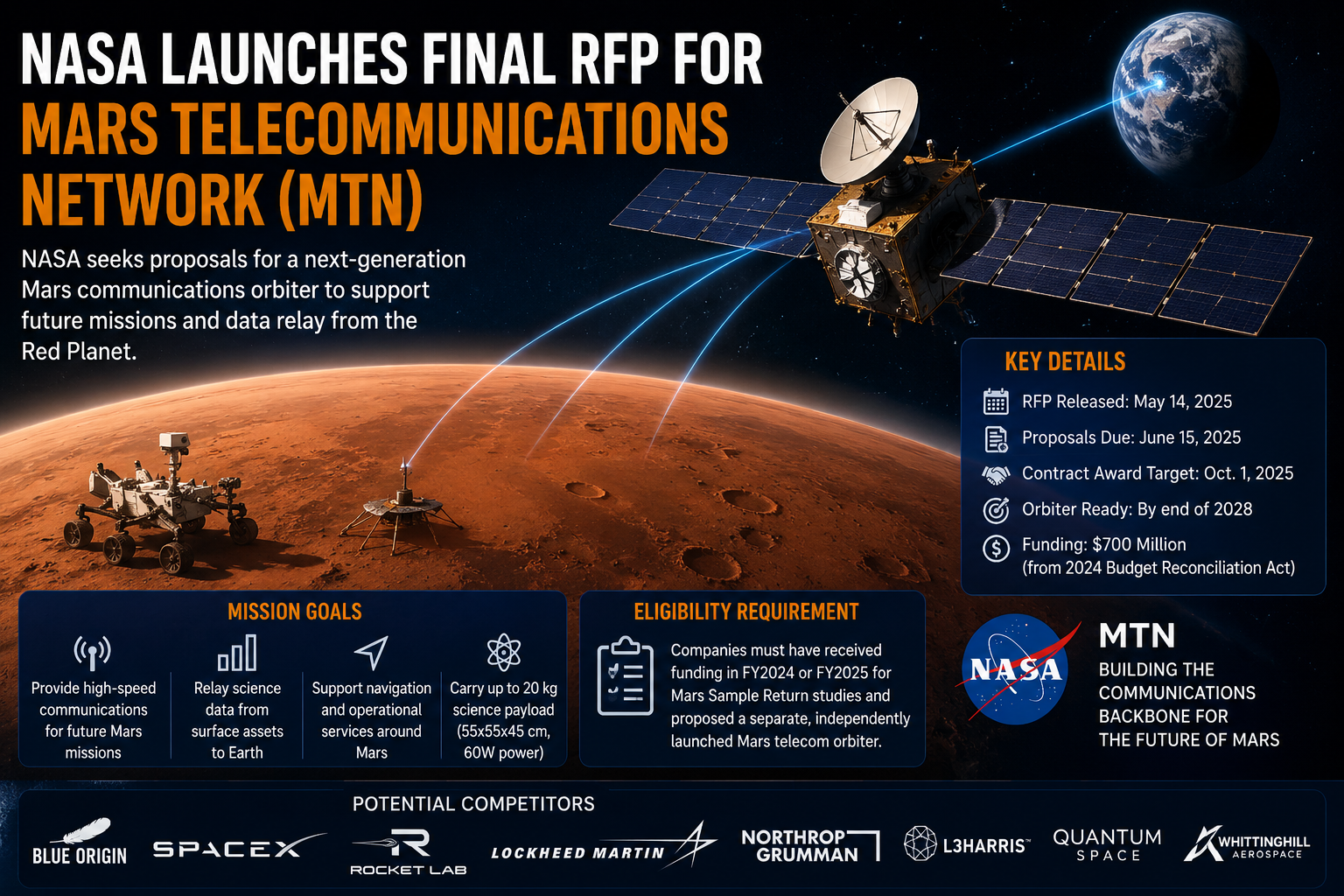
NASA is officially moving forward with one of its most important Mars infrastructure projects in years. The agency has released the final request for proposals (RFP) for the new Mars Telecommunications Network (MTN), a next-generation communications system designed to support future Mars exploration missions, data relay operations, and deep-space communications.
The ambitious Mars Telecommunications Network project could reshape the future of human and robotic exploration on the Red Planet. At the same time, it is creating intense competition among some of the world’s biggest aerospace and space technology companies, including Blue Origin, SpaceX, Rocket Lab, Lockheed Martin, and Northrop Grumman.
NASA’s new Mars telecommunications satellite system represents far more than a simple communications upgrade. It is part of a long-term strategy to build permanent infrastructure around Mars as the agency prepares for increasingly advanced robotic missions and eventual human exploration.
The project could become one of the most important space communication systems ever developed for interplanetary travel.
Why NASA Needs a New Mars Telecommunications Network
Currently, NASA relies heavily on aging Mars orbiters to relay data between spacecraft on the Martian surface and Earth. These orbiters were originally designed for scientific research missions but also serve as communication relays for Mars rovers, landers, and exploration systems.
However, many of these spacecraft are growing older and may not remain operational for much longer.
As NASA prepares for future missions involving:
- Mars sample return missions
- Advanced robotic exploration
- Human Mars mission planning
- AI-powered planetary research
- High-bandwidth scientific data transfer
the need for a dedicated Mars communication infrastructure has become increasingly urgent.
The new Mars Telecommunications Network aims to solve this problem by creating a modern orbital communications system specifically designed to support long-term Mars operations.
NASA wants the new Mars telecom orbiter operational by the end of 2028, making the timeline extremely aggressive for competing aerospace companies.
NASA Confirms Strict Eligibility Rules for the Mars Telecom Contract
One of the biggest developments surrounding the Mars Telecommunications Network involves the strict eligibility requirements included in the final contract proposal.
NASA confirmed that companies bidding for the project must meet special conditions connected to previous Mars Sample Return commercial studies funded during fiscal years 2024 and 2025.
According to the official requirements, eligible companies must have already proposed a separate independently launched Mars telecommunications orbiter as part of earlier Mars Sample Return mission concepts.
This rule dramatically limits the number of companies that can realistically compete for the contract.
The restrictions also sparked political attention in Washington after some lawmakers worried NASA might ignore the original intent of the legislation by opening the competition too broadly.
In response, NASA clarified that while the bidding process remains technically “full and open,” companies must still prove they meet the statutory eligibility conditions established by Congress.
The decision has effectively narrowed the competition to a small group of highly specialized aerospace firms already deeply involved in Mars exploration planning.
Which Companies Are Competing for NASA’s Mars Telecommunications Network?
A total of eight major aerospace companies reportedly participated in earlier Mars Sample Return commercial studies connected to the project.
These companies include:
- Blue Origin
- SpaceX
- Rocket Lab
- Lockheed Martin
- Northrop Grumman
- L3Harris
- Quantum Space
- Whittinghill Aerospace
However, NASA has not publicly revealed which companies specifically included Mars telecommunications orbiters in their original proposals.
Among all competitors, Blue Origin and Rocket Lab have emerged as some of the strongest public supporters of the Mars telecom orbiter concept.
Both companies have openly discussed plans to provide communications infrastructure, navigation systems, scientific payload support, and orbital relay services around Mars.
The competition is expected to intensify as NASA moves closer to selecting a contractor later this year.
Blue Origin’s Mars Orbiter Proposal Draws Attention
One of the most closely watched proposals comes from Blue Origin.
The company’s chief executive officer, Dave Limp, recently discussed the company’s Mars telecommunications strategy publicly.
According to Blue Origin, its proposed Mars Telecommunications Orbiter would be based on the company’s Blue Ring spacecraft platform.
The system is designed to provide:
- Deep-space communications
- Navigation services
- Data relay capabilities
- Scientific payload transportation
- Mars orbital infrastructure support
Blue Origin also claims the spacecraft could carry up to 500 kilograms of scientific instruments to Mars, significantly expanding research opportunities for future missions.
This combination of telecommunications and scientific support could make the proposal especially attractive to NASA as it looks for flexible multi-purpose Mars infrastructure.
NASA Expands Science Capabilities for the Mars Telecom Orbiter
The final request for proposals includes new requirements that were not part of the earlier draft version.
NASA now wants the spacecraft to support a dedicated scientific payload weighing up to 20 kilograms while operating within strict size and power limits.
According to the updated specifications, the science payload must:
- Fit within dimensions of 55 × 55 × 45 centimeters
- Operate using approximately 60 watts of power
- Function alongside telecommunications systems
This addition highlights NASA’s broader strategy of combining communication infrastructure with scientific exploration capabilities.
Rather than building a simple relay satellite, NASA appears interested in creating a versatile orbital platform capable of supporting both operational and research objectives around Mars.
That approach could help reduce mission costs while increasing scientific value.
Why the Mars Telecommunications Network Is So Important for Future Mars Exploration
The Mars Telecommunications Network represents a critical step toward building permanent infrastructure around Mars.
Future Mars missions will require far more advanced communications systems than those used today.
High-resolution video transmissions, autonomous robotics, AI-assisted navigation, scientific sensor networks, and eventually human astronauts will all require reliable high-bandwidth communications between Mars and Earth.
The current relay system was never designed to handle the enormous data demands expected from future missions.
NASA’s long-term vision includes creating a sustainable communication backbone capable of supporting continuous Mars exploration for decades.
This type of infrastructure is similar to how Earth-orbiting satellites support GPS, internet communications, and global data networks today.
In many ways, the Mars Telecommunications Network could become the first true interplanetary communications network in human history.
NASA’s 2028 Deadline Creates Intense Pressure
One major challenge facing the project is time.
NASA wants the Mars Telecommunications Network ready before the end of 2028, leaving only a few years for companies to finalize designs, build spacecraft, complete testing, and prepare for launch.
Deep-space missions are notoriously difficult and expensive, especially when dealing with:
- Interplanetary communications
- Radiation exposure
- Autonomous operations
- Long-distance navigation
- Mars orbital insertion
- High-reliability hardware systems
Any delays could impact future Mars missions that depend on the network for communication support.
Because of this, NASA will likely prioritize companies with proven spacecraft development experience and existing deep-space infrastructure capabilities.
The Future of Mars Infrastructure Is Beginning Now
The release of NASA’s final Mars Telecommunications Network proposal marks a major moment in the future of space exploration.
For decades, Mars missions focused primarily on short-term science experiments and robotic exploration. Now, the focus is shifting toward building long-term infrastructure capable of supporting sustained activity around the Red Planet.
The Mars telecom orbiter could eventually become the foundation for:
- Future Mars colonies
- Human astronaut missions
- AI-powered exploration systems
- Autonomous robotic networks
- Interplanetary internet systems
- Continuous scientific operations
As aerospace giants like Blue Origin, SpaceX, and Rocket Lab compete for the contract, the project is becoming one of the most important commercial space opportunities in the industry.
NASA’s decision in the coming months could shape the future of Mars exploration, deep-space communication technology, and humanity’s long-term expansion beyond Earth.