Why Professionals Must Protect Sensitive Data Before Using AI Tools
The Hidden AI Privacy Problem Most ChatGPT, Gemini, and Claude Users Ignore
Artificial intelligence tools like OpenAI ChatGPT, Google Gemini, Anthropic Claude, Perplexity, Grok, and Qwen have completely transformed the modern workplace. Today, millions of professionals rely on AI chatbots for writing reports, analyzing documents, generating code, drafting contracts, handling customer support, and improving productivity.
AI assistants are now deeply integrated into industries including healthcare, finance, legal services, human resources, cybersecurity, and software development.
But behind this explosive AI revolution lies a dangerous cybersecurity and compliance issue that most people rarely discuss.
Every day, employees unknowingly paste highly sensitive personal information directly into AI chatbots without understanding where that data goes, how it is processed, or whether it remains private.
That hidden risk is becoming one of the biggest data privacy challenges of the AI era.
Why Copy-Pasting Sensitive Data Into AI Chatbots Is Dangerous
Most professionals use AI tools because they are fast, intelligent, and incredibly convenient. However, convenience often comes at the cost of privacy and data security.
When users paste confidential information into AI platforms, they may unknowingly expose:
- Client names
- Email addresses
- Phone numbers
- Financial records
- Social security numbers
- Medical information
- Employee data
- Legal contracts
- Customer databases
- Proprietary business information
This type of information is commonly known as Personally Identifiable Information (PII).
The major issue is that many AI chatbot platforms may temporarily process, store, or review user prompts to improve future AI models unless users specifically disable those settings.
Most people never change default privacy configurations because they either do not know the settings exist or assume their conversations remain fully private.
That misunderstanding creates significant cybersecurity, compliance, and legal risks for businesses worldwide.
AI Privacy Risks Could Violate GDPR, HIPAA, and CCPA Regulations
The growing use of AI tools inside workplaces has created serious concerns among regulators and privacy experts.
Organizations operating in regions covered by privacy laws such as:
- GDPR (General Data Protection Regulation)
- HIPAA (Health Insurance Portability and Accountability Act)
- CCPA (California Consumer Privacy Act)
must follow strict rules regarding personal data protection and confidential information handling.
Pasting unredacted sensitive information into third-party AI systems could potentially violate these regulations.
For example:
- Healthcare providers risk exposing patient records
- HR departments may leak employee information
- Legal firms could compromise confidential case details
- Financial institutions may reveal customer financial data
- Software developers might expose production databases or API keys
The consequences of an accidental data leak can be devastating.
Businesses could face:
- Massive regulatory fines
- Client lawsuits
- Compliance investigations
- Reputational damage
- Loss of customer trust
- Cybersecurity breaches
As artificial intelligence adoption continues growing rapidly, experts warn that AI data governance is becoming a critical business priority.
Real-World AI Data Leaks Have Already Happened
These privacy concerns are not theoretical.
Several major incidents have already demonstrated how dangerous careless AI usage can become.
One of the most famous examples involved Samsung engineers accidentally leaking sensitive proprietary source code into ChatGPT while using the tool for development assistance.
The incident reportedly forced Samsung to temporarily restrict employee use of generative AI platforms.
Similarly, Italy temporarily blocked ChatGPT over concerns related to GDPR compliance, data collection practices, and user privacy protections.
Governments, regulators, and cybersecurity professionals worldwide are now paying closer attention to how AI companies process user information.
As generative AI becomes more powerful, protecting confidential business data is becoming more important than ever.
The Rise of Zero-Trust AI Security Solutions
Many companies initially attempted to solve the problem by banning AI tools entirely inside the workplace.
However, that strategy is becoming increasingly unrealistic.
Artificial intelligence now provides enormous productivity benefits, and employees continue using AI tools regardless of restrictions. In many industries, AI has already become essential for daily operations.
Instead of banning AI, cybersecurity experts are increasingly promoting a “Zero-Trust AI” approach.
The core principle is simple:
Sensitive data should never reach external AI systems in its raw form.
That means businesses must sanitize, redact, or mask confidential information before submitting it to AI chatbots.
This is where modern AI privacy tools are becoming extremely important.
How PrivacyScrubber Protects Sensitive Data Before It Reaches AI
One emerging solution attracting attention is PrivacyScrubber, a client-side AI privacy and PII sanitization tool designed specifically for professionals using AI daily.
The concept behind the tool is straightforward but powerful.
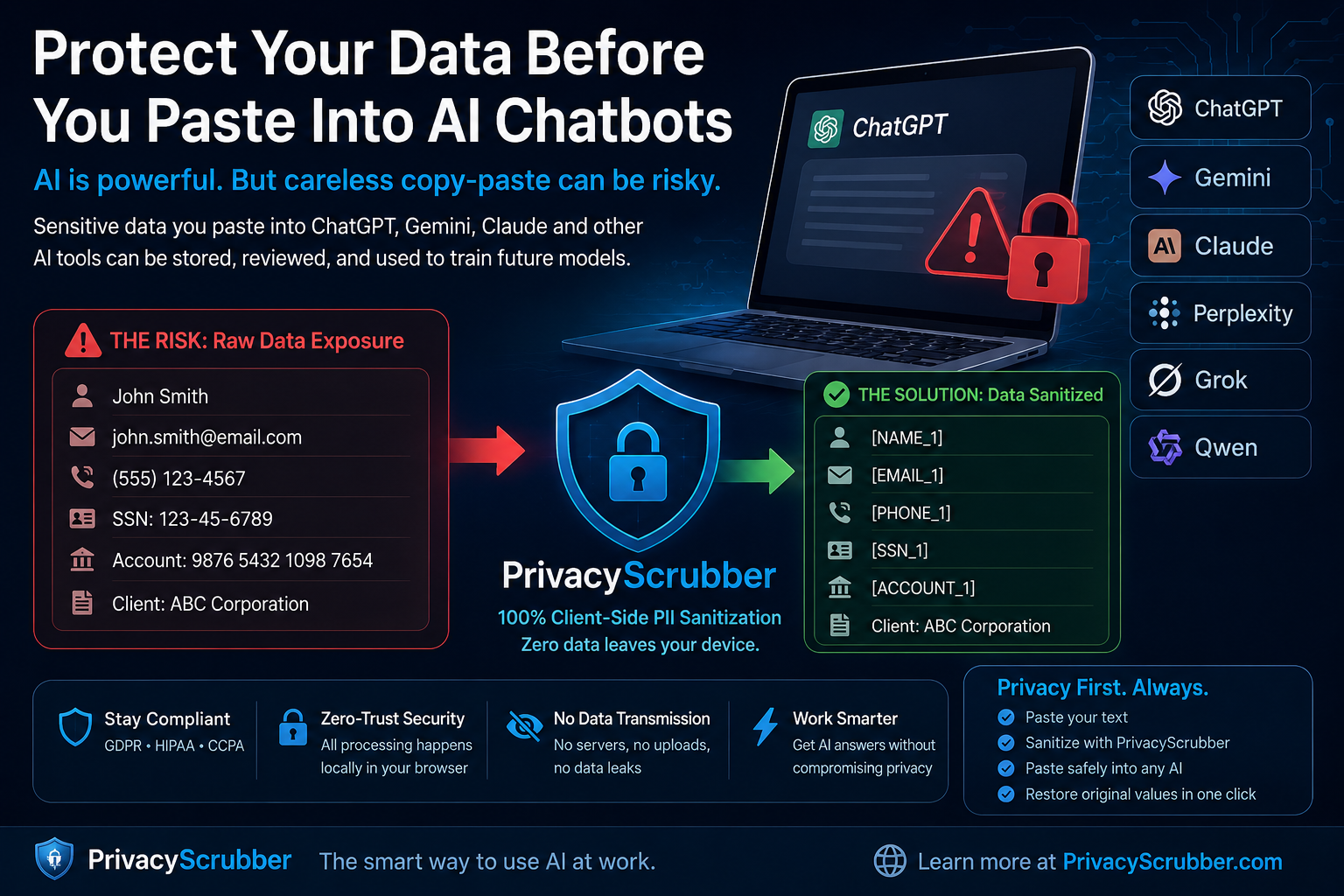
Before pasting information into ChatGPT, Gemini, Claude, or other AI assistants, users first process their text through PrivacyScrubber.
The software automatically detects sensitive identifiers such as:
- Names
- Emails
- Phone numbers
- Identification numbers
- Financial details
- Personal records
- Addresses
- Confidential references
It then replaces them with neutral placeholders like:
- [NAME_1]
- [EMAIL_2]
- [PHONE_3]
Users can safely send the sanitized version to the AI chatbot without exposing real confidential information.
After receiving the AI-generated response, the original values can be restored instantly.
This process dramatically reduces the risk of exposing sensitive information to external AI systems.
Why Local Processing Matters for AI Privacy and Cybersecurity
One of the biggest differentiators in AI privacy tools is whether processing happens locally or through cloud servers.
Ironically, many privacy platforms themselves rely on cloud infrastructure, which introduces another layer of privacy risk.
PrivacyScrubber takes a different approach by operating entirely inside the user’s browser.
According to its design principles:
- No backend servers are involved
- No user accounts are required
- No information is transmitted externally
- No data leaves the device
- Processing remains completely local
This “client-side processing” model aligns closely with Zero-Trust cybersecurity principles because it minimizes external exposure entirely.
Even if the internet connection is disabled after loading the tool, it can reportedly continue functioning normally.
For privacy-conscious professionals, local AI data masking offers a much safer workflow compared to cloud-based processing systems.
Which Professionals Face the Biggest AI Privacy Risks?
While nearly everyone using AI tools should think about privacy, certain industries face significantly higher risks due to the nature of their work.
High-risk professionals include:
Legal Professionals
Law firms regularly handle confidential contracts, lawsuits, and sensitive client communications.
Healthcare Providers
Doctors, hospitals, and medical staff manage highly protected patient records and medical histories.
Human Resources Teams
HR departments process resumes, payroll information, employee records, and internal investigations.
Financial Analysts
Banks and financial firms handle customer portfolios, investment records, tax information, and banking data.
Software Developers
Developers frequently paste real application logs, user databases, source code, and API credentials into AI systems for debugging.
For these industries, even a single AI-related privacy mistake could trigger enormous consequences.
AI Data Privacy Will Become One of the Biggest Tech Challenges of the Decade
Artificial intelligence is rapidly becoming a core part of modern business operations, but AI privacy and compliance challenges are growing just as quickly.
As more professionals rely on ChatGPT, Gemini, Claude, and similar AI tools, the importance of protecting personally identifiable information will continue increasing.
Zero-Trust AI workflows, local data masking, browser-based sanitization tools, and privacy-first AI practices may soon become standard cybersecurity requirements across many industries.
The future of AI is not just about smarter models or faster automation.
It is also about building systems that protect human privacy, safeguard confidential information, and reduce the risks of accidental data exposure.
Businesses that ignore these risks today may face serious legal, financial, and reputational consequences tomorrow.
In the age of artificial intelligence, protecting sensitive data before it reaches AI systems may become one of the most important cybersecurity habits professionals can adopt.