What the Massive Fireball Reveals About Earth’s Cosmic Vulnerability
A Powerful Fireball Lights Up the Sky and Shakes Homes Across the Northeast
A dramatic celestial event captured the attention of thousands across the northeastern United States when a meteor exploded high above the region, creating a powerful shockwave that rattled homes and generated loud booms heard across multiple states.
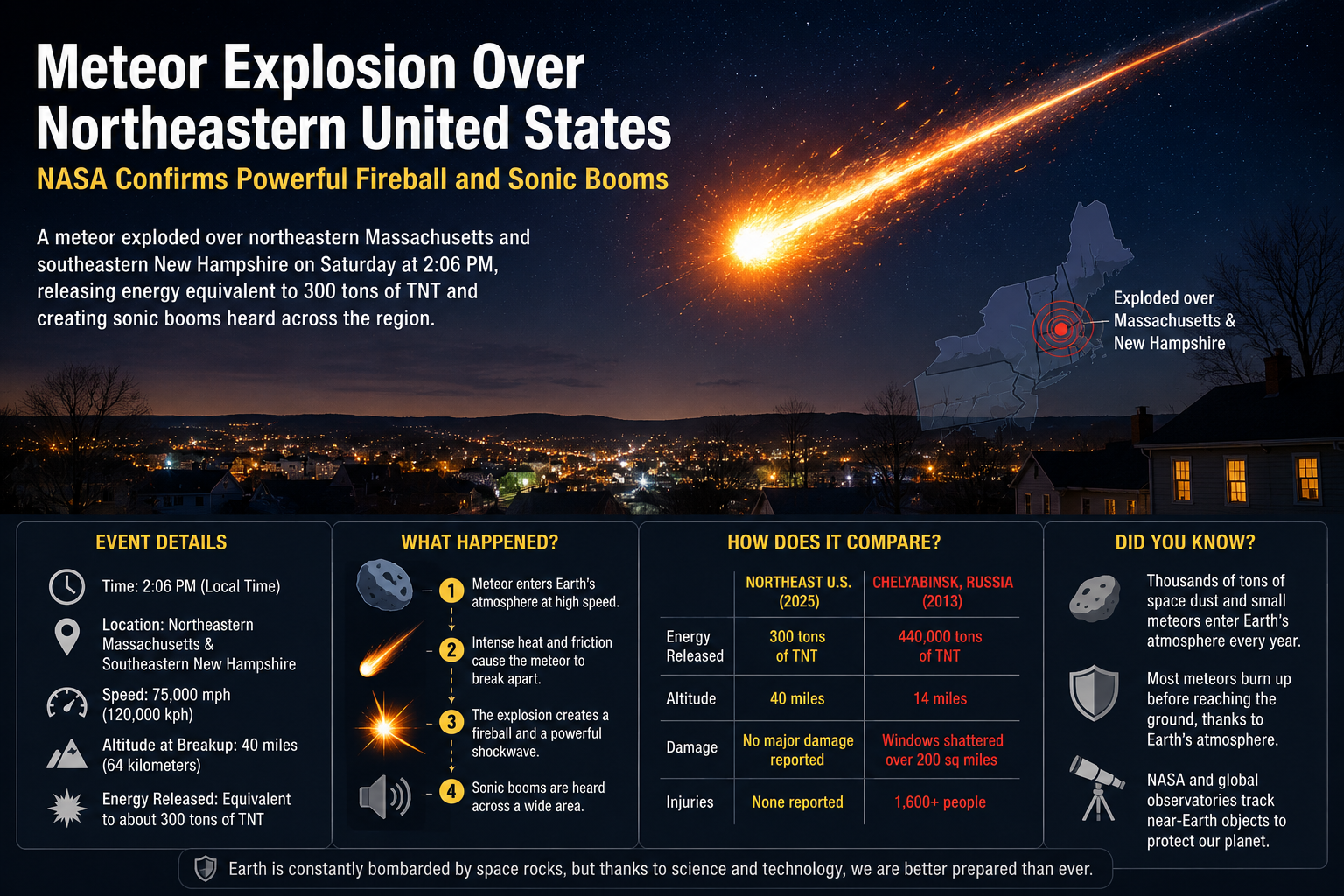
According to NASA, the meteor entered Earth’s atmosphere on Saturday afternoon and disintegrated over northeastern Massachusetts and southeastern New Hampshire at approximately 2:06 PM local time. While no injuries or damage have been reported, the event serves as a striking reminder that Earth remains under constant bombardment from space debris, most of which goes unnoticed.
The explosion released energy equivalent to approximately 300 tons of TNT, making it one of the more significant meteor airbursts observed over the United States in recent years. Residents across the region reported hearing thunder-like booms and feeling vibrations strong enough to shake windows and walls.
While the event was harmless compared to larger historical impacts, it highlights the growing importance of planetary defense, space monitoring, and public awareness of near-Earth objects.
What Exactly Happened?
NASA officials reported that the meteor was traveling at an astonishing speed of approximately 75,000 miles per hour (120,000 kilometers per hour) when it entered Earth’s atmosphere.
As the space rock encountered increasing atmospheric pressure and friction, it rapidly heated up and ultimately exploded at an altitude of roughly 40 miles above Earth’s surface.
The resulting phenomenon, commonly known as a “fireball,” produced a brilliant flash of light followed by a sonic boom powerful enough to be heard across a wide area.
Importantly, NASA confirmed that the object was:
- A natural meteor
- Not part of any active meteor shower
- Not a falling satellite
- Not space debris re-entering Earth’s atmosphere
This clarification helped eliminate speculation that the explosion was related to human-made objects.
Why Did People Hear Such Loud Booms?
One of the most surprising aspects of the event was the intensity of the sound.
Many residents initially believed an earthquake, explosion, or military activity had occurred because the booms were loud enough to shake buildings.
The explanation lies in the enormous energy released during the breakup.
When meteors travel through the atmosphere at tens of thousands of miles per hour, they compress air in front of them. Once the object fragments or explodes, that compressed energy is released as a shockwave.
In this case, NASA estimated the blast energy at approximately 300 tons of TNT.
Although significant, this was still relatively small compared to some of history’s most famous meteor explosions.
Comparing the Event to the Chelyabinsk Meteor
Whenever a major fireball appears over populated areas, comparisons inevitably arise with the famous Chelyabinsk meteor event in Russia.
On February 15, 2013, a house-sized asteroid exploded approximately 14 miles above Chelyabinsk, Russia.
The results were dramatic:
| Event | Estimated Energy Release |
|---|---|
| Massachusetts-New Hampshire Meteor (2025) | 300 tons TNT |
| Chelyabinsk Meteor (2013) | 440,000 tons TNT |
The Chelyabinsk explosion was nearly 1,500 times more powerful.
The shockwave shattered windows across hundreds of square miles and injured more than 1,600 people, primarily from flying glass.
The recent U.S. event was far smaller, but it demonstrates how even relatively modest meteors can create noticeable effects on the ground.
Why Earth Encounters Meteors So Frequently
Many people assume meteor events are rare, but Earth’s atmosphere is constantly interacting with space material.
Scientists estimate that:
- Thousands of tons of cosmic dust enter Earth’s atmosphere every year.
- Small meteors burn up daily.
- Fireballs occur regularly worldwide.
- Larger asteroid impacts are considerably less common.
Most objects never reach the ground because atmospheric friction destroys them long before impact.
In many ways, Earth’s atmosphere acts as a protective shield, absorbing and dispersing the energy of incoming objects.
Without this natural defense system, life on Earth would face significantly greater risks from space.
The Growing Importance of Planetary Defense
Events like this highlight why governments and space agencies are investing heavily in asteroid detection and planetary defense programs.
Over the past decade, organizations such as NASA and international space agencies have dramatically expanded efforts to identify potentially hazardous near-Earth objects (NEOs).
One major milestone came with NASA’s DART (Double Asteroid Redirection Test) mission, which successfully demonstrated that humanity can alter the trajectory of an asteroid through a controlled impact.
The recent meteor explosion poses no threat to planetary safety, but it reinforces an important reality:
Not all incoming objects are detected before entering Earth’s atmosphere.
As telescope networks improve and AI-powered tracking systems become more sophisticated, scientists hope to identify potentially dangerous objects years—or even decades—in advance.
What This Means for the Future of Space Monitoring
The northeastern fireball may also provide valuable scientific data.
Every meteor event offers researchers an opportunity to better understand:
- Asteroid composition
- Atmospheric interactions
- Fragmentation patterns
- Shockwave behavior
- Impact risk assessment
Advancements in satellite monitoring, ground-based sensors, radar systems, and artificial intelligence are transforming how scientists study these phenomena.
In the future, AI-powered detection networks could enable near-instant alerts whenever significant meteors enter Earth’s atmosphere.
This would improve public awareness and help reduce confusion when sonic booms occur unexpectedly.
Could a Larger Meteor Strike Earth?
The short answer is yes—but the probability of a civilization-threatening impact remains extremely low.
Scientists track thousands of near-Earth asteroids every year. Most pose no danger, and many are discovered decades before any potential close approach.
However, smaller objects similar to the Chelyabinsk meteor are much harder to detect because of their size.
Experts believe the greatest near-term risk comes not from giant extinction-level asteroids but from medium-sized objects capable of causing regional damage.
This is why continued investment in space surveillance and planetary defense remains essential.
Unique Insight: AI May Become Earth’s First Line of Defense
One emerging trend is the use of artificial intelligence in asteroid detection.
Traditional systems rely heavily on astronomers manually reviewing telescope observations. AI can process millions of observations far faster than humans, identifying potential threats that might otherwise be missed.
Over the next decade, machine learning systems could revolutionize planetary defense by:
- Detecting asteroids earlier
- Predicting trajectories more accurately
- Improving impact probability models
- Coordinating global response strategies
The future of planetary protection may depend as much on advanced software as it does on powerful telescopes.
Suggested Visuals for Your Blog
Infographic: How a Meteor Becomes a Fireball
Show the journey from space entry to atmospheric explosion.
Comparison Chart
Meteor Event vs Chelyabinsk Explosion
- Speed
- Altitude
- Energy Release
- Damage Potential
Timeline Graphic
Major Meteor Events in Modern History:
- Tunguska (1908)
- Chelyabinsk (2013)
- Northeastern U.S. Fireball (2025)
Planetary Defense Diagram
Illustrate how NASA tracks near-Earth objects and potential threats.
Final Thoughts
The meteor explosion over Massachusetts and New Hampshire was a spectacular reminder that Earth exists within a dynamic cosmic environment. While the event posed no danger to the public, its powerful shockwave captured widespread attention and demonstrated the incredible energies involved when even relatively small space rocks encounter our atmosphere.
As technology advances and planetary defense systems become more sophisticated, humanity is better prepared than ever to monitor and understand these events. Nevertheless, every fireball serves as an important reminder that our planet is part of a much larger and constantly changing universe.
Join the Conversation
Were you in the northeastern United States when the fireball exploded?
Do you think governments should invest more heavily in asteroid detection and planetary defense programs?
Share your thoughts in the comments below and join the discussion about Earth’s ongoing relationship with the cosmos.