Mystery After 100 Years of Research
DAMPE Space Telescope Discovers Hidden Cosmic Ray Pattern That Could Transform Astrophysics
For more than a century, cosmic rays have remained one of the biggest mysteries in modern astrophysics. These ultra-powerful particles constantly travel through the universe at nearly the speed of light, carrying enormous amounts of energy across galaxies. Despite decades of scientific research, astronomers and physicists have struggled to fully explain where cosmic rays originate, how they gain such extreme energy, and what hidden laws control their movement through space.
Now, a groundbreaking discovery by scientists using the Dark Matter Particle Explorer, better known as DAMPE, may finally provide one of the most important answers yet.
Researchers studying high-energy cosmic rays have identified a mysterious universal pattern shared by different types of cosmic particles. The discovery could reshape our understanding of cosmic ray acceleration, particle physics, dark matter research, and the violent astrophysical events that shape our universe.
The findings are already being described as a major breakthrough in space science and high-energy astrophysics.
What Are Cosmic Rays and Why Are Scientists So Interested in Them?
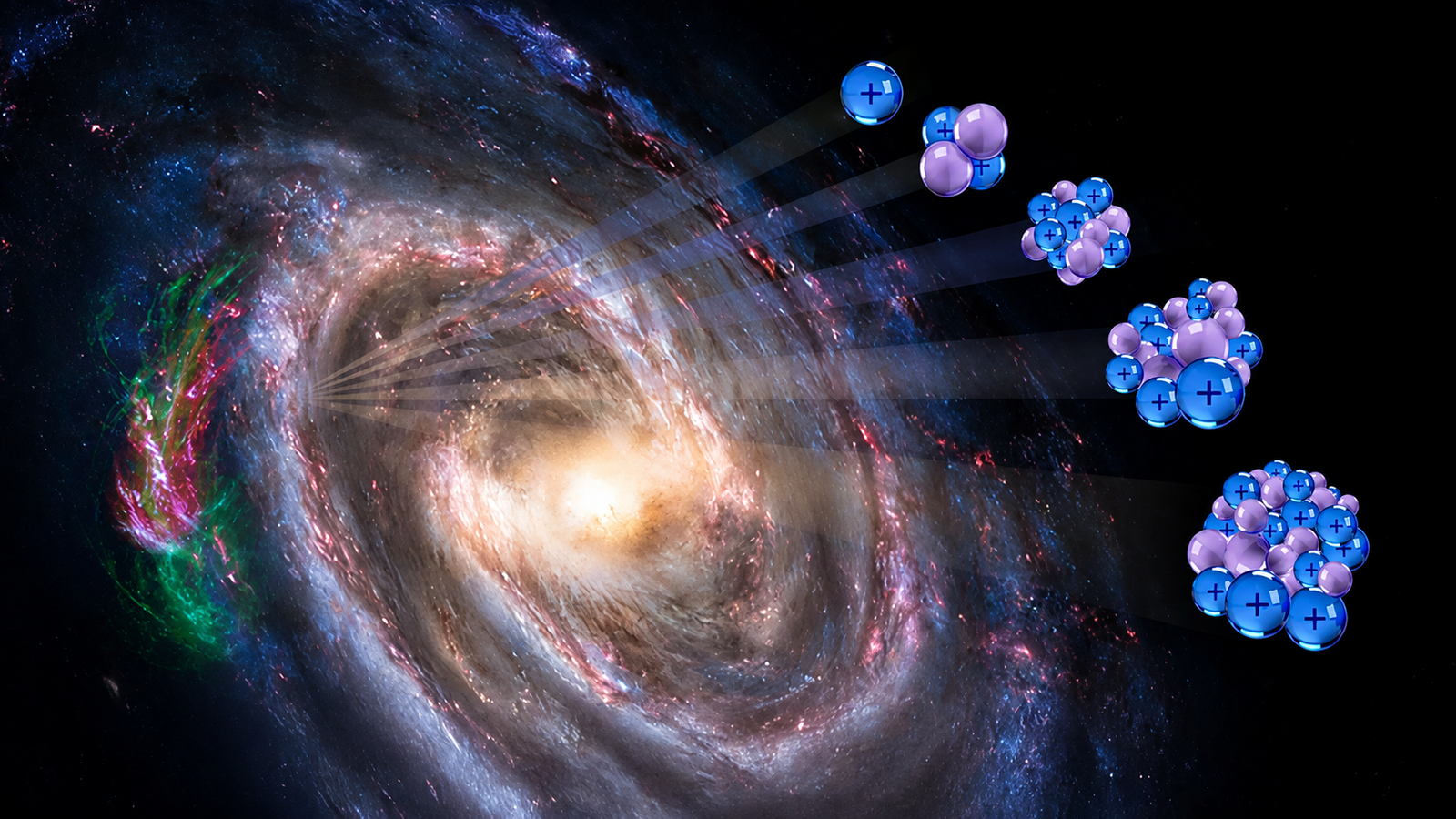
Cosmic rays are among the most energetic particles ever observed in nature. These particles travel through outer space at extraordinary speeds and carry far more energy than particles produced in even the world’s most advanced laboratories and particle accelerators.
Most cosmic rays are made up of protons, but they also include helium, carbon, oxygen, iron nuclei, and other atomic particles. Scientists believe these particles are generated by some of the most violent and powerful events in the universe.
Possible cosmic ray sources include:
- Supernova explosions
- Pulsars
- Black hole jets
- Active galactic nuclei
- Stellar shockwaves
- Extreme magnetic fields
For decades, researchers have tried to understand how these cosmic particles are accelerated to such enormous energies and how they travel across interstellar space.
The challenge has been that cosmic rays behave unpredictably, making them extremely difficult to study.
That is why the latest DAMPE discovery is attracting global attention in the scientific community.
DAMPE Space Telescope Uncovers a Hidden Universal Cosmic Ray Pattern
Launched in 2015, the DAMPE space telescope was specifically designed to study cosmic rays, dark matter, and high-energy particles traveling through space.
The mission combines advanced detectors, artificial intelligence systems, and precision measurement tools to analyze incoming cosmic particles with exceptional accuracy.
After years of collecting data, scientists discovered something remarkable.
Researchers found that multiple types of cosmic ray particles — from lightweight protons to massive iron nuclei — all begin losing intensity sharply at almost the exact same energy threshold.
This effect is known as “spectral softening.”
Normally, the number of high-energy cosmic rays gradually decreases as energy levels rise. However, DAMPE observations revealed that the decline suddenly becomes much steeper beyond a rigidity level of approximately 15 TV (teraelectron-volts).
This consistent pattern appearing across completely different particle types strongly suggests that a universal rule governs how cosmic rays move through the galaxy.
That discovery could help scientists finally understand the hidden mechanics behind cosmic ray acceleration and propagation.
Scientists Believe Rigidity Controls Cosmic Ray Behavior
One of the most important parts of the DAMPE discovery involves something physicists call “rigidity.”
Rigidity measures how resistant a particle’s path is to bending when exposed to magnetic fields in space. In simple terms, it determines how cosmic rays travel through galactic magnetic environments.
The DAMPE findings strongly support theories suggesting that rigidity — not simply energy alone — controls the behavior of cosmic rays.
Because the same spectral softening pattern appears across many different particle types, scientists now believe cosmic ray acceleration follows a universal rigidity-based process.
This is extremely important because it eliminates several older competing theories.
According to researchers, the confidence level against alternative explanations reached an astonishing 99.999%, making the rigidity-based interpretation incredibly convincing.
This level of statistical confidence is considered exceptionally strong in physics and astrophysics research.
Artificial Intelligence Helped Scientists Analyze Cosmic Rays
Artificial intelligence played a major role in this historic space discovery.
Researchers from University of Geneva and other international institutions developed advanced AI algorithms capable of reconstructing particle events detected by DAMPE.
The enormous amount of data generated by cosmic ray observations would have been nearly impossible to analyze manually. AI systems allowed scientists to identify hidden particle patterns, energy signatures, and movement behaviors with far greater precision.
The research team also conducted detailed measurements involving:
- Proton flux
- Helium flux
- Carbon nuclei
- Heavy particle trajectories
- High-energy cosmic particle interactions
Artificial intelligence is becoming increasingly important in modern astrophysics, especially as telescopes and detectors continue generating massive amounts of complex scientific data.
The DAMPE discovery highlights how AI and space science are now working together to unlock some of the universe’s deepest mysteries.
The Silicon-Tungsten Tracker Played a Critical Role in the Discovery
Another major component behind the breakthrough was the advanced Silicon-Tungsten Tracker, commonly known as the STK detector.
This sophisticated instrument was designed to precisely track incoming cosmic ray particles and identify their electrical charge.
The STK detector allows scientists to trace particle paths with extraordinary accuracy, helping researchers determine how different cosmic rays behave under extreme astrophysical conditions.
Without this technology, detecting the universal cosmic ray pattern would have been far more difficult.
The detector also improves measurements involving particle rigidity, which became central to the discovery itself.
Modern astrophysics increasingly depends on ultra-sensitive instruments like the STK to study invisible or extremely distant cosmic phenomena.
Why This Discovery Could Change Our Understanding of the Universe
The DAMPE findings are important far beyond cosmic ray research alone.
Understanding cosmic rays could eventually help scientists answer some of the biggest questions in astrophysics and cosmology, including:
- How particles gain extreme energy in space
- How galaxies generate high-energy radiation
- How magnetic fields shape the universe
- The relationship between cosmic rays and dark matter
- The physics behind supernova explosions
- The structure of interstellar space
The discovery also places tighter restrictions on existing astrophysical models, forcing scientists to rethink how high-energy particles are accelerated and transported through galaxies.
In many ways, the new cosmic ray pattern acts like a hidden fingerprint of the universe’s most violent astrophysical processes.
Researchers believe future studies could uncover even deeper universal laws governing high-energy particles.
Cosmic Ray Research Enters a New Era
For over 100 years, cosmic rays remained one of the most puzzling unsolved mysteries in space science. Scientists knew these particles carried extraordinary energy, but they lacked clear evidence explaining the universal mechanisms controlling them.
Now, thanks to the DAMPE space telescope and cutting-edge artificial intelligence analysis, researchers finally have one of the strongest clues yet.
The discovery of a shared rigidity-based cosmic ray pattern represents a major step toward solving a century-old astrophysics mystery.
It also demonstrates how modern space technology, AI systems, and advanced detectors are transforming humanity’s understanding of the universe.
As scientists continue studying cosmic rays and deep-space particle physics, the DAMPE findings may eventually help unlock entirely new insights into dark matter, black holes, supernova explosions, and the fundamental laws of nature itself.
The universe still holds countless mysteries — but after 100 years of searching, humanity may finally be getting closer to understanding one of its most powerful hidden forces.