Why Many Employees Still Refuse to Use Artificial Intelligence
AI in the Workplace 2026: Rising Adoption, Growing Resistance
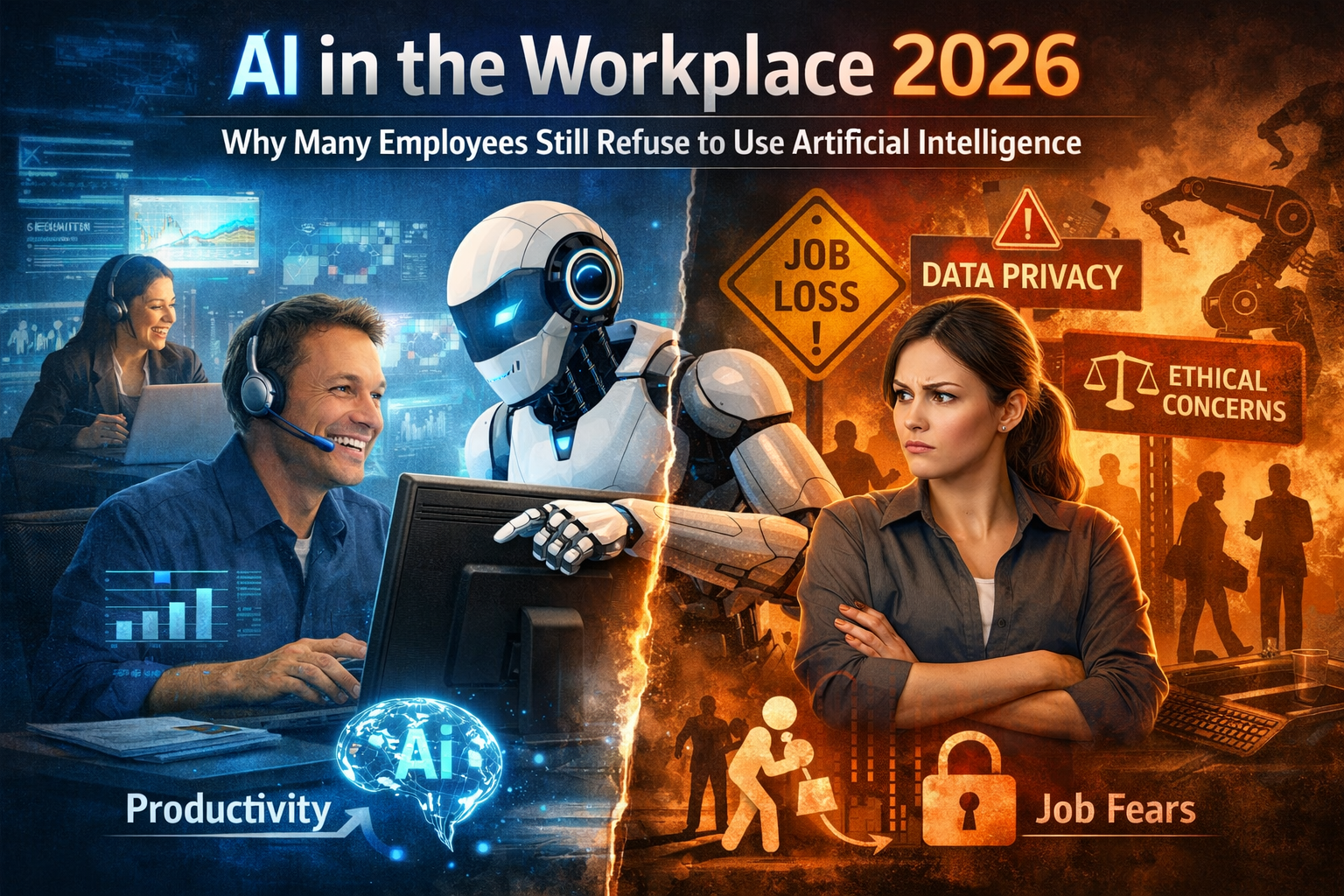
Artificial intelligence (AI) is rapidly transforming modern workplaces, boosting productivity and reshaping how employees perform daily tasks. However, despite its growing presence, a significant number of workers are still hesitant—or even unwilling—to use AI tools.
A recent survey by Gallup highlights a fascinating divide: while many employees are embracing AI to improve efficiency, others remain skeptical due to concerns about job security, ethics, and data privacy.
More Employees Are Using AI—But Not Everyone Is Onboard
According to the latest findings, around 30% of employees use AI frequently, meaning daily or several times a week. Another 20% use it occasionally, while nearly half of workers rarely or never use AI at all.
This shows a clear split in adoption. Even though many organizations are introducing AI tools to streamline operations, not every employee is convinced of their value.
AI Boosts Productivity for Many Workers
For those who do use AI, the benefits are hard to ignore.
- Nearly two-thirds of AI users report improved productivity
- AI helps automate repetitive tasks and speed up workflows
- It assists in drafting emails, reports, and research
Professionals in management, healthcare, and technology sectors are seeing the biggest gains. In fact, about 70% of leaders using AI say it has made them more efficient, compared to just over half of non-managerial employees.
Many workers now rely on AI tools like ChatGPT to:
- Write professional emails
- Generate ideas
- Simplify complex tasks
This growing reliance highlights AI’s potential as a powerful workplace assistant.
Why Some Employees Refuse to Use AI
Despite the advantages, a large group of employees remains resistant. The reasons vary:
1. Preference for Traditional Work Methods
Nearly 46% of non-users say they simply prefer doing their work the way they always have.
2. Ethical Concerns
Some workers are uncomfortable with AI’s impact on society, including:
- Job displacement
- Bias in algorithms
- Over-reliance on automation
3. Data Privacy Fears
Many employees worry about how AI tools handle sensitive information, especially in industries like law, healthcare, and government.
4. Lack of Trust in Accuracy
AI is not perfect. Issues like hallucinations—where AI generates incorrect or misleading information—make some professionals hesitant to rely on it.
5. Skill Gap
Some employees feel they don’t know how to use AI effectively, which prevents them from adopting it.
Growing Fear of Job Loss Due to AI
One of the biggest concerns surrounding AI is job security.
- About 18% of workers believe their jobs could disappear within five years due to AI and automation
- This is an increase from 15% the previous year
- Workers in companies already using AI feel even more at risk
At the same time, public opinion reflects similar fears. Many believe AI will eliminate more jobs than it creates in the near future.
The Human vs. Machine Debate
While AI can automate tasks, it still struggles to replace human connection, creativity, and emotional intelligence.
For example:
- Social workers rely on empathy and personal interaction
- Lawyers need critical thinking and judgment
- Healthcare professionals provide human care that machines cannot replicate
Some workers believe AI will eventually replace many roles, while others see it as a tool that enhances human capability rather than replacing it.
The Future of AI in the Workplace
The workplace of the future will likely be a mix of human skills and AI support. Employees who adapt and learn how to use AI effectively may gain a competitive edge.
However, organizations must address key concerns by:
- Providing proper AI training
- Ensuring data privacy and security
- Promoting ethical AI use
Final Thoughts
AI is undoubtedly changing the way we work, but adoption is far from universal. While many employees are embracing its benefits, others remain cautious due to valid concerns.
The key to success in this evolving landscape lies in balance—using AI as a tool to enhance productivity while preserving the human elements that machines cannot replace.
As AI continues to evolve, one thing is clear: the future of work will not just be about technology—but about how humans choose to use it.