Powerful Rocket Delivers Next-Gen Internet Satellite
Introduction
In a spectacular display of engineering power, SpaceX has successfully launched one of the most advanced communications satellites ever built. Riding aboard the mighty Falcon Heavy, the ViaSat-3 F3 mission marks a major milestone in global connectivity and satellite technology.
This mission not only highlights SpaceX’s dominance in heavy-lift launches but also signals a new era for high-speed internet across the Asia-Pacific region.
Falcon Heavy Roars Back to Life
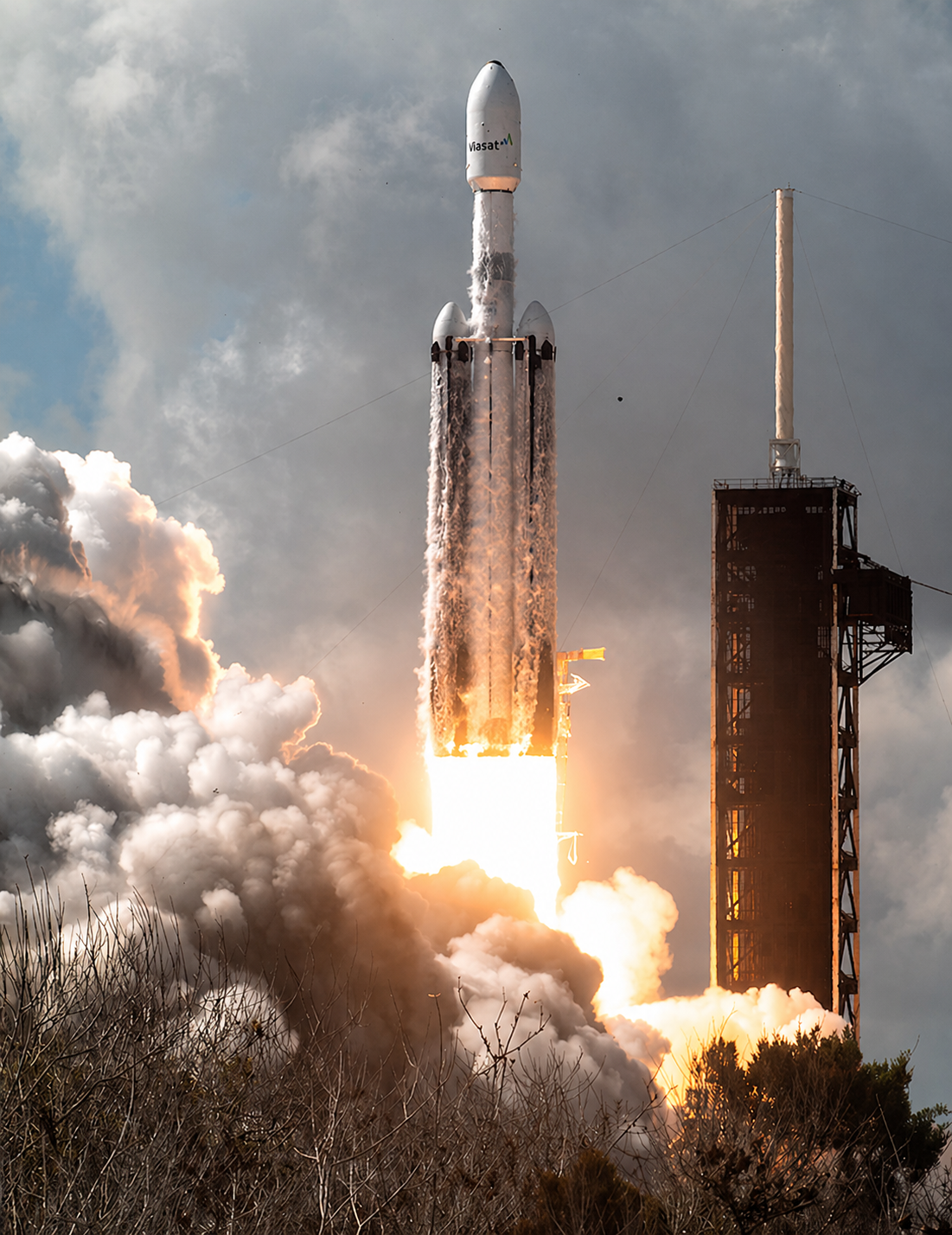
The Falcon Heavy rocket lifted off from Launch Complex 39A at Kennedy Space Center, generating an incredible 5 million pounds of thrust from its 27 Merlin engines.
Standing at 70 meters tall, the rocket delivered a flawless launch, marking its 12th flight since its debut in 2018. The sheer power of Falcon Heavy continues to make it one of the most capable operational rockets in the world.
Precision Engineering: Booster Separation and Landing
Shortly after liftoff, the Falcon Heavy demonstrated its signature precision:
- The two side boosters separated about 2.5 minutes into flight
- Both boosters successfully returned and landed at Cape Canaveral Space Force Station
- The central core continued its journey before being discarded into the Atlantic Ocean
This mission also marked the first use of SpaceX’s newest landing facility at Space Launch Complex 40, showcasing ongoing advancements in reusable rocket technology.
A Complex Journey to Orbit
After booster separation, the rocket’s upper stage began a carefully planned sequence of burns to deliver the satellite into a Geosynchronous Transfer Orbit.
The process included:
- Multiple engine ignitions over nearly five hours
- A long coasting phase requiring advanced thermal protection
- Final deployment of the satellite into its transfer orbit
Once released, ViaSat-3 F3 will spend around two months adjusting its orbit before reaching its final position above the equator.
ViaSat-3 F3: A Game-Changer for Global Internet
The ViaSat-3 F3 satellite is the third and final member of the ViaSat-3 constellation. It follows:
- ViaSat-3 Americas (launched in 2023)
- ViaSat-3 EMEA (launched in 2025)
This latest satellite will focus on delivering high-speed broadband services across the Asia-Pacific region, significantly expanding internet access.
With a capacity exceeding 1 terabit per second (Tbps), it promises faster, more reliable connectivity for industries like aviation, defense, and commercial broadband.
Advanced Technology: Flexibility Like Never Before
Unlike traditional satellites, ViaSat-3 F3 uses cutting-edge phased array antenna technology, allowing it to dynamically adjust coverage areas.
This means:
- Bandwidth can be allocated where demand is highest
- Multiple beams can be directed to high-traffic regions
- No wasted capacity in low-demand areas
This flexibility represents a major leap forward compared to older satellite systems with fixed coverage zones.
End of a Decade-Long Journey
For ViaSat, this launch marks the culmination of more than a decade of work. The company has evolved significantly during this time, including expanding its satellite fleet and merging with other major players in the industry.
The successful deployment of ViaSat-3 F3 completes a powerful global network designed to meet the growing demand for high-speed connectivity.
Conclusion
The launch of ViaSat-3 F3 aboard Falcon Heavy is more than just another space mission—it’s a step toward a more connected world. With unmatched capacity and flexibility, this satellite will play a key role in transforming how internet services are delivered across vast regions.
As SpaceX continues to push the boundaries of space technology, missions like this prove that the future of global communication is not just in orbit—it’s evolving faster than ever.