NASA Tracks Close Flyby of Massive Near-Earth Object
Asteroid 2026 JH2 to Pass Extremely Close to Earth This Week — Here’s What Scientists Know
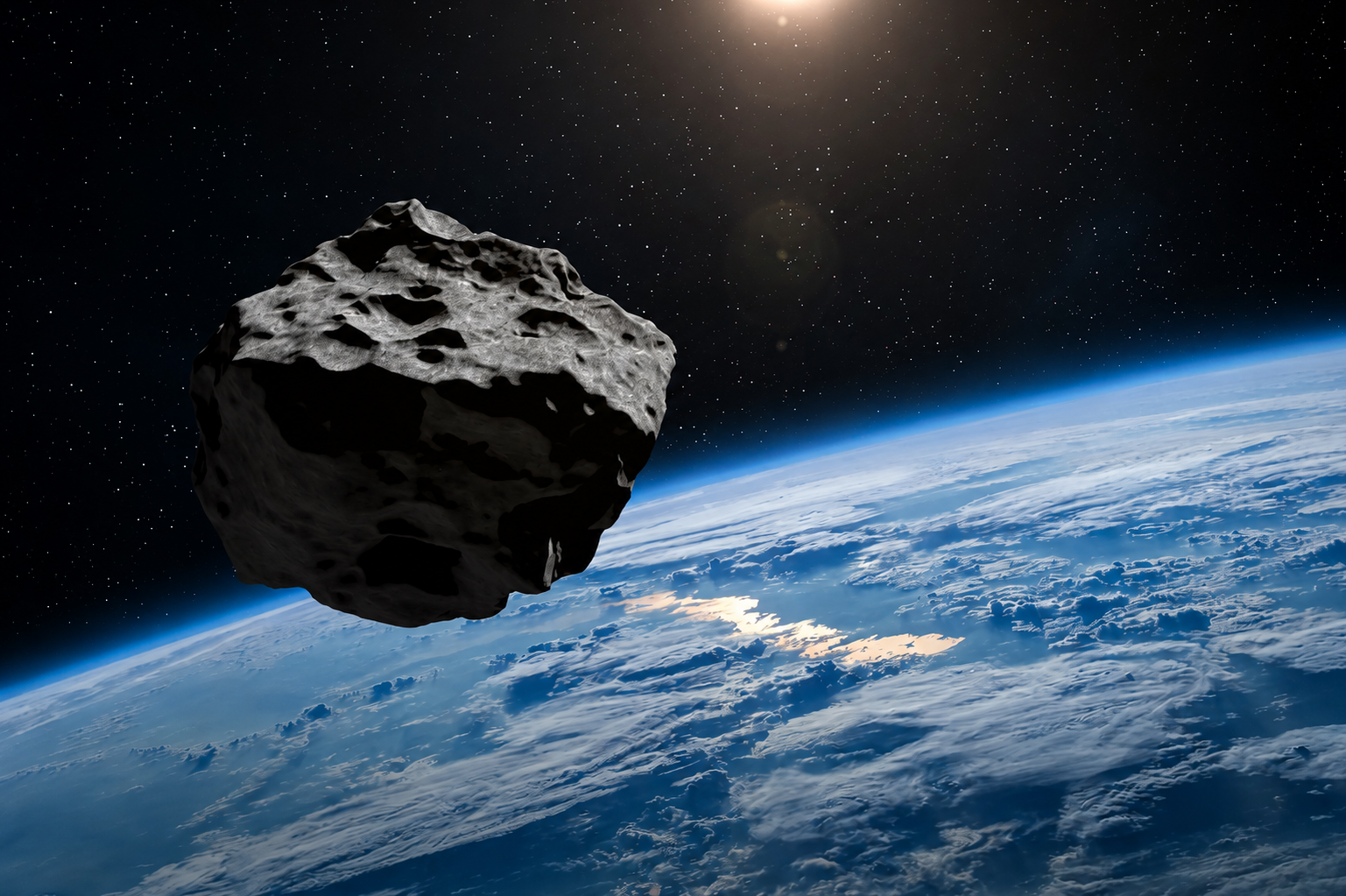
Skywatchers and astronomy enthusiasts around the world are preparing for a rare celestial event as asteroid 2026 JH2 makes a remarkably close approach to Earth. The near-Earth asteroid, estimated to be around 20 meters (66 feet) wide, is scheduled to pass our planet on May 18 at a distance much closer than the Moon.
The flyby has captured global attention because the asteroid will travel only about 57,000 miles from Earth — roughly four times closer than the Moon’s average distance. While scientists emphasize there is no danger of impact, the event is still considered significant due to the asteroid’s proximity and visibility for amateur astronomers.
Astronomy organizations and observatories are already preparing live broadcasts and telescope viewing opportunities so people worldwide can safely watch the space rock as it speeds through the inner solar system.
The close flyby of asteroid 2026 JH2 also highlights the growing importance of planetary defense systems, asteroid tracking technology, and ongoing efforts to monitor near-Earth objects that travel close to our planet.
What Is Asteroid 2026 JH2?
Asteroid 2026 JH2 is classified as a near-Earth object (NEO), meaning its orbit brings it relatively close to Earth’s orbital path around the Sun.
Scientists estimate the asteroid measures approximately 20 meters in diameter, making it comparable in size to Chicago’s famous Cloud Gate sculpture, commonly known as “The Bean.”
Although it is relatively small compared to giant asteroids capable of causing global disasters, an object of this size could still create noticeable atmospheric effects if it ever entered Earth’s atmosphere directly.
Fortunately, researchers confirm that asteroid 2026 JH2 poses no immediate impact threat.
The asteroid belongs to a category known as Apollo-type near-Earth asteroids, one of the most common groups of potentially Earth-crossing objects observed by astronomers.
Asteroid 2026 JH2 Will Pass Closer Than the Moon
One of the reasons asteroid 2026 JH2 is generating so much attention is the extremely close distance of its flyby.
According to astronomers, the asteroid will pass approximately 57,000 miles from Earth during its closest approach.
For comparison:
- The Moon orbits Earth at an average distance of about 238,855 miles
- Asteroid 2026 JH2 will pass nearly four times closer than the Moon
- It is expected to become one of the closest near-Earth object flybys in the coming months
Even though this sounds dramatic, scientists stress that “close” in astronomical terms does not automatically mean dangerous.
Modern asteroid tracking systems are highly advanced and continuously monitor thousands of near-Earth objects moving through the solar system.
Researchers already know the trajectory of asteroid 2026 JH2 with high precision, and current calculations show no collision risk with Earth.
What Are Near-Earth Objects (NEOs)?
Near-Earth objects, commonly called NEOs, include asteroids and comets whose orbits bring them within approximately 1.3 astronomical units of the Sun.
Because Earth also orbits relatively close to this region, some NEOs occasionally pass near our planet.
NASA and global space agencies actively monitor tens of thousands of near-Earth objects using:
- Ground-based telescopes
- Space observatories
- Radar tracking systems
- Artificial intelligence analysis
- Planetary defense programs
Most NEOs are harmless and never pose any serious danger to Earth.
However, scientists continue tracking them carefully because even relatively small asteroids can produce regional damage if they enter Earth’s atmosphere at high speed.
The study of near-Earth objects has become one of the most important fields in modern planetary science and space defense.
Asteroid 2026 JH2 Is an Apollo-Type Near-Earth Asteroid
Astronomers classify asteroid 2026 JH2 as an Apollo-type asteroid based on the shape and characteristics of its orbit.
Apollo asteroids are among the most closely monitored near-Earth objects because their orbital paths cross Earth’s orbit around the Sun.
An Apollo-type asteroid typically has:
- A semi-major axis larger than Earth’s orbit
- A perihelion distance less than 1.017 astronomical units
- The ability to approach Earth relatively closely
This classification does not mean the asteroid is automatically dangerous.
In fact, thousands of Apollo asteroids are already cataloged and tracked safely by scientists.
Still, because their orbits intersect Earth’s orbital region, astronomers pay close attention to these objects for long-term planetary defense monitoring.
Why Scientists Closely Monitor Near-Earth Asteroids
Asteroid tracking has become increasingly important over the past several decades as scientists improve their understanding of planetary impact risks.
Space agencies such as NASA, the European Space Agency, and international observatories continuously search for new asteroids that could potentially approach Earth.
Advanced monitoring systems now help scientists:
- Predict asteroid trajectories
- Calculate impact probabilities
- Identify potentially hazardous objects
- Study asteroid composition
- Improve planetary defense strategies
The close approach of asteroid 2026 JH2 serves as another reminder of why these monitoring systems matter.
Even though this asteroid is not considered dangerous, tracking these events allows scientists to refine models and improve early-warning capabilities for future space threats.
How to Watch Asteroid 2026 JH2 Pass Earth
Astronomy enthusiasts may have the opportunity to observe asteroid 2026 JH2 using telescopes during its close flyby.
Several astronomy organizations are expected to provide live online broadcasts of the event, including viewing sessions hosted by the Virtual Telescope Project.
Depending on weather conditions and visibility, amateur astronomers with moderately powerful telescopes may also be able to spot the asteroid moving through the night sky.
Because the asteroid itself is relatively small, it will not appear as a giant object or visible “fireball” to the naked eye.
Instead, observers using telescopes may see it as a fast-moving point of light crossing the background stars.
Events like this are exciting for space enthusiasts because they offer a rare opportunity to observe real near-Earth objects traveling through our cosmic neighborhood.
Close Asteroid Flybys Are More Common Than Many People Realize
Although headlines about “close asteroid flybys” often sound alarming, these events are actually more common than most people think.
Every year, multiple near-Earth objects pass within lunar distance of Earth without causing harm.
In some cases, smaller asteroids pass even closer.
One notable recent example involved asteroid 2025 TF, which reportedly passed only a few hundred miles above Earth’s surface.
Because many small asteroids are difficult to detect until shortly before arrival, astronomers are constantly improving telescope systems and sky surveys to identify these objects earlier.
The increasing number of asteroid discoveries reflects better detection technology rather than growing danger.
Planetary Defense Is Becoming a Global Scientific Priority
The flyby of asteroid 2026 JH2 also highlights the growing focus on planetary defense programs worldwide.
Scientists are not only tracking asteroids but also developing technologies that could potentially deflect dangerous objects in the future.
Recent planetary defense efforts include:
- NASA’s DART asteroid deflection mission
- AI-powered asteroid detection systems
- Space-based tracking telescopes
- International asteroid monitoring partnerships
Humanity now has far greater awareness of near-Earth objects than ever before in history.
While asteroid 2026 JH2 poses no danger, events like this remind people how active and dynamic our solar system truly is.
For astronomers, researchers, and space enthusiasts alike, the close flyby offers both a fascinating scientific opportunity and an important demonstration of how modern space monitoring systems help protect our planet.