Companies Now Spend More on Artificial Intelligence Than Employee Salaries
Rising AI Costs Are Reshaping Business Budgets as Companies Spend Billions on Automation and Computing Power
Artificial intelligence is transforming the global business world faster than almost any technology in modern history. Companies across industries are rapidly integrating AI tools into coding, customer support, research, automation, data analysis, cybersecurity, marketing, and enterprise operations.
But as businesses race to adopt advanced AI systems, a surprising new reality is emerging:
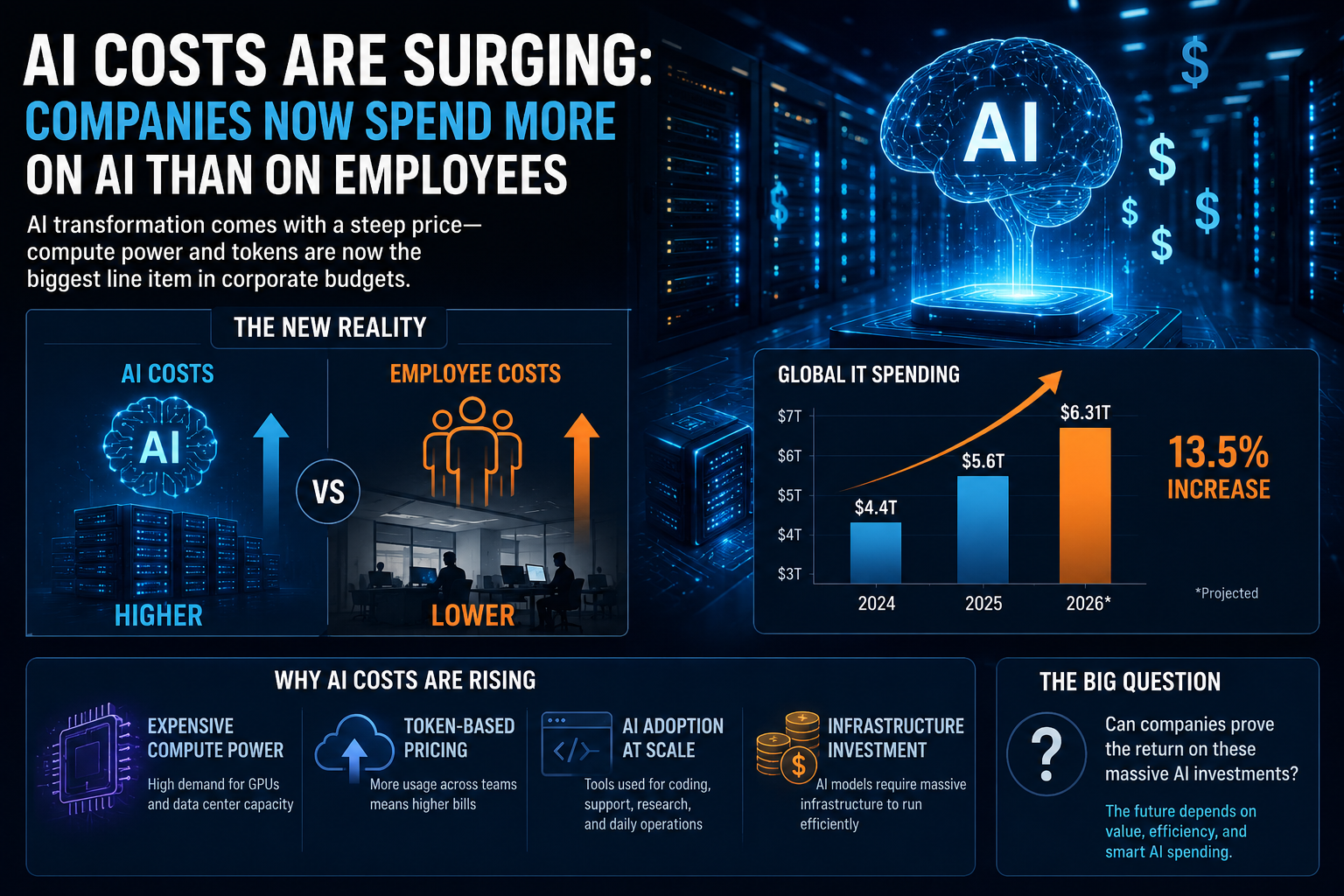
Many companies are now spending more money on artificial intelligence infrastructure, token usage, and computing power than on their own employees.
The shift is raising serious questions about the long-term financial sustainability of AI adoption, the true cost of automation, and whether businesses will eventually see enough return on investment to justify the enormous spending.
Industry leaders from major technology companies are already warning that AI operating costs are increasing at an unprecedented pace.
What initially looked like a productivity revolution is quickly becoming one of the most expensive technological transitions in corporate history.
Nvidia Executive Says AI Compute Costs Now Exceed Employee Costs
One of the strongest signals about rising AI expenses came from NVIDIA executive Bryan Catanzaro, the company’s vice president of applied deep learning.
According to reports, Catanzaro revealed that computing expenses for his AI team are now significantly higher than employee-related costs.
That statement highlights just how dramatically enterprise spending priorities are shifting in the AI era.
Traditionally, salaries represented one of the largest operational costs for technology companies. Today, businesses increasingly face enormous bills related to:
- AI cloud infrastructure
- GPU computing power
- Large language model usage
- AI training systems
- Token-based AI pricing
- Enterprise AI subscriptions
- Data center expansion
- AI inference workloads
The cost of running advanced artificial intelligence systems is becoming so high that many organizations are now treating AI infrastructure as a core financial risk category.
AI Token Costs Are Becoming a Serious Enterprise Problem
One of the biggest drivers behind rising AI expenses is token-based pricing.
Most modern AI platforms charge businesses based on token consumption — essentially billing companies according to how much data employees send into AI systems and how much output the AI generates in return.
As businesses scale AI usage across thousands of employees and workflows, token costs can increase rapidly.
According to reports, Uber chief technology officer has already exhausted the company’s full AI budget allocated for 2026 due largely to soaring token-related expenses.
This demonstrates how difficult it has become for enterprises to predict long-term AI operating costs.
Activities that seem relatively small individually — such as:
- AI coding assistance
- Customer support automation
- AI research tools
- Automated reporting
- Document summarization
- Chatbot interactions
- AI-generated analytics
can collectively generate enormous usage costs when scaled across large organizations.
The more companies rely on artificial intelligence systems, the faster their token expenses grow.
Businesses Are Scaling With AI Instead of Hiring More Employees
The growing AI spending trend is also changing how companies think about workforce expansion.
Instead of increasing employee headcount, many businesses are now attempting to scale operations through artificial intelligence systems.
Amos Bar Joseph, chief executive officer of Swan AI, recently gained attention after discussing his company’s large AI bills online while explaining how the business was building an “autonomous company” powered primarily by AI intelligence rather than traditional staffing growth.
This reflects a broader trend emerging across the technology sector.
Many startups and enterprises now believe AI systems can replace or significantly reduce the need for additional:
- Software developers
- Analysts
- Researchers
- Customer support agents
- Administrative workers
- Marketing teams
- Content creators
- Operations staff
However, the financial reality is becoming more complicated than many initially expected.
Replacing employees with AI tools does not necessarily reduce expenses if computing infrastructure costs continue rising aggressively.
Global IT Spending Is Expected to Reach Record Levels
According to research firm Gartner, worldwide IT spending is expected to reach approximately $6.31 trillion in 2026.
That represents a massive 13.5% increase compared to previous years.
A major portion of this growth is being driven directly by artificial intelligence investments.
Gartner predicts particularly strong spending growth in areas such as:
AI Infrastructure
Businesses are rapidly purchasing advanced GPUs, servers, and AI computing hardware.
Data Centers
Global data center system spending is projected to grow nearly 56% as companies build AI-capable infrastructure.
Enterprise Software
AI-powered enterprise software spending is expected to increase more than 15%.
Cloud Computing
Cloud providers are expanding aggressively to support growing AI workloads worldwide.
The AI boom is creating one of the largest technology spending cycles in decades.
However, many analysts now warn that companies could eventually face pressure if AI investments fail to deliver measurable financial returns.
Businesses Must Now Prove AI Return on Investment
As AI budgets continue growing, investors and shareholders are beginning to ask tougher questions.
Companies spending billions on artificial intelligence systems will eventually need to demonstrate clear business value.
Executives are increasingly being asked whether AI tools are actually:
- Improving productivity
- Increasing efficiency
- Reducing operational costs
- Accelerating software development
- Driving revenue growth
- Improving customer experiences
- Replacing labor expenses
- Strengthening competitive advantage
For public companies especially, the pressure could intensify as quarterly earnings reports face closer scrutiny from investors.
AI adoption is no longer viewed simply as innovation experimentation.
It is now becoming a major financial strategy that must justify enormous spending commitments.
AI Labs Like OpenAI and Anthropic May Face Enterprise Pushback
The growing cost concerns could also impact major AI providers themselves.
Companies like OpenAI and Anthropic depend heavily on enterprise subscriptions and large-scale business adoption to sustain growth.
However, if AI operating expenses continue climbing, some enterprises may begin limiting usage or seeking more cost-efficient alternatives.
Reports suggest that some investors already believe AI pricing efficiency could become a major competitive advantage.
For example, enterprise customers may increasingly compare:
- Token efficiency
- AI response costs
- Infrastructure requirements
- Subscription pricing
- Performance-per-dollar
- Operational scalability
This could create significant competition among AI providers as businesses prioritize affordability alongside capability.
Anthropic has reportedly already adjusted pricing structures in response to rising demand and increasing operational pressures.
The AI Industry Is Entering a New Financial Reality
The rapid growth of artificial intelligence has created extraordinary excitement across nearly every industry.
AI tools are helping businesses automate workflows, generate content, analyze data, accelerate development, and improve productivity at unprecedented speed.
But beneath the innovation boom, a new financial reality is emerging.
Artificial intelligence is expensive.
Extremely expensive.
The infrastructure required to run modern AI systems — including GPUs, cloud servers, data centers, networking hardware, and large-scale inference systems — demands enormous capital investment.
As usage scales globally, the costs continue growing even faster.
Businesses now face a critical balancing act:
They must determine whether the productivity gains from AI can truly outweigh the exploding operational costs associated with deploying these systems at scale.
The Future of AI Spending Could Reshape the Global Economy
The next few years may determine whether artificial intelligence becomes a sustainable productivity revolution or a financial burden that forces companies to rethink their automation strategies.
If AI tools continue improving rapidly while becoming more cost-efficient, businesses could unlock enormous long-term value.
However, if pricing continues rising faster than measurable returns, organizations may eventually reduce AI adoption or limit enterprise-wide deployment.
The conversation around artificial intelligence is no longer focused only on innovation.
It is now increasingly about economics.
Companies, investors, regulators, and technology leaders are all beginning to recognize the same reality:
In the modern AI era, computing power may become one of the most expensive operational resources in the global economy.