
What It Means for the Future of Work
Introduction
By gathering real-time employee interaction data, Meta is taking a risky and contentious step farther into artificial intelligence. In order to improve its AI systems, the corporation is purportedly implementing internal tracking software that can record keystrokes, clicks, and mouse movements.
This advancement demonstrates a developing trend in the IT industry: training more intelligent and independent AI agents using actual human behavior.
Meta’s New AI Training Strategy
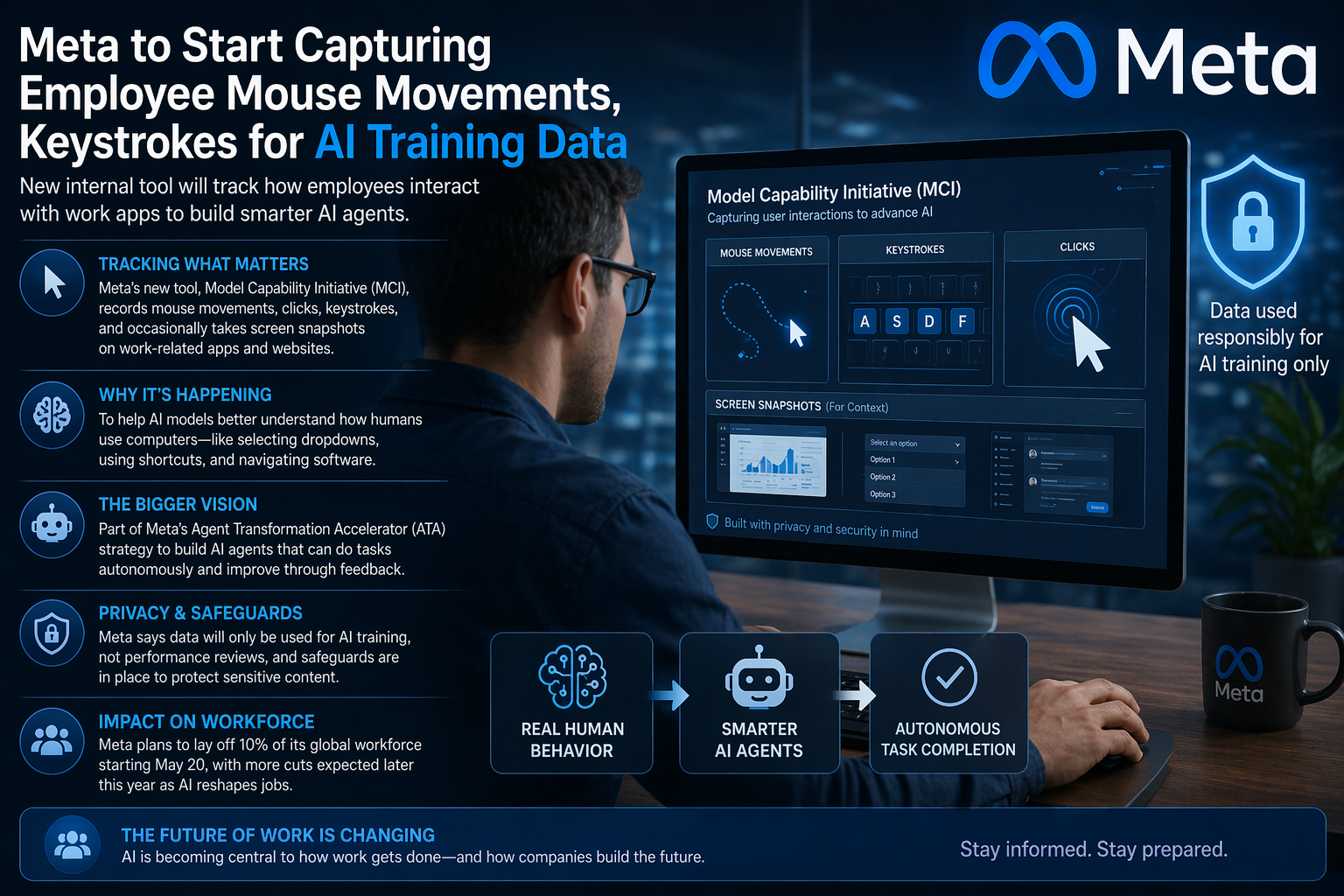
Meta’s latest initiative revolves around a tool called the Model Capability Initiative (MCI). This software is being installed on employee devices, primarily in the United States, to monitor how people interact with computers during their daily work.
The system tracks:
- Mouse movements and clicks
- Keyboard inputs and shortcuts
- Navigation patterns across apps and websites
- Occasional screen snapshots for context
The goal is simple but powerful—teach AI models to behave more like humans when using computers.
Why Is Meta Collecting This Data?
Despite rapid progress in AI, machines still struggle with everyday computer tasks that humans perform effortlessly. For example:
- Selecting options from dropdown menus
- Using keyboard shortcuts efficiently
- Navigating complex software interfaces
By observing real employee behavior, Meta hopes to bridge this gap. The collected data will help AI systems better understand how users interact with digital environments, making them more intuitive and capable.
The Vision: AI Agents Doing the Work
According to internal communications led by Andrew Bosworth, this initiative is part of a broader transformation strategy. Previously known as AI for Work (AI4W), the program has now been rebranded as the Agent Transformation Accelerator (ATA).
The long-term vision?
AI agents that can:
- Perform routine work tasks independently
- Learn from human intervention
- Continuously improve through feedback loops
Bosworth described it as a “closed-loop system,” where AI learns from moments when humans step in—making it smarter over time.
Privacy Concerns and Safeguards
With such extensive data collection, privacy concerns are inevitable. Meta has stated that:
- The data will only be used for AI training
- It will not impact employee performance evaluations
- Safeguards are in place to protect sensitive information
However, the company has not provided detailed clarity on what types of data are excluded, leaving room for ongoing debate.
Meta’s AI-First Transformation
Under the leadership of Mark Zuckerberg, Meta is rapidly evolving into an AI-first company. The focus is shifting from traditional workflows to AI-driven automation.
This transformation includes:
- Integrating AI into everyday operations
- Building advanced AI agents
- Restructuring teams around AI capabilities
The strategy aims to make the company faster, more efficient, and better positioned in the competitive AI landscape.
Impact on Jobs and Workforce
Meta’s push toward automation reflects a broader shift across the tech industry. As AI tools become more capable of handling complex tasks—like building apps, managing data, and automating workflows—companies are rethinking their workforce needs.
Reports suggest that Meta is planning:
- A 10% global workforce reduction
- Potential additional layoffs later in the year
This trend mirrors actions taken by other major tech firms, signaling a future where AI plays a central role in shaping employment.
The Bigger Picture: AI and the Future of Work
Meta’s move is not happening in isolation. Across Silicon Valley, companies are investing heavily in AI systems that can replicate human decision-making and productivity.
While this promises greater efficiency and innovation, it also raises important questions:
- How much data collection is too much?
- What are the limits of workplace surveillance?
- How will jobs evolve in an AI-driven world?
Conclusion
Meta’s decision to track employee interactions for AI training marks a significant step in the evolution of workplace technology. By leveraging real-world human behavior, the company aims to build smarter AI agents capable of handling everyday tasks autonomously.
However, this innovation comes with trade-offs—particularly around privacy and job security. As AI continues to reshape industries, companies and employees alike will need to adapt to a rapidly changing digital landscape.
The future of work is being rewritten—and AI is holding the pen.