What the Loss Means for Future Red Planet Exploration
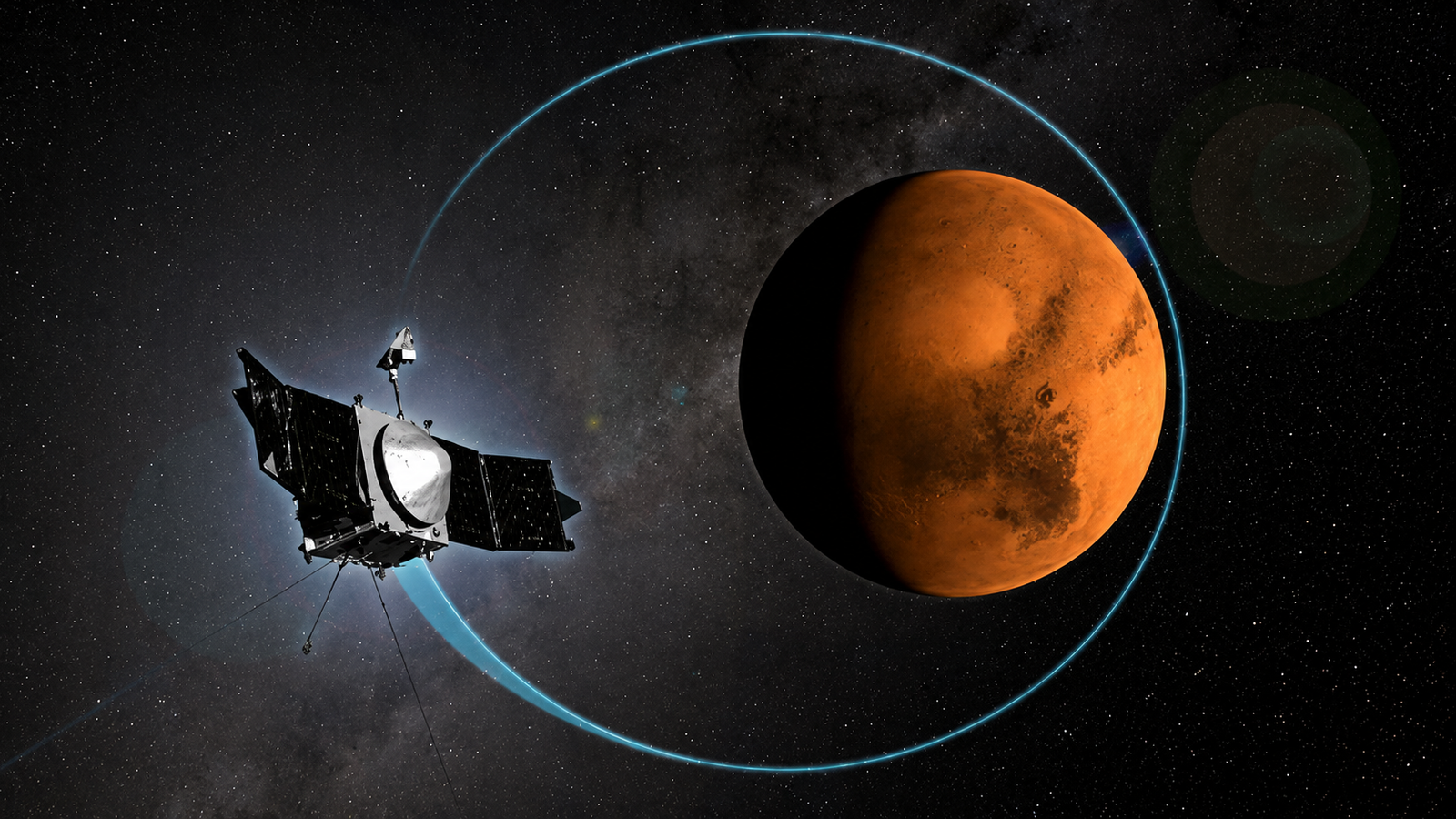
The exploration of Mars has entered a new chapter with the unexpected end of NASA’s Mars Atmosphere and Volatile Evolution (MAVEN) mission. After more than a decade of groundbreaking scientific discoveries, the spacecraft suddenly lost contact with Earth during a routine orbital maneuver behind Mars, leaving scientists and engineers with more questions than answers.
While the loss of MAVEN marks the end of one of NASA’s most successful Mars missions, its scientific legacy will continue to shape our understanding of the Red Planet for decades to come. More importantly, the incident highlights the growing need for a more advanced communication infrastructure around Mars as humanity prepares for increasingly ambitious missions.
The Unexpected Silence: How NASA Lost Contact with MAVEN
On December 6, during a routine event known as an occultation, MAVEN passed behind Mars from Earth’s perspective. Such events occur regularly and typically interrupt communications for less than an hour.
However, this time was different.
When the spacecraft was expected to re-establish contact, mission controllers received no signal. Engineers immediately activated contingency procedures, searching for faint transmissions and sending commands in the hope of recovering the spacecraft.
Despite months of recovery efforts, NASA ultimately concluded that MAVEN could not be saved.
The spacecraft had been operating flawlessly before the communication loss, making the sudden failure particularly surprising. Planetary missions often continue functioning far beyond their intended lifespans, and MAVEN was expected to remain productive for years.
What Investigators Know So Far
Although the exact cause remains under investigation, engineers were able to recover fragments of telemetry data and Doppler measurements after the loss of contact.
These data revealed an important clue: MAVEN appeared to be spinning at approximately 2.7 revolutions per minute.
This rotation rate was far beyond normal operating conditions.
A spacecraft spinning uncontrollably cannot properly point its solar panels toward the Sun, preventing battery recharging. As power levels decline, onboard systems begin shutting down until the spacecraft eventually becomes inoperable.
Scientists believe this uncontrolled tumbling likely led to a complete power failure.
Possible Causes Being Investigated
Several scenarios could explain the anomaly:
- Hardware failure in attitude control systems
- Gyroscope or sensor malfunction
- Software-related navigation errors
- Unexpected environmental effects during occultation
- Aging spacecraft components after more than a decade in space
Since MAVEN was located over 200 million miles away, investigators may never determine the exact root cause.
MAVEN’s Historic Mission to Mars
Launched in November 2013, MAVEN entered Mars orbit in September 2014 with a specific objective:
To understand how Mars lost its atmosphere over billions of years.
This question lies at the heart of one of planetary science’s greatest mysteries.
Evidence suggests ancient Mars once had:
- Flowing rivers
- Large lakes
- A thicker atmosphere
- Warmer temperatures
- Conditions potentially suitable for life
Today, Mars is cold, dry, and largely inhospitable.
Scientists wanted to know what happened.
MAVEN provided the answers.
How MAVEN Changed Our Understanding of Mars
Before MAVEN, researchers knew Mars had lost much of its atmosphere, but the mechanisms responsible were not fully understood.
The spacecraft studied interactions between the Martian atmosphere and the solar wind—a stream of charged particles continuously emitted by the Sun.
Over 11 years, MAVEN demonstrated how solar activity gradually strips atmospheric particles into space.
The Discovery of Atmospheric Sputtering
One of MAVEN’s most significant achievements was confirming a process known as atmospheric sputtering.
This occurs when charged particles collide with the upper atmosphere, ejecting neutral particles into space.
Think of it like a cannonball splashing water out of a swimming pool.
Scientists used noble gas isotope measurements to prove that sputtering has been a major contributor to Mars’ atmospheric loss for billions of years.
This discovery represents one of the most important breakthroughs in planetary climate science.
Capturing Mars During Powerful Solar Storms
MAVEN also witnessed some of the most intense solar events ever observed at Mars.
A particularly powerful solar storm in 2024 provided valuable insights into how the planet responds to extreme space weather.
The spacecraft observed:
- Massive increases in atmospheric escape
- Planet-wide auroras
- Enhanced interactions between solar particles and the atmosphere
- Rapid changes in atmospheric density
These observations help scientists understand not only Mars but also how solar activity influences planetary environments throughout the solar system.
Beyond Science: MAVEN’s Critical Communication Role
While MAVEN was designed primarily as a science mission, it became an essential part of NASA’s Mars communication network.
The Invisible Backbone of Mars Exploration
Most people associate Mars exploration with rovers like:
- Perseverance
- Curiosity
However, these rovers rely heavily on orbiting spacecraft to relay data back to Earth.
Direct communication between Mars rovers and Earth is slow and inefficient.
Instead, orbiters collect information from the surface and forward it home.
Throughout its operational life, MAVEN supported:
- More than 8% of all Mars relay sessions
- Nearly 18% of all data returned from Mars missions
- High-volume scientific data transfers
- Rover operational communications
Its higher orbital altitude made it particularly effective for communications.
Will Mars Missions Be Affected?
Fortunately, NASA still operates four other orbiters capable of relaying communications.
These include:
- Mars Reconnaissance Orbiter
- Mars Odyssey
- Additional international and NASA assets
As a result, current missions remain safe.
However, there are concerns.
Several remaining orbiters are older than MAVEN and approaching the end of their operational lifetimes.
The immediate impact will likely include:
- Slight delays in data transmission
- Reduced communication redundancy
- Greater strain on remaining relay assets
For now, NASA believes the network remains sufficiently robust to support ongoing operations.
Why MAVEN’s Loss Highlights a Bigger Challenge
The end of MAVEN underscores a growing problem in Mars exploration.
As more missions arrive at Mars, communication demands continue increasing.
Future plans include:
- Advanced robotic explorers
- Sample-return missions
- Human exploration preparation missions
- Potential crewed missions in the 2030s and beyond
Current communication systems were not designed to support such a large-scale exploration effort.
Enter the Mars Telecommunications Network
NASA is already planning the next generation of Martian communications infrastructure.
The proposed Mars Telecommunications Network (MTN) aims to create a commercial communications architecture around Mars similar to satellite networks around Earth.
The system is expected to offer:
- Higher data throughput
- Expanded planetary coverage
- Improved reliability
- Lower operational costs
- Support for future human missions
NASA hopes to have portions of the network operational during the 2030s.
This shift toward commercial partnerships mirrors successful strategies already being used in Earth orbit and around the Moon.
What Happens to MAVEN Now?
Although communications have ceased, MAVEN remains in orbit around Mars.
The spacecraft follows an elliptical path ranging between approximately:
- 110 miles (180 km) above Mars
- 2,500 miles (4,000 km) above Mars
Scientists estimate it will remain in orbit for another 50 to 100 years before eventually entering the Martian atmosphere and burning up.
In a sense, MAVEN will continue circling Mars long after its mission has ended.
The Lasting Legacy of MAVEN
Few space missions achieve all their objectives. Even fewer exceed expectations as dramatically as MAVEN.
The spacecraft transformed our understanding of how planets evolve, why Mars became uninhabitable, and how solar activity shapes planetary atmospheres.
Its findings will influence future research into:
- Planetary climate evolution
- Atmospheric escape processes
- Exoplanet habitability
- Future human exploration of Mars
Most importantly, MAVEN helped answer one of humanity’s oldest questions:
What happened to the Mars that once may have looked much more like Earth?
While the spacecraft is gone, the knowledge it provided will continue guiding scientists for generations.
Suggested Visuals for This Article
Infographic 1: MAVEN Mission Timeline
- 2013: Launch from Earth
- 2014: Arrival at Mars
- 2015–2025: Atmospheric studies
- 2024: Major solar storm observations
- 2025/2026: Loss of communication
- Mission end announcement
Infographic 2: How Mars Lost Its Atmosphere
Sun → Solar Wind → Upper Atmosphere Impact → Atmospheric Escape → Thinner Atmosphere → Loss of Surface Water
Chart: MAVEN’s Contributions
| Contribution | Impact |
|---|---|
| Atmospheric Escape Research | Revolutionary |
| Solar Storm Monitoring | High |
| Rover Communications | Critical |
| Mars Climate History | Essential |
| Future Mission Planning | Significant |
Join the Discussion
Do you think NASA should accelerate development of the Mars Telecommunications Network after the loss of MAVEN? Could commercial companies become the backbone of future Mars exploration?
Share your thoughts in the comments below and let us know what discovery from MAVEN’s remarkable 11-year mission fascinates you the most.