China’s Shenzhou 23 Mission Marks a Historic New Era for Tiangong Space Station and Human Spaceflight
China Prepares Shenzhou 23 Launch as Tiangong Space Station Enters a New Phase of Global Space Exploration
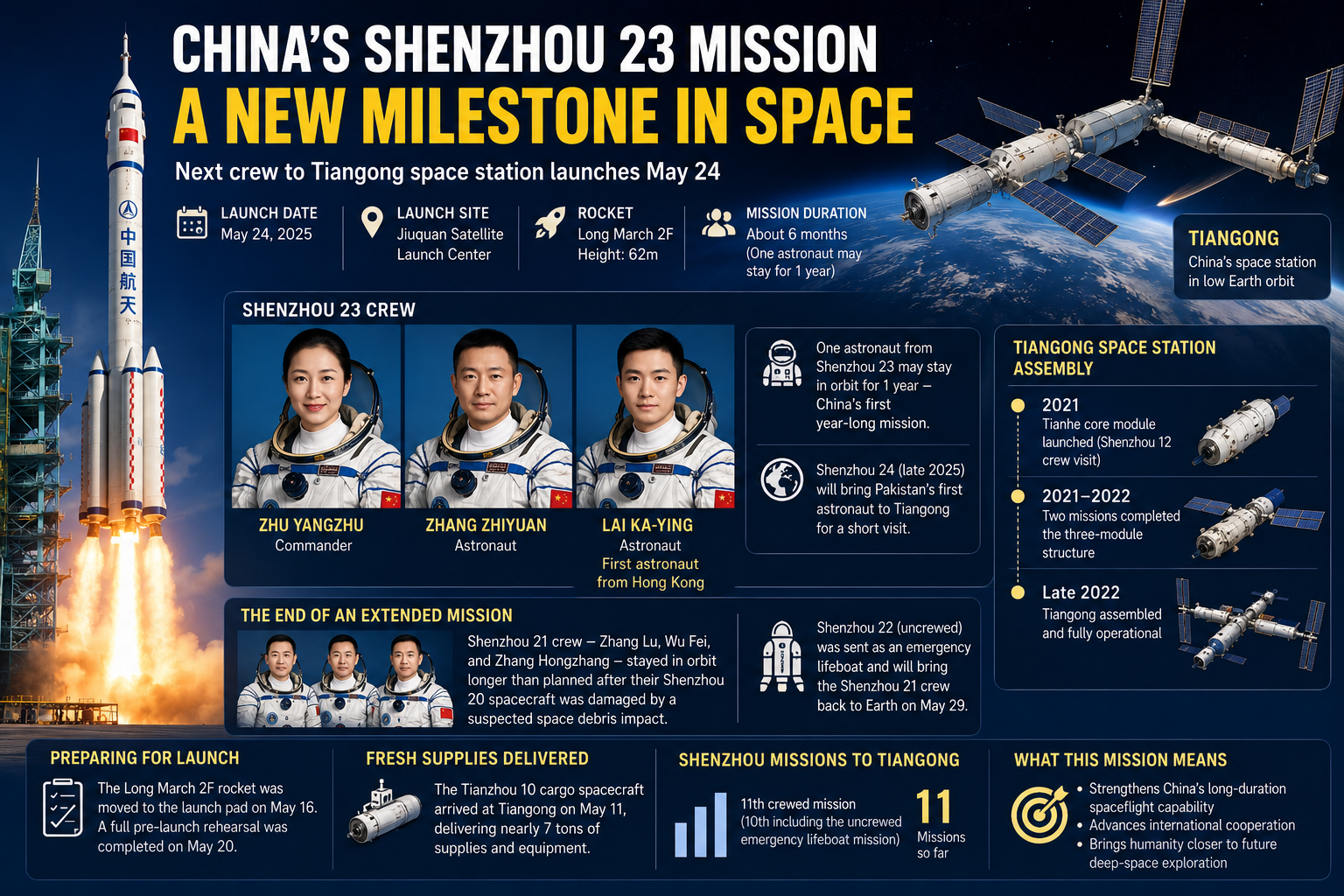
China is preparing for another major milestone in its rapidly expanding space program as the country gets ready to launch the Shenzhou 23 crewed mission to the Tiangong space station. The highly anticipated mission is expected to begin on May 24 and could become one of the most historically significant flights in China’s human spaceflight history.
The upcoming launch not only represents the next routine crew rotation aboard China’s orbiting space station, but it may also mark China’s first-ever one-year human space mission in orbit. In addition, the mission highlights China’s growing ambitions to transform Tiangong into an internationally collaborative space platform capable of supporting astronauts from multiple countries.
As global competition in space exploration intensifies between major powers like the United States, China, and emerging international space programs, the Shenzhou 23 mission demonstrates how rapidly China is becoming a dominant force in modern space technology and orbital operations.
China’s Tiangong Space Station Is Becoming a Major Global Space Platform
Over the past several years, China has accelerated its investment in space exploration, human spaceflight, satellite systems, lunar missions, and future Mars exploration programs.
At the center of these ambitions is the Tiangong Space Station, China’s permanently crewed orbital laboratory.
Tiangong, which translates to “Heavenly Palace,” represents China’s answer to the aging International Space Station (ISS). Since the launch of the Tianhe core module in 2021, the station has rapidly evolved into a sophisticated three-module orbital research facility capable of supporting long-duration missions and advanced scientific experiments.
The Shenzhou 23 mission will become the 11th crewed flight to Tiangong, further strengthening China’s long-term goal of maintaining a continuous human presence in low Earth orbit.
Shenzhou 23 Crew Includes a Historic Astronaut From Hong Kong
The China Manned Space Agency (CMSA) officially introduced the three-member crew during a press conference ahead of launch.
The Shenzhou 23 astronauts are:
- Zhu Yangzhu (Mission Commander)
- Zhang Zhiyuan
- Lai Ka-ying
Among them, Lai Ka-ying is attracting particular global attention because he is expected to become the first astronaut from Hong Kong to travel into space.
This milestone carries significant symbolic importance for China’s space program, reflecting efforts to broaden participation in national space achievements across different regions.
The inclusion of a Hong Kong astronaut may also help inspire greater public interest in STEM education, aerospace engineering, and scientific research among younger generations throughout Asia.
China May Begin Its First One-Year Human Spaceflight
One of the most groundbreaking aspects of the Shenzhou 23 mission is the possibility that one astronaut could remain aboard Tiangong for an entire year.
If completed successfully, this would become China’s longest continuous human spaceflight mission ever.
Why One Astronaut May Stay for a Full Year
According to current mission plans, the future Shenzhou 24 mission — expected later this year — will carry a Pakistani astronaut to Tiangong for a short-duration international visit.
In a highly unusual operational arrangement, the visiting astronaut may return to Earth aboard the Shenzhou 23 spacecraft shortly after arriving. This would leave one of the original Shenzhou 23 astronauts aboard the station to continue operating in orbit until the next crew rotation.
Although Chinese officials have not yet confirmed which astronaut will remain for the extended mission, the potential one-year stay represents a major advancement in China’s long-duration spaceflight capabilities.
Why Long-Duration Space Missions Matter
Extended human space missions are essential for the future of deep-space exploration.
Countries preparing for missions to the Moon and Mars must understand how the human body responds to:
- Long-term microgravity exposure
- Isolation
- Radiation
- Psychological stress
- Muscle and bone loss
- Closed-loop life support systems
A one-year mission allows scientists to gather critical biomedical data that could help future astronauts survive long interplanetary journeys.
NASA previously conducted similar long-duration studies aboard the International Space Station, most notably with astronaut Scott Kelly’s nearly year-long mission.
China now appears ready to enter this advanced phase of human spaceflight research.
Shenzhou 21 Mission Faced Unexpected Orbital Challenges
The Shenzhou 23 launch also marks the conclusion of what has become China’s longest human spaceflight mission to date: the emergency-impacted Shenzhou 21 mission.
The situation reportedly became more complicated after concerns emerged about possible debris damage involving the Shenzhou 20 spacecraft.
As a precautionary measure:
- The Shenzhou 20 crew used the Shenzhou 21 spacecraft to safely return home
- China later launched the uncrewed Shenzhou 22 spacecraft as an orbital emergency lifeboat
- The Shenzhou 21 astronauts remained aboard Tiangong longer than originally planned
This unexpected extension provided China with valuable operational experience in handling orbital emergencies and crew safety procedures.
The Shenzhou 21 astronauts — Zhang Lu, Wu Fei, and Zhang Hongzhang — are now expected to return to Earth on May 29.
Long March 2F Rocket Ready for Launch
The Shenzhou 23 crew will launch aboard China’s trusted Long March 2F rocket.
The 203-foot-long launch vehicle was recently transported from the vertical integration building to the launch pad at the Jiuquan Satellite Launch Center.
China’s space agency confirmed that all systems and launch facilities remain in excellent condition following multiple pre-launch rehearsals and technical inspections.
The Long March 2F rocket has become one of the most reliable crewed launch systems in the world, playing a central role in China’s human spaceflight program since the early Shenzhou missions.
Tianzhou 10 Cargo Mission Recently Delivered Critical Supplies
The Shenzhou 23 mission follows shortly after the successful arrival of the Tianzhou 10 cargo spacecraft.
Tianzhou 10 docked with Tiangong on May 11 and delivered nearly seven tons of supplies, scientific equipment, food, fuel, and operational materials for the incoming crew.
Cargo missions are essential for maintaining long-duration orbital stations because they support:
- Crew survival
- Scientific research
- Equipment maintenance
- Propellant replenishment
- Waste disposal
China’s ability to regularly conduct cargo resupply operations demonstrates the growing maturity of its orbital logistics infrastructure.
China’s Space Program Is Expanding International Cooperation
The inclusion of a future Pakistani astronaut aboard Tiangong signals a major strategic shift toward international participation in China’s space program.
As geopolitical tensions continue affecting partnerships aboard the International Space Station, China appears increasingly interested in positioning Tiangong as an alternative international research platform.
This could eventually attract:
- Emerging space nations
- Scientific research institutions
- International aerospace partnerships
- Commercial space companies
China’s expanding space diplomacy efforts may significantly reshape the future balance of international space collaboration.
China’s Long-Term Space Ambitions Go Beyond Low Earth Orbit
The Tiangong space station is only one part of China’s broader long-term exploration strategy.
China is also aggressively pursuing:
- Crewed Moon missions
- Lunar base construction
- Mars exploration
- Asteroid missions
- Space-based solar power research
- Advanced reusable spacecraft systems
Some analysts believe China could eventually challenge NASA’s dominance in deep-space exploration during the next decade.
The success of missions like Shenzhou 23 will play an important role in preparing Chinese astronauts and engineers for these future ambitions.
Why Tiangong Matters for the Future of Human Spaceflight
The Tiangong space station is becoming increasingly important not only for China but for the broader future of human space exploration.
With the International Space Station approaching eventual retirement during the next decade, Tiangong may become one of the few permanently crewed orbital research stations operating in low Earth orbit.
This could dramatically increase China’s influence in:
- Space science
- Orbital research
- Human spaceflight operations
- International aerospace collaboration
As more nations seek access to space research opportunities, Tiangong could emerge as a major hub for future international missions.
Final Thoughts
The upcoming Shenzhou 23 mission represents far more than another routine crew rotation aboard the Tiangong space station. It symbolizes China’s growing confidence, technical maturity, and expanding global ambitions in human spaceflight.
From launching Hong Kong’s first astronaut to potentially beginning China’s first one-year orbital mission, Shenzhou 23 could become one of the most historically important Chinese space missions ever conducted.
As China continues investing heavily in advanced space technologies, lunar exploration, and international collaboration, the global space industry is entering a new era of competition, innovation, and transformation.
The success of Tiangong and missions like Shenzhou 23 may ultimately help define the future of human activity in space for decades to come.